 NeoBit Daily

Introduction: The Escalating Cyber Threat Landscape in 2026
As we approach 2026, data breaches and ransomware attacks are surging, with enterprises losing billions annually. Recent reports highlight a 30% year-over-year increase in sophisticated hacking incidents targeting remote workforces and cloud environments. Traditional Virtual Private Networks (VPNs) have long been the go-to for secure remote access, but Secure Access Service Edge (SASE) is emerging as a game-changer. This VPN vs SASE showdown focuses on data privacy strengths, performance, scalability, zero-trust integration, and practical implementation tips to help enterprises navigate evolving cyber risks.
Understanding these frameworks isn't just technical—it's a strategic imperative for protecting sensitive data in a zero-trust world. We'll dive deep into comparisons, real-world examples, and recommendations to equip you with actionable insights.
What is a VPN? The Traditional Security Stalwart
A VPN creates encrypted tunnels between user devices and corporate networks, masking IP addresses and securing data in transit. Popularized in the early 2000s, VPNs route all traffic through centralized data centers, ensuring compliance with standards like GDPR and HIPAA.
Key components include:
- Encryption Protocols: OpenVPN, IPSec, WireGuard for robust data protection.
- Centralized Gateways: Traffic funnels through on-premises or cloud-hosted servers.
- Access Control: Username/password or multi-factor authentication (MFA).
VPNs excel in point-to-site connectivity but struggle with modern distributed workforces. For instance, during peak hours, bandwidth bottlenecks can slow applications by up to 50%, compromising user experience and indirectly exposing data to risks from frustrated users bypassing security.
What is SASE? The Cloud-Native Evolution
Coined by Gartner in 2019, SASE converges networking (SD-WAN) and security (FWaaS, ZTNA, CASB) into a cloud-delivered service. Delivered from thousands of global Points of Presence (PoPs), SASE inspects traffic closest to the user, minimizing latency and enhancing privacy.
Core pillars of SASE include:
- Zero-Trust Network Access (ZTNA): Continuous verification without full network exposure.
- Secure Web Gateway (SWG): Real-time threat blocking.
- Cloud Access Security Broker (CASB): Shadow IT visibility and data loss prevention (DLP).
Unlike VPNs, SASE scales effortlessly for hybrid clouds, making it ideal for 2026's edge computing boom. Providers like Zscaler and Cisco lead the market, with adoption projected to hit 40% among enterprises by 2026.
VPN vs SASE: Head-to-Head Comparison
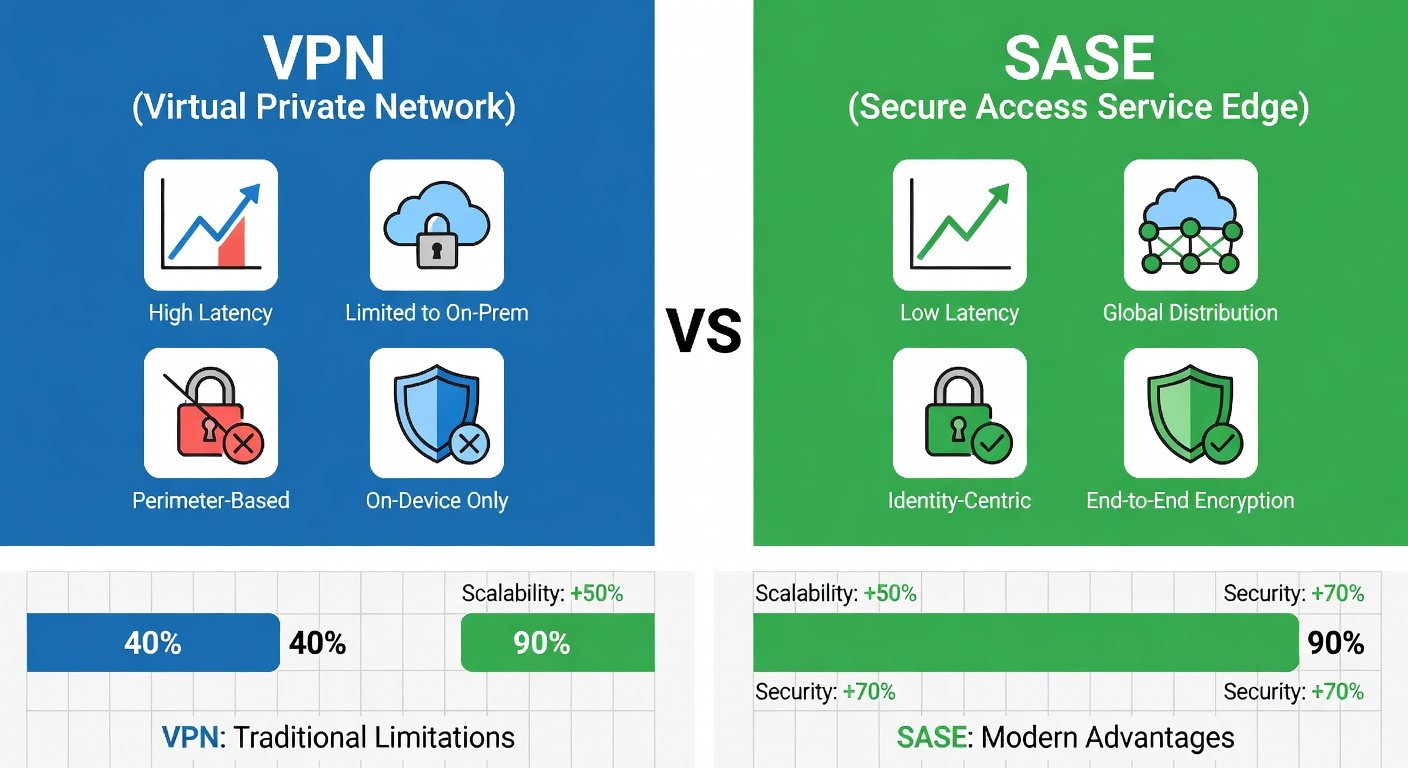
Let's break down the critical battlegrounds: data privacy, performance, scalability, and zero-trust integration.
| Aspect | VPN | SASE |
|---|---|---|
| Data Privacy | Strong tunnel encryption but backhauls traffic to central points, increasing exposure. | Distributed inspection with DLP and inline encryption; reduces data exfiltration risks by 70%. |
| Performance | Latency from hairpinning; 100-300ms added. | Local PoP routing; sub-50ms latency. |
| Scalability | Hardware-limited; scales via appliances. | Elastic cloud; auto-scales to millions of users. |
| Zero-Trust Fit | Retrofit challenges; trust-once model. | Native; per-session verification. |
Data Privacy Strengths in the 2026 Hacking Era
With quantum threats looming, data privacy is paramount. VPNs provide solid encryption but route all traffic through choke points, creating single points of failure. A 2025 Verizon DBIR noted 80% of breaches involved remote access misconfigurations—VPNs are prime targets.
SASE shines with granular controls: contextual access denies lateral movement, while AI-driven DLP scans for PII in real-time. For example, SASE can block SaaS uploads containing credit card data, a feat VPNs handle poorly without add-ons.
Link to NIST guidelines for enhanced privacy: NIST Cybersecurity Framework.
Performance and Scalability: Why SASE Wins for Global Teams
VPN performance degrades with user growth; a 10,000-user firm might need 50+ gateways. SASE's anycast routing ensures optimal paths, supporting 4K streaming and VoIP without jitter.
Scalability is SASE's ace: auto-provisioning handles spikes from 1,000 to 100,000 sessions seamlessly. Enterprises like a Fortune 500 retailer reported 40% productivity gains post-SASE migration.
Zero-Trust Integration: The Future-Proof Choice
Zero-trust assumes breach, verifying every access. VPNs grant network-level trust post-authentication, vulnerable to insider threats. SASE embeds ZTNA natively, aligning with NIST SP 800-207.
Implementation steps for zero-trust with SASE:
- Assess Assets: Inventory apps and data flows.
- Deploy ZTNA: Policy-based access from SASE PoPs.
- Monitor Continuously: UEBA for anomaly detection.
- Integrate MFA: Biometrics or FIDO2.
Real-World Security Tips for Implementation
Migrating from VPN? Avoid common pitfalls:
- Mistake to Avoid: Full rip-and-replace; phase with hybrid VPN/SASE.
- Tip 1: Start with high-risk users (execs, devs) on SASE.
- Tip 2: Leverage SD-WAN for branch optimization; see Cisco's approach at Cisco Networking.
- Tip 3: Audit logs weekly; integrate SIEM for alerts.
- Tip 4: Train teams on phishing—SASE blocks 99% but humans err.
Case Study: A global bank switched to Zscaler's SASE, thwarting a 2025 ransomware wave that hit VPN-reliant peers, saving $10M.
2026 Predictions: SASE Dominance?
By 2026, Gartner forecasts SASE market at $25B, driven by 5G and IoT. VPNs will persist for legacy but hybrid models prevail. Quantum-safe encryption in SASE will counter harvest-now-decrypt-later attacks.
Recommendations for Enterprises
Choose VPN if: Small team, on-prem focus, budget-constrained.
Choose SASE if: Distributed workforce, cloud-heavy, scalability needed. Start with PoC from vendors like Cato or Palo Alto.
For optimal privacy: Hybrid VPN-to-SASE transition over 12-18 months.
Conclusion
In the 2026 data privacy battle, SASE outmaneuvers VPN with superior performance, scalability, and zero-trust prowess. Enterprises ignoring this shift risk obsolescence amid relentless hacks. Assess your setup today—secure tomorrow's data.


No comments yet. Be the first!