 NeoBit Daily

Introduction to Satellite Cyber Threats in 2026
Satellite networks serve as the critical backbone for global communications, navigation systems, weather forecasting, and secure data transmission across industries. With the rapid expansion of low-Earth orbit constellations and increased commercial reliance on these assets, cyber threats targeting orbital infrastructure have escalated dramatically. In 2026, attackers are leveraging sophisticated techniques to breach satellite networks, leading to potential compromises of sensitive information. This comprehensive guide explores documented intrusion cases from recent years, examines the resulting effects on data privacy, and provides detailed defense strategies. Organizations must understand these risks to protect their operations effectively.
Real-World Cases of Satellite Network Intrusions
Security researchers have documented several high-profile incidents involving satellite ground stations and onboard systems throughout 2025 and into 2026. One major breach targeted a commercial Earth observation network where threat actors exploited vulnerabilities in firmware update mechanisms to gain persistent access. This allowed them to exfiltrate high-resolution imagery data used by agricultural and defense clients. Another incident involved sophisticated signal spoofing attacks on low-Earth orbit satellites supporting logistics and maritime tracking, enabling interception of real-time location and operational data.
Additional cases include ransomware deployment against satellite command links in European networks and supply-chain compromises affecting multiple small satellite operators. These events demonstrate how even well-protected systems can fall victim to advanced persistent threats. The consequences often ripple outward, disrupting downstream services that depend on reliable satellite feeds and exposing vast amounts of telemetry and user data.
Impact on Data Privacy
Unauthorized access to satellite networks frequently results in the exposure of critical information such as precise geolocation coordinates, encrypted business communications, and personal data transmitted via satellite internet services. Privacy regulations in regions like the EU and United States now place heightened scrutiny on how organizations secure orbital data pathways. Data breaches can trigger significant regulatory penalties, reputational damage, and erosion of customer trust when sensitive location histories or proprietary telemetry become public. In one 2025 case, leaked satellite-derived data led to privacy lawsuits involving multiple corporations. Organizations must prioritize privacy-by-design principles to mitigate these cascading effects.
Mitigation Tactics: Encryption Upgrades
Effective defense starts with implementing post-quantum encryption algorithms for both uplink and downlink communications. Organizations should transition legacy systems to AES-256 combined with quantum-resistant key exchange protocols. Regular cryptographic key rotation schedules, integrated with hardware security modules, significantly reduce risks of interception. For example, satellite operators can deploy end-to-end encryption that protects data from the moment it leaves the ground station until it reaches end-user applications. Additional measures include segmenting encryption keys across multiple orbital assets to limit the blast radius of any single compromise.
Access Controls and Monitoring Protocols
Zero-trust architectures should govern all ground control interfaces and satellite command channels. This involves enforcing multi-factor authentication, role-based access permissions, and continuous behavioral analytics to identify unusual login patterns or command sequences. Monitoring protocols benefit from AI-powered anomaly detection systems that analyze telemetry streams in real time. NIST guidelines emphasize layered monitoring combining terrestrial security information and event management with space-segment analysis. Practical examples include setting up automated alerts for unexpected orbital maneuvers or signal strength variations that could indicate jamming attempts.
NASA resources provide further frameworks for implementing these controls across diverse satellite fleets.
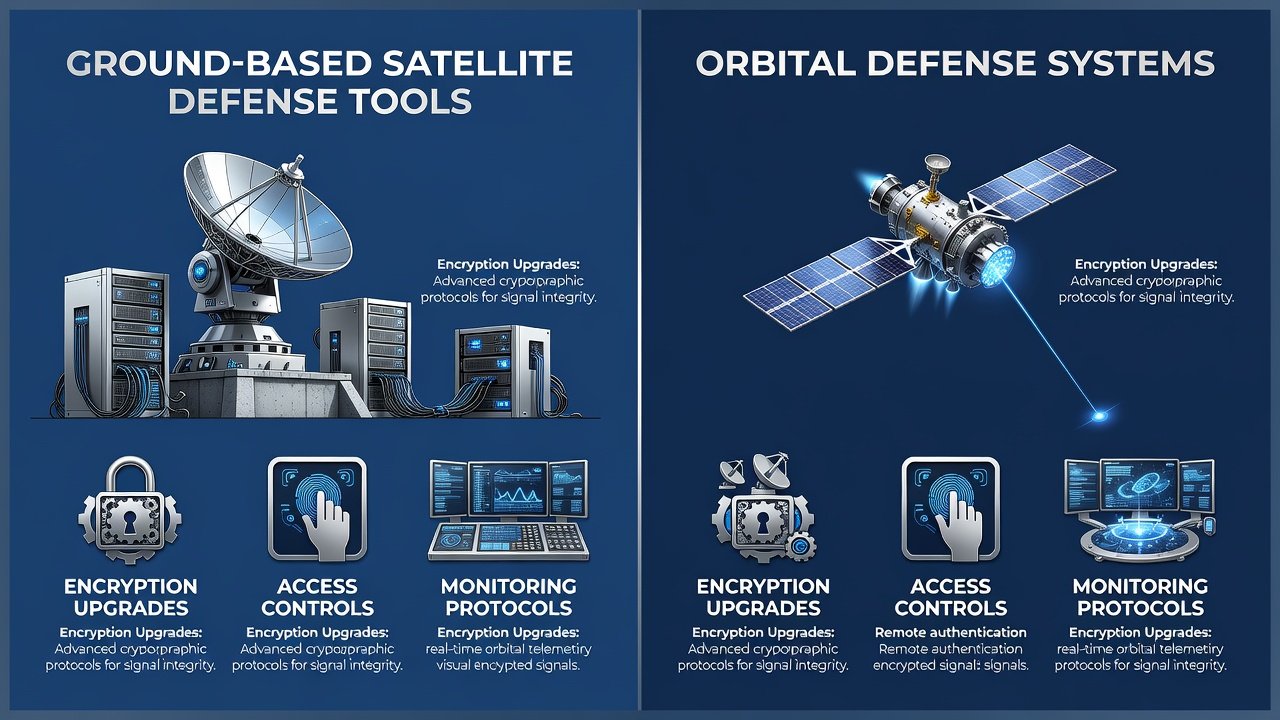
Ground-Based vs Orbital Defense Tools: A Comparison
Ground-based defense tools excel in centralized management, rapid software updates, and integration with existing enterprise security platforms, though they introduce potential latency during threat response. Orbital defense mechanisms, including onboard encryption processors and autonomous response modules, enable faster localized reactions but face limitations in power consumption, radiation hardening requirements, and infrequent patching opportunities. A hybrid model that synchronizes both layers typically yields optimal results. Ground systems handle policy enforcement while orbital components provide immediate encryption and basic anomaly filtering. Decision-makers should evaluate factors such as mission criticality, update frequency needs, and budget constraints when selecting approaches.
Practical Implementation Steps
- Conduct a thorough audit of all satellite communication links to identify outdated encryption standards and weak access points.
- Begin phased upgrades prioritizing ground stations before extending protections to orbital segments.
- Deploy integrated monitoring dashboards that aggregate data from both ground and space assets for unified visibility.
- Schedule quarterly red-team exercises simulating realistic attack scenarios to test response effectiveness.
- Develop and maintain incident response playbooks tailored specifically to orbital infrastructure scenarios.
- Train staff on emerging threats and establish clear escalation procedures for detected anomalies.
Regulatory Compliance Needs
Adhering to established frameworks ensures organizations meet minimum security baselines required by international and national authorities. ESA standards outline specific requirements for space system cybersecurity that complement broader data protection laws. Compliance involves regular audits, documentation of security controls, and reporting mechanisms for incidents. Steps include mapping current practices against regulatory checklists, engaging third-party assessors, and maintaining continuous improvement programs to address evolving mandates.
Emerging Hacking Trends in Space Systems
Current trends feature AI-assisted signal jamming that dynamically adapts to countermeasures, ransomware campaigns aimed directly at satellite command and control links, and exploitation of inter-satellite laser communication protocols for stealthy data theft. Additional concerns involve supply-chain attacks on component manufacturers and the use of machine learning to predict and evade traditional monitoring systems. Defenders should participate in industry threat intelligence sharing networks to anticipate and counter these developments proactively.
Conclusion
Securing satellite infrastructure against 2026 cyber threats demands a multifaceted strategy encompassing advanced encryption, rigorous access management, continuous monitoring, and strict regulatory compliance. By following the detailed tactics and implementation guidance provided, organizations can substantially reduce risks to data privacy and maintain resilient orbital operations amid an evolving threat landscape.
FAQ
What are the most common satellite cyber attack vectors in 2026?
Primary vectors include firmware compromise through malicious updates, signal spoofing to intercept communications, ground station credential theft, and increasingly sophisticated AI-driven jamming techniques targeting specific frequency bands.
How does encryption protect satellite data privacy?
Robust encryption renders intercepted signals completely unreadable without the corresponding decryption keys, preventing unauthorized parties from accessing location data, telemetry, or relayed communications even if they successfully tap into the transmission.
Are ground-based defenses sufficient alone?
Ground-based measures alone cannot provide complete protection due to inherent latency and limited visibility into orbital conditions. Hybrid solutions integrating both ground and orbital tools deliver superior resilience and faster response capabilities.
What regulations apply to satellite cybersecurity?
Relevant frameworks include the NIST Cybersecurity Framework, ESA guidelines for space systems, and various national space agency directives that emphasize encryption standards, incident reporting, and supply chain security for satellite operators.
How often should organizations conduct satellite security audits?
Comprehensive audits should occur at least annually, supplemented by continuous monitoring and quarterly simulated attack exercises to identify and address vulnerabilities before they can be exploited.
What emerging technologies are improving satellite defense?
Key advancements include post-quantum cryptography, AI-based anomaly detection for real-time monitoring, and autonomous onboard response systems that can isolate threats without ground intervention.


No comments yet. Be the first!