 NeoBit Daily

Introduction: The Quantum Computing Wake-Up Call for Cybersecurity
As we enter 2026, quantum computing is no longer a distant theoretical possibility but an emerging reality that demands immediate attention from cybersecurity professionals and business leaders alike. Traditional encryption methods like RSA and ECC, which underpin much of today's data security across global networks, face existential risks from advanced quantum algorithms. This comprehensive guide delivers actionable insights for IT professionals seeking to future-proof their organizations against these evolving threats. The focus remains on practical implementation rather than speculation, providing depth on risks, solutions, and strategic roadmaps.
Quantum computers leverage principles of superposition and entanglement to solve certain problems exponentially faster than classical machines. The most pressing concern is Shor's algorithm, capable of factoring large integers and computing discrete logarithms in polynomial time, directly breaking widely used public-key cryptosystems that protect everything from online banking to secure communications. Organizations that delay preparation risk data breaches that could compromise years of sensitive information once quantum capabilities mature.
Understanding Quantum Threats to Encryption
Current asymmetric cryptography relies on mathematical problems that are computationally infeasible for classical computers. However, a sufficiently powerful quantum computer running Shor's algorithm could decrypt sensitive communications in real time, compromise digital signatures used in software updates, and expose private keys across critical industries including finance, healthcare, government, and supply chain management. The implications extend beyond immediate decryption to long-term data harvesting attacks, where adversaries collect encrypted data today for decryption tomorrow.
Symmetric encryption like AES remains relatively safer but may require larger key sizes to maintain adequate security margins against quantum brute-force methods such as Grover's algorithm. The transition window is narrowing as quantum hardware advances, with estimates from leading research institutions suggesting cryptographically relevant quantum computers could emerge within the next decade. IT teams must understand these distinctions to prioritize defenses effectively and avoid over-investing in areas that are less vulnerable while under-protecting high-risk assets.
Post-Quantum Cryptography Solutions
Post-quantum cryptography (PQC) refers to cryptographic algorithms designed to resist both classical and quantum attacks. Leading candidates include lattice-based schemes like Kyber and Dilithium, hash-based signatures such as SPHINCS+, and code-based approaches like Classic McEliece. These algorithms rely on mathematical problems believed to be hard even for quantum computers, such as finding short vectors in high-dimensional lattices or decoding random linear codes.
The U.S. National Institute of Standards and Technology (NIST) has standardized several PQC algorithms following years of rigorous evaluation and public cryptanalysis. Organizations should prioritize hybrid approaches that combine classical and post-quantum methods during the migration phase for backward compatibility and added security layers. Implementation often involves updating libraries, testing performance impacts, and ensuring interoperability with legacy systems. For authoritative guidance, consult resources from NIST on standardized algorithms and implementation best practices.
Steps Organizations Can Take to Transition Securely
Transitioning to quantum-resistant security requires a structured, phased approach that minimizes operational disruption while maximizing protection. The following expanded steps provide a clear framework:
- Inventory and Prioritize Assets: Begin by cataloging all cryptographic assets, including certificates, protocols, and hardware modules. Identify systems using vulnerable algorithms and rank them by data sensitivity, exposure level, and regulatory requirements. This audit often reveals hidden dependencies in third-party software and IoT devices.
- Adopt Crypto-Agility: Design or refactor systems to allow rapid swapping of cryptographic primitives without major architectural overhauls. This includes modular code structures, configurable algorithm suites, and automated certificate management tools that support future standards.
- Implement Hybrid Cryptography: Deploy solutions that layer PQC with existing standards to maintain security during the shift. Hybrid key exchanges provide protection against both current and future threats while allowing gradual rollout.
- Train Teams and Update Policies: Ensure staff understand quantum risks through targeted workshops and simulations. Update security policies to mandate PQC evaluations for new projects and establish governance for algorithm selection.
- Monitor Quantum Developments and Test Implementations: Stay informed through industry reports and test PQC implementations in controlled environments. Pilot programs should measure performance overhead, integration challenges, and compatibility with existing infrastructure before full deployment.
- Engage Vendors and Supply Chain Partners: Require suppliers to demonstrate quantum-safe roadmaps and conduct joint testing to avoid weak links in the ecosystem.
These steps help minimize disruption while building long-term resilience across the enterprise.
Real-World Examples from Tech Giants
Major technology companies are already investing heavily in quantum-safe solutions, offering valuable lessons for smaller organizations. IBM has integrated post-quantum algorithms into its cloud offerings and provides open toolkits for developers to experiment with hybrid encryption in enterprise environments. Google has conducted large-scale experiments with hybrid key exchanges in Chrome browsers, demonstrating minimal performance impact on everyday web traffic. Microsoft focuses on quantum-resistant protocols for Azure services, including updates to its cryptographic libraries that support NIST standards.
These initiatives demonstrate that proactive investment pays dividends, with early adopters gaining competitive advantages in regulated sectors. Financial institutions and government agencies are following suit by funding internal research labs and participating in standards bodies to influence practical outcomes.
Additional insights are available via IBM quantum computing resources and through Microsoft’s extensive documentation on secure cloud migrations.
Comparing Quantum-Resistant Algorithms
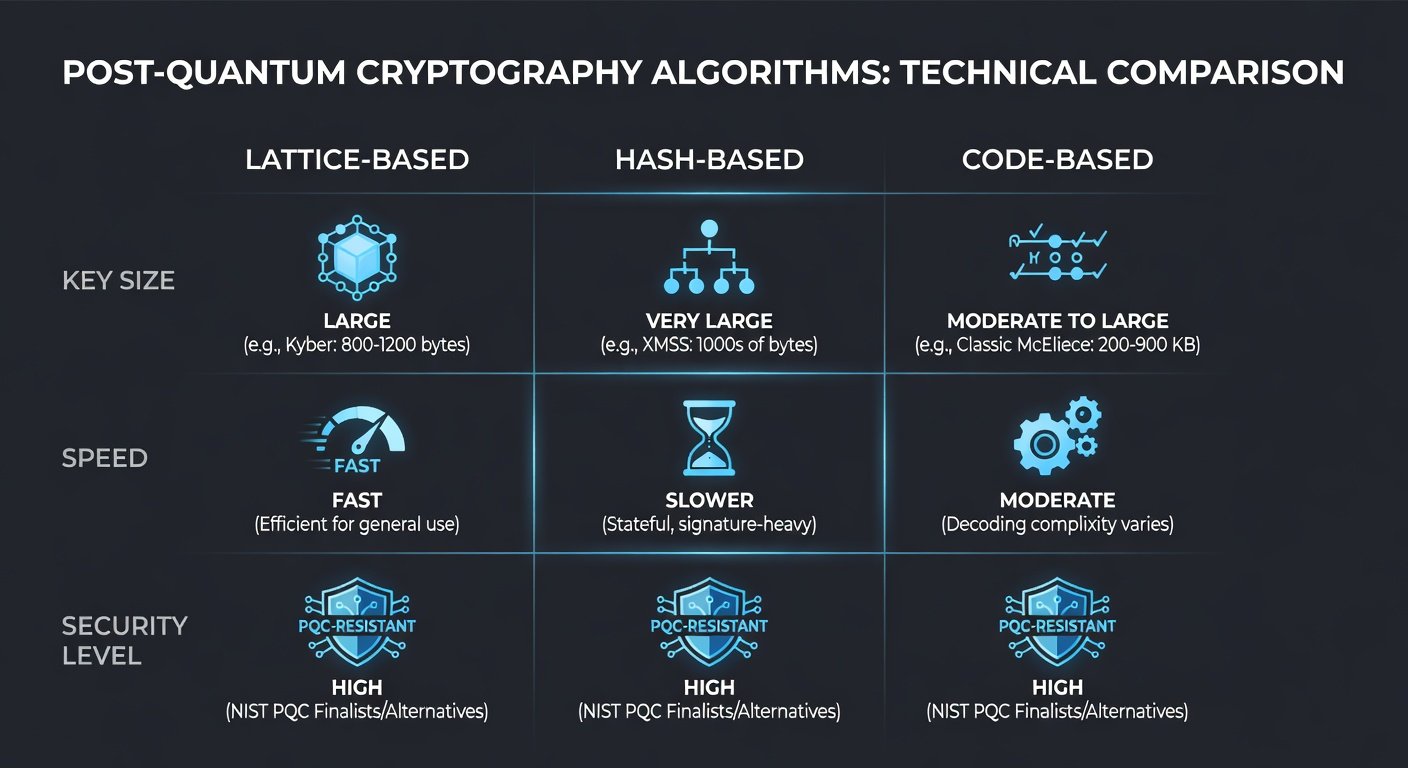
When evaluating PQC options, decision-makers must weigh performance metrics, key and signature sizes, and proven security levels against specific use cases. Lattice-based methods generally offer the best balance for high-volume applications, while hash-based signatures provide conservative security assumptions suitable for long-term archival data.
- Kyber (now ML-KEM): Highly efficient for key encapsulation with strong security proofs and compact keys; ideal for most network protocols and TLS handshakes where speed is critical.
- Dilithium (now ML-DSA): Delivers high-performance digital signatures that balance computational speed with reasonable signature sizes, making it suitable for code signing and authentication.
- SPHINCS+: A stateless hash-based signature scheme offering very conservative security but producing larger signatures, best reserved for scenarios where simplicity outweighs efficiency.
- BIKE and HQC: Code-based alternatives that are gaining traction for specific applications such as key exchange in constrained environments, though they may require more bandwidth.
Benchmark studies consistently show lattice-based methods excelling in speed and bandwidth efficiency, while hash-based options trade performance for minimal reliance on new hardness assumptions. Organizations should run internal benchmarks tailored to their workloads before standardization.
Practical Security Tips for IT Professionals
Beyond high-level strategy, implement these actionable measures immediately to strengthen defenses:
- Enable crypto-agility features in all new deployments and schedule retrofits for critical legacy systems.
- Conduct regular quantum risk assessments as part of annual security audits, including tabletop exercises simulating harvest-now-decrypt-later scenarios.
- Use vetted open-source PQC libraries and contribute feedback to improve community standards.
- Collaborate closely with vendors on firmware and software updates that support PQC, verifying timelines and compatibility matrices.
- Simulate quantum attacks during red-team exercises to identify gaps in detection and response capabilities.
- Document all cryptographic dependencies in a centralized repository accessible to security and compliance teams.
Industry-Specific Impacts and Timeline Considerations
Different sectors face unique pressures. Healthcare must protect patient records for decades, making early migration essential. Finance requires real-time transaction security, favoring high-performance lattice algorithms. Government agencies often operate under strict compliance mandates that accelerate adoption timelines. Monitoring hardware progress from companies like IBM and Google helps organizations align investments with realistic milestones rather than reacting to hype.
Frequently Asked Questions
Will quantum computers break all encryption in 2026?
No. While threats are real and growing, large-scale quantum computers capable of breaking current standards are not expected until later in the decade or beyond. Symmetric encryption with increased key sizes remains viable for many applications in the near term.
How soon should my organization start migrating?
Begin inventory and planning immediately. Full migration may take several years depending on complexity, so early action prevents last-minute crises and allows for cost-effective phased rollouts.
What challenges commonly arise during PQC adoption?
Common hurdles include performance overhead, interoperability with legacy systems, and the need for updated skills. Addressing these through pilots and training reduces risks significantly.
Are there any costs associated with PQC adoption?
Adoption involves investment in testing, training, and infrastructure updates, but specific figures vary widely by organization size and existing infrastructure complexity.
Conclusion: Building a Quantum-Resilient Future
Quantum threats represent both a significant challenge and an opportunity for meaningful cybersecurity evolution. By understanding the underlying risks in depth, adopting post-quantum solutions strategically, and following structured transition plans with clear milestones, organizations can safeguard data privacy well into the future. IT leaders who act decisively today will position their enterprises for secure, innovative growth in the quantum era while maintaining compliance and operational continuity.

No comments yet. Be the first!