 NeoBit Daily

Introduction to GraphQL API Security in 2026
GraphQL has become the preferred query language for modern APIs due to its flexibility and efficiency in fetching precisely the data clients require. However, its dynamic nature introduces unique security challenges that can compromise data privacy if left unaddressed. In 2026, organizations must prioritize advanced protections against threats like introspection abuse and query complexity attacks. This comprehensive guide provides developers with practical strategies, multiple code examples, comparisons, and checklists to secure GraphQL endpoints while maintaining compliance with evolving privacy standards. Unlike rigid REST structures, GraphQL allows clients to request exactly the data they need, which can lead to over-fetching risks or unintended data exposure if not controlled properly. As data privacy regulations tighten globally, securing these APIs is essential for protecting sensitive information across industries such as finance, healthcare, and e-commerce.
Key GraphQL-Specific Threats Targeting Data Privacy
GraphQL APIs face distinct vulnerabilities that differ from traditional endpoints. Two prominent threats in 2026 include introspection abuse and query complexity attacks, each capable of enabling large-scale data privacy breaches when exploited.
Introspection Abuse Explained
Introspection allows clients to query the schema for available types and fields. Attackers exploit this to map the entire API structure, identifying sensitive data fields for targeted exfiltration. Disabling introspection in production environments is a baseline defense, but advanced attackers may still probe through error messages or alternative queries. For instance, a malicious actor could use partial introspection queries to discover user profile fields containing personal identifiers, leading to privacy violations under regulations like GDPR.
Query Complexity Attacks in Detail
These attacks involve crafting deeply nested or recursive queries that consume excessive server resources, leading to denial-of-service conditions. In privacy contexts, such attacks can mask data scraping attempts by overwhelming monitoring systems. Developers should calculate query costs using custom directives to assign weights to fields, rejecting any query exceeding a predefined threshold.
GraphQL vs REST API Risks: A Comparative Analysis
REST APIs typically expose fixed endpoints, making unauthorized access more predictable to detect. GraphQL's single endpoint and flexible queries increase the attack surface significantly. For example, a REST breach might involve guessing resource IDs, whereas GraphQL enables precise field-level data harvesting without multiple round trips. Organizations migrating from REST should implement equivalent controls adapted for GraphQL's resolver-based architecture, including per-field authorization checks that REST often handles at the route level. This shift requires rethinking security models to address GraphQL's batched query capabilities, which can amplify risks if not rate-limited effectively.
Authentication Hardening Techniques
Strong authentication forms the foundation of GraphQL security. Use JSON Web Tokens (JWT) with short expiration times and validate scopes at the resolver level. Implement multi-factor authentication (MFA) for admin access and consider integrating OAuth 2.0 with fine-grained permissions. Code example for a basic JWT middleware in Node.js with added role checks:
const jwt = require('jsonwebtoken');
app.use((req, res, next) => {
  const token = req.headers.authorization;
  if (!token) return res.status(401).send('Unauthorized');
  jwt.verify(token, process.env.SECRET, (err, decoded) => {
    if (err) return res.status(403).send('Invalid token');
    if (!decoded.roles.includes('user')) return res.status(403).send('Insufficient permissions');
    req.user = decoded;
    next();
  });
});
Additional hardening includes rotating secrets regularly and using refresh tokens to limit exposure windows.
Rate Limiting Strategies for GraphQL
Implement rate limiting based on query complexity scores rather than simple request counts. Tools like graphql-rate-limit can assign costs to fields and reject expensive queries. Combine with IP-based throttling and token bucket algorithms to prevent abuse while allowing legitimate high-volume clients. For advanced setups, integrate sliding window counters that adapt dynamically based on user authentication status, ensuring anonymous queries face stricter limits than authenticated ones.
Schema Validation and Sanitization Techniques
Validate all incoming queries against a strict schema definition. Use libraries like graphql-constraint-directive to enforce input limits on strings, numbers, and arrays. Always sanitize resolver outputs to prevent leakage of internal fields or metadata. Extend validation with custom directives for business rules, such as restricting access to certain fields based on user context. 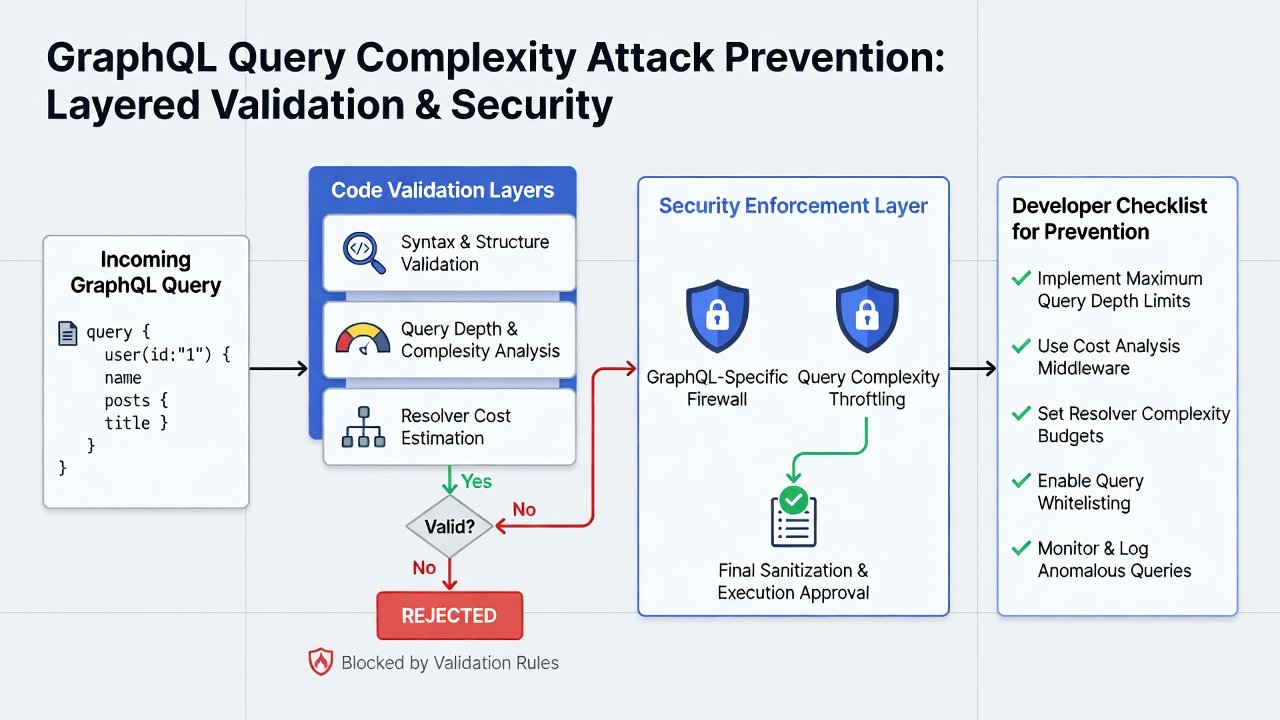
Real-World Breach Case Studies
In documented incidents, companies suffered data leaks when introspection remained enabled, allowing attackers to discover and query private user data fields containing emails and addresses. Another case involved complexity attacks that bypassed basic rate limits, resulting in unauthorized bulk data extraction over several hours. A third example from a fintech firm showed how missing resolver-level checks enabled privilege escalation through nested queries. These examples underscore the need for layered defenses and regular penetration testing tailored to GraphQL.
Practical Developer Checklist
- Disable introspection in production and replace with static schema documentation
- Implement query depth and complexity limits using libraries like graphql-depth-limit
- Enforce field-level authorization in every resolver function
- Integrate comprehensive logging for all query patterns and errors
- Regularly audit schema for sensitive data exposure during code reviews
- Test thoroughly with tools like GraphQL Voyager for visualization and Apollo Studio for performance profiling
- Apply input sanitization and output filtering consistently across all operations
- Monitor for anomalous patterns such as repeated failed authentications
Integrating with SIEM Tools and Anomaly Detection
Connect GraphQL logs to SIEM platforms such as those from major vendors for real-time monitoring. Set alerts for unusual query patterns, high complexity scores, or repeated introspection attempts. Machine learning models can baseline normal traffic and flag deviations, enhancing proactive privacy defense. For example, feed resolver execution times and field access frequencies into the SIEM to detect potential scraping. This integration supports compliance audits by providing traceable logs of data access events.
Learn more from authoritative resources: OWASP API Security Project and GraphQL Foundation documentation.
Common Mistakes to Avoid
Developers often overlook resolver-level security, relying solely on gateway protections. Another frequent error is failing to update dependencies, leaving known vulnerabilities in GraphQL libraries unpatched. Always conduct regular schema reviews to remove deprecated sensitive fields.
Conclusion
Securing GraphQL APIs in 2026 requires a proactive, multi-layered approach focused on privacy. By addressing specific threats, implementing the outlined strategies with code examples, and following the checklist, developers can build resilient systems that protect user data effectively while supporting business needs.
FAQs on Compliance and Tooling
How does GraphQL security impact GDPR compliance? Proper controls help prevent unauthorized data access, supporting Article 32 requirements for security measures. Implementing query logging and access controls directly aids in demonstrating accountability during audits.
What emerging tools are available in 2026? Updated versions of Apollo Server and Hasura now include built-in complexity analysis and enhanced logging for anomaly detection, with improved support for integrating custom SIEM connectors.
Can GraphQL be used securely with microservices? Yes, by applying consistent authentication across services and using schema stitching with security boundaries enforced at each layer.
How often should security audits occur? Conduct full audits quarterly, with automated scans running continuously to catch new threats early.

No comments yet. Be the first!