 NeoBit Daily

Introduction to Autonomous Vehicle Cybersecurity in 2026
Autonomous vehicles (AVs) and connected fleets are transforming transportation, but they introduce significant cybersecurity risks that directly impact data privacy. As we move into 2026, the integration of vehicle-to-everything (V2X) communications, advanced sensors, and real-time data sharing creates new attack surfaces. This article examines emerging threats, regulatory requirements, and practical defense strategies to help manufacturers and fleet operators stay ahead. The rapid adoption of level 4 and level 5 autonomy means vehicles are collecting vast amounts of location, biometric, and behavioral data, making privacy protection a core business requirement rather than an afterthought. Organizations that fail to address these issues risk not only operational disruptions but also severe reputational damage and legal penalties under expanding global privacy regulations.
V2X Communication Vulnerabilities
V2X technology enables vehicles to exchange data with infrastructure, other vehicles, and pedestrians. However, these open channels are prime targets for interception and manipulation. Attackers can exploit unencrypted messages to inject false traffic data, leading to unsafe decisions by autonomous systems. In 2025 incidents, researchers demonstrated how compromised V2X signals caused vehicles to brake unexpectedly or reroute into hazards. Expanding on this, vulnerabilities often stem from legacy protocols that lack mutual authentication, allowing man-in-the-middle attacks during high-speed data exchanges. Fleet operators must prioritize secure V2X implementations to prevent cascading failures across entire networks of connected vehicles. Furthermore, the sheer volume of messages exchanged in dense urban environments increases the attack surface, requiring advanced cryptographic solutions to maintain integrity without introducing latency that could affect safety-critical decisions.
Sensor Spoofing Attacks and Real-World Case Studies
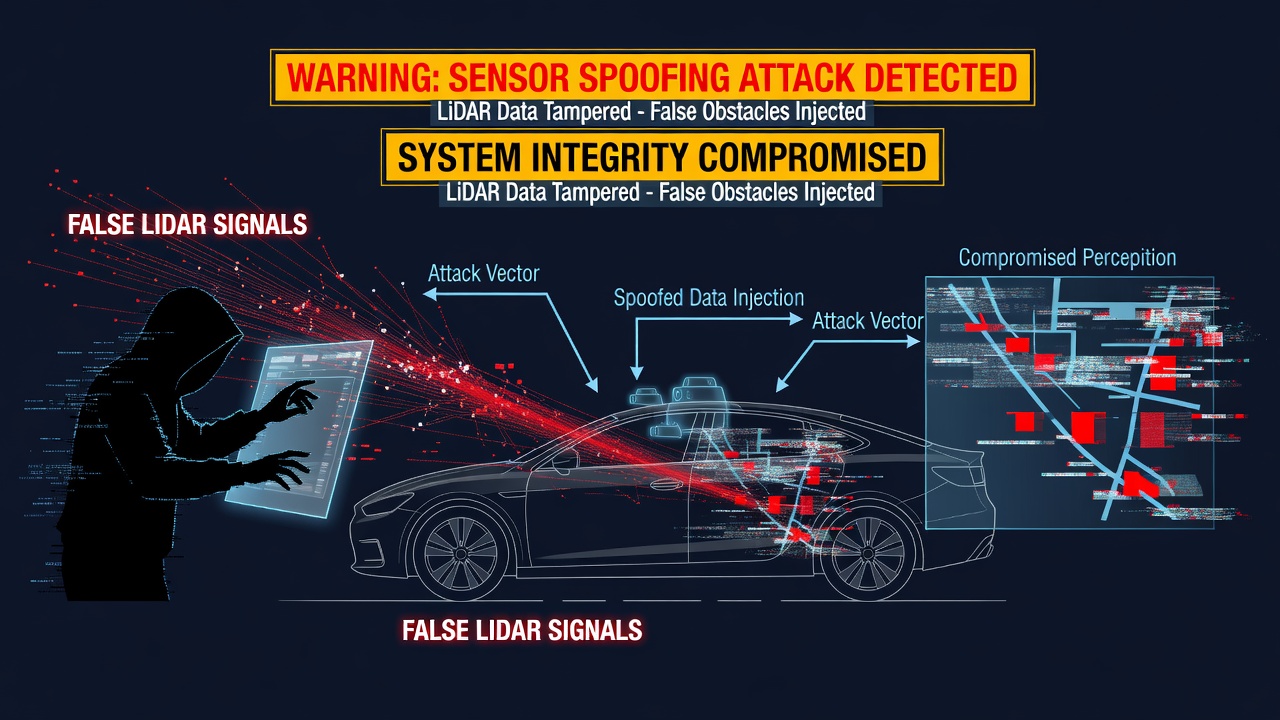
Sensor spoofing involves feeding false data to LiDAR, radar, or cameras. A notable 2025 case involved a fleet in Europe where spoofed GPS signals caused multiple trucks to deviate from routes, exposing sensitive cargo location data. Another incident in Asia saw hacked cameras on ride-sharing AVs leaking passenger imagery. These events highlight the need for robust authentication in sensor feeds. Additional examples include a North American demonstration where attackers used portable devices to overwhelm ultrasonic sensors, forcing emergency stops that disrupted traffic flow and potentially compromised passenger safety records. Such attacks not only endanger lives but also expose personal data streams that could be harvested for malicious purposes like stalking or identity theft.
Regulatory Compliance Needs for 2026
Compliance with evolving standards is critical. Organizations should align with guidelines from NIST on cybersecurity frameworks and NHTSA safety regulations. Data privacy laws such as GDPR extensions for connected devices require explicit consent for vehicle-collected personal data and mandatory breach notifications within 72 hours. In addition, emerging U.S. state-level rules and international standards are pushing for continuous risk assessments, with non-compliance potentially resulting in operational restrictions for fleets operating across borders. Manufacturers must also prepare for potential updates to UNECE WP.29 regulations that mandate cybersecurity management systems for vehicle type approvals starting in 2026.
Comparison of Security Frameworks
Several frameworks address AV security. NIST's Cybersecurity Framework emphasizes identify-protect-detect-respond-recover phases, while ISO/SAE 21434 focuses on automotive-specific risk management. The former offers broad applicability for data privacy, whereas the latter provides detailed threat modeling for vehicle electronics. Manufacturers often combine both for comprehensive coverage. When comparing further, the NIST approach excels in organizational governance and data handling, whereas ISO/SAE 21434 offers granular hardware-level controls; choosing between them depends on whether the priority is enterprise-wide privacy or component-level resilience. A hybrid model often yields the best results for global fleets navigating multiple jurisdictions.
Actionable Checklists for Manufacturers
- Implement end-to-end encryption for all V2X and sensor data streams to prevent interception.
- Conduct regular penetration testing on autonomous driving systems to uncover hidden weaknesses before deployment.
- Establish secure boot processes and firmware update mechanisms that verify authenticity at every stage.
- Deploy anomaly detection AI to identify spoofing attempts in real time across multiple sensor inputs.
- Ensure compliance audits cover data minimization and user consent protocols to avoid regulatory fines.
- Integrate hardware security modules for key storage and cryptographic operations to protect against physical tampering.
- Perform third-party code reviews on all autonomous software components before deployment to eliminate supply-chain risks.
Practical Mitigation Steps and Security Tips
Fleet operators should prioritize zero-trust architectures and continuous monitoring. Training staff on recognizing phishing attempts targeting vehicle networks is essential. Regular software updates, segmented networks, and multi-factor authentication for fleet management platforms reduce exposure. Integrating privacy-by-design principles from the outset prevents costly retrofits. Additional steps include establishing incident response teams specialized in automotive threats, conducting quarterly tabletop exercises simulating sensor spoofing scenarios, and maintaining detailed logs of all data access events to support forensic investigations after potential breaches. Operators should also collaborate with cybersecurity vendors to implement over-the-air update capabilities that patch vulnerabilities without requiring vehicles to return to depots.
Security Tips for Proactive Defense in 2026
Proactive defense requires layering multiple controls. Use redundant sensor validation to cross-check inputs from different modalities before acting on them. Encrypt all stored vehicle data at rest using industry-standard algorithms updated annually. Educate drivers and operators about social engineering risks that could grant physical access to onboard systems. Monitor for unusual data transmission patterns that may indicate ongoing attacks, and partner with cybersecurity firms experienced in automotive environments for ongoing threat intelligence sharing. These measures collectively create a resilient ecosystem capable of withstanding sophisticated threats while preserving user trust in data handling practices.
FAQ: Common Fleet Operator Concerns
How can fleets protect against V2X attacks?
Use authenticated message protocols and real-time validation of incoming data against multiple sources.
What are the biggest data privacy risks in 2026?
Unauthorized access to location histories and passenger biometrics collected by AV sensors remain top concerns.
Are there specific tools recommended for mitigation?
Industry leaders recommend solutions aligned with NIST guidelines for intrusion detection and encrypted communications.
How often should security audits occur?
Comprehensive audits should take place at least twice per year, with continuous automated scanning supplementing manual reviews.
What role does AI play in defending AVs?
AI-driven anomaly detection can identify subtle deviations in sensor data that traditional rules-based systems might miss.
Conclusion
Proactive defense in autonomous vehicle cybersecurity is no longer optional. By addressing V2X vulnerabilities, sensor threats, and regulatory demands with structured frameworks and checklists, stakeholders can safeguard both vehicle operations and user data privacy in 2026 and beyond. Implementing these measures early positions organizations as leaders in secure mobility solutions while minimizing exposure to evolving cyber threats and privacy violations.


No comments yet. Be the first!