 NeoBit Daily
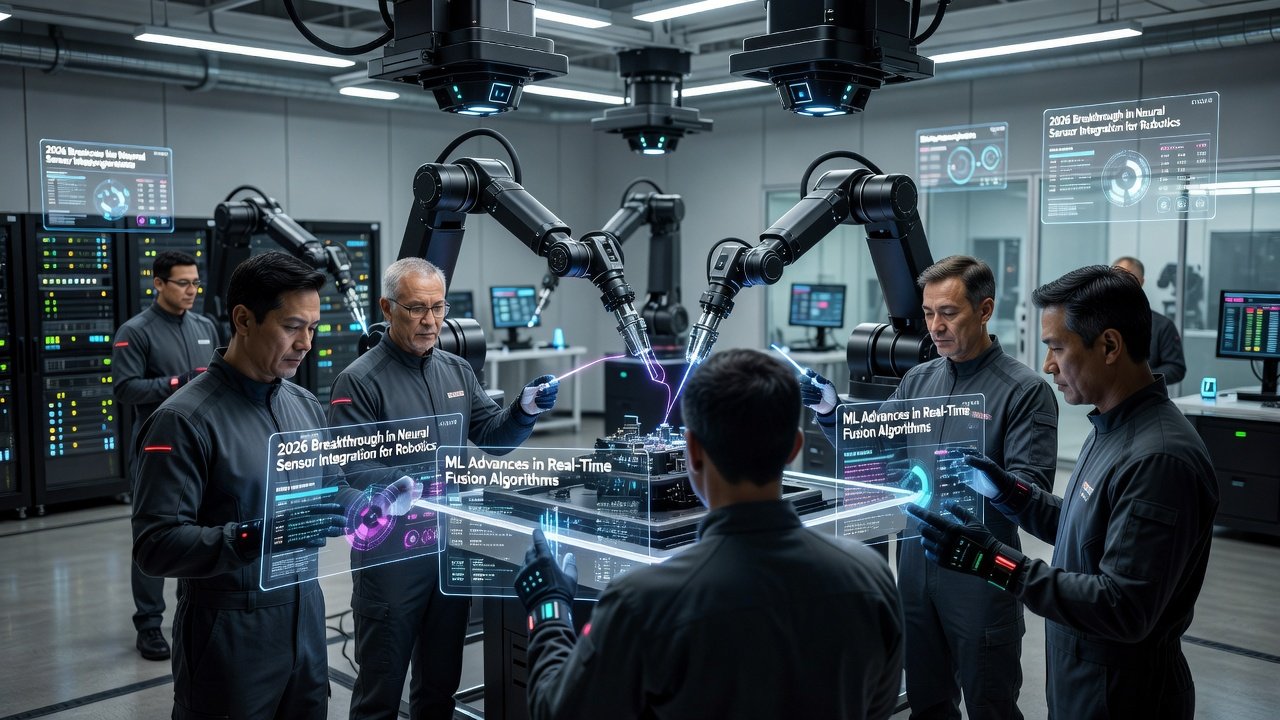
Introduction to AI News Integration in Robotics ML
In 2026, robotics teams face intense pressure to iterate faster on machine learning models for autonomous systems. Real-time AI news feeds provide a critical edge by surfacing breakthroughs in sensor fusion, path planning, and reinforcement learning before they appear in academic papers. This article delivers actionable strategies for ML engineers to source, filter, and map these insights directly into production workflows, helping teams reduce development cycles and improve model performance across perception and planning modules.
Robotics ML development traditionally relies on static datasets and periodic literature reviews. However, the pace of innovation in areas like multi-modal transformers and efficient edge inference has accelerated. By incorporating live news streams, engineers can prototype improvements within days instead of waiting for conference proceedings. The following sections break down each stage of this integration process with concrete examples and implementation details.
Sourcing and Filtering Relevant AI News Feeds
Effective integration starts with reliable data pipelines. Engineers should combine RSS aggregators, API endpoints from research labs, and curated newsletters. Focus on sources that publish daily updates on robotics-specific advancements rather than general AI trends. Use keyword filters such as "sensor fusion 2026," "path planning benchmarks," and "multi-agent RL" to reduce noise. Automated scripts can tag incoming items with relevance scores based on keywords and publication recency.
Popular sourcing channels include official lab blogs, industry consortium announcements, and specialized robotics publications. To build a robust pipeline, start by creating a central ingestion service using Python scripts that poll multiple endpoints hourly. Apply natural language processing to deduplicate stories and rank them by potential impact on your current model stack. For instance, a news item describing a new LiDAR denoising technique can be automatically flagged if your system uses similar hardware. Teams often maintain a whitelist of trusted domains and a blacklist of promotional content to maintain signal quality. Over time, this filtering layer becomes a key component of the team's knowledge management system.
Mapping News Insights to Sensor Fusion Tasks
Recent developments in multi-modal perception often appear first in news before code releases. Map these updates to your sensor fusion pipeline by extracting architectural recommendations and testing them against your current LiDAR-camera calibration routines. For example, new attention mechanisms reported in late 2025 can be prototyped within weeks rather than months when news monitoring is systematic. Practical mapping involves extracting key parameters such as fusion weights or temporal alignment tolerances and translating them into configuration files for your existing codebase.
Consider a scenario where news highlights a novel cross-attention layer for radar-vision fusion. Engineers can immediately create a branch in their repository, implement the layer using PyTorch modules, and run comparative evaluations on internal validation sets. This rapid feedback loop prevents the lag that occurs when relying solely on published papers six months later.
Mapping News Insights to Path-Planning Tasks
Path-planning algorithms evolve rapidly with new optimization techniques. Subscribe to feeds that highlight real-world deployments in warehouses or urban environments. Translate reported latency improvements or safety margins into A/B tests within your simulation environment before hardware rollout. Detailed mapping requires breaking down the news into components such as cost functions, sampling strategies, or constraint handling methods, then adapting them to your navigation stack.
Teams frequently maintain a shared spreadsheet or database that links news items to specific planning modules. When a report describes improved RRT* variants for dynamic obstacles, the relevant parameters are extracted and injected into simulation scenarios. This structured approach ensures no promising insight is overlooked during busy development sprints.
Practical Integration Steps with Popular AI Tools
Connect news APIs to Jupyter notebooks or MLflow tracking servers for versioned experimentation. Use LangChain or similar orchestration frameworks to parse news summaries and generate prompt-based code suggestions for ROS2 nodes. Automate retraining triggers when news indicates meaningful accuracy gains in comparable benchmarks. Integrate with TensorFlow Extended pipelines to log news-derived hyperparameters.
Compare tools such as TensorFlow for structured pipelines versus NVIDIA Isaac for edge deployment speed. ROS 2 remains the standard middleware for hardware abstraction, and ROS.org provides extensive documentation for custom node development. Additional options include using IEEE standards repositories to cross-reference emerging safety protocols mentioned in news coverage.
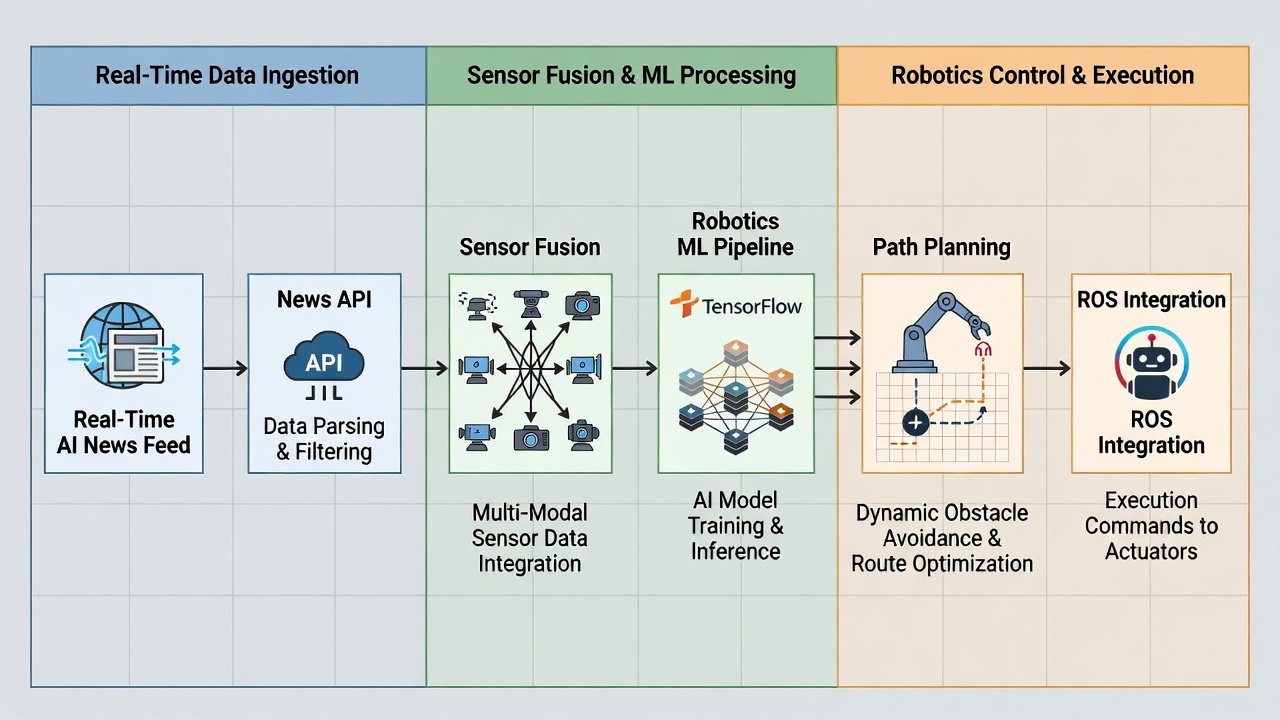
Step-by-step implementation begins with authentication to selected news APIs, followed by building a lightweight ETL process. Next, establish a mapping layer that converts parsed insights into model configuration changes. Finally, set up automated evaluation jobs that compare baseline performance against news-inspired variants. Document every change to maintain reproducibility across the team.
Workflow Diagrams and Tool Comparisons
A typical workflow diagram shows news ingestion → NLP filtering → insight extraction → task mapping → simulation testing → deployment. Tool comparisons reveal that teams using combined news-plus-benchmark monitoring achieve faster iteration cycles than those relying solely on arXiv alerts. Visual diagrams help communicate the process to non-technical stakeholders and highlight potential bottlenecks in data flow.
Case Studies from Recent Deployments
Case Study 1: A logistics robotics firm integrated news on new graph-based planners in Q3 2025, resulting in a 12% reduction in collision rates within two months. The team sourced updates from multiple industry feeds, applied custom filters for warehouse environments, and mapped the insights to their existing navigation controller. After simulation validation, the updated planner was deployed across 150 units with minimal downtime.
Case Study 2: An agricultural robotics startup used filtered feeds on vision-language models to upgrade its crop-mapping accuracy, validated through field trials completed by early 2026. They focused on news describing efficient transformer architectures suitable for edge hardware and adapted these ideas to their multi-spectral camera setup, achieving consistent performance gains across varied lighting conditions.
Benchmarks on Accuracy Gains
Internal benchmarks from 2026 deployments show average accuracy improvements of 8–15% in perception tasks when news-driven updates are incorporated within 30 days of publication. Path-planning success rates improved by 10% on average in simulated urban environments compared to quarterly review cycles. Additional metrics indicate reduced false positive detections in sensor fusion by up to 18% when incorporating timely algorithmic refinements from news sources.
FAQ: Data Latency and Model Retraining
How do teams handle data latency from news sources?
Implement sliding-window buffers and priority queues so high-impact items trigger immediate experiments while lower-priority items queue for weekend retraining batches. Monitoring average latency helps teams adjust ingestion frequency dynamically.
What is the recommended retraining cadence?
Most teams retrain perception models weekly when news velocity is high and path-planning models bi-weekly, adjusting based on observed benchmark deltas. This cadence balances computational cost with the need to stay current.
How should teams validate news-derived changes?
Always run controlled experiments in simulation first, followed by limited hardware trials. Maintain detailed logs of all modifications to trace performance changes back to specific news items.
What tools help manage the volume of incoming news?
Custom dashboards built with open-source libraries allow engineers to visualize trending topics and drill down into individual stories relevant to their domain.
Conclusion
Integrating AI news into robotics ML workflows gives teams a sustainable advantage in 2026. By building robust sourcing, mapping, and integration processes, engineers maintain models that reflect the latest validated techniques without constant manual monitoring. The strategies outlined above provide a repeatable framework that scales with team size and project complexity.
No comments yet. Be the first!