 NeoBit Daily

Introduction to Edge ML Inference in 2026
Edge machine learning inference enables real-time processing on devices like sensors and gateways without cloud dependency. In 2026, AI tools streamline optimization for lower latency and higher efficiency across IoT deployments. This guide covers proven techniques, practical workflows, and performance monitoring strategies that help engineering teams achieve consistent results on constrained hardware. Organizations deploying models at the edge must balance accuracy, power consumption, and response time, which makes systematic optimization essential from the start of any project.
Core Optimization Techniques: Pruning and Quantization
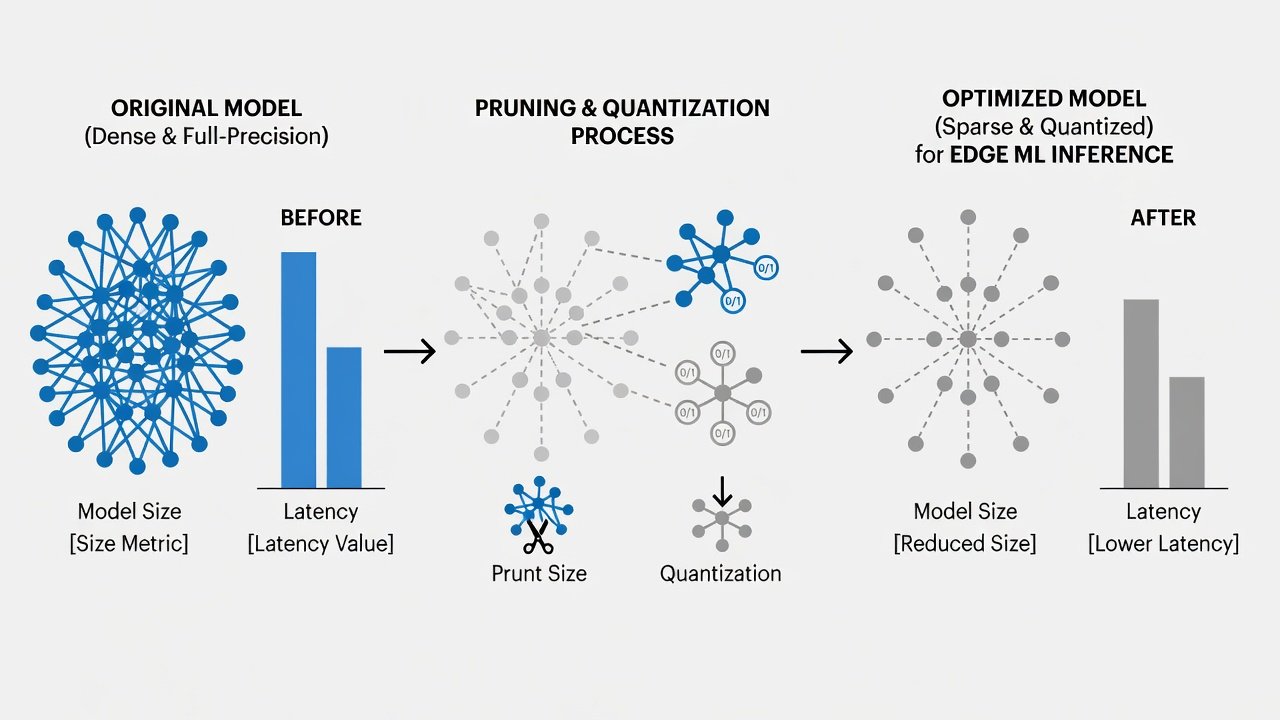
Model pruning removes unnecessary weights to reduce size while preserving accuracy. Structured pruning targets entire channels or layers, while unstructured approaches remove individual connections. Teams typically begin with magnitude-based pruning followed by fine-tuning to recover any lost performance. Quantization converts floating-point parameters to lower precision formats such as INT8 or even INT4 in advanced cases. Post-training quantization works quickly on existing models, whereas quantization-aware training integrates the precision reduction during the learning process for better final accuracy. Real-world benchmarks show pruned and quantized models achieving up to 4x faster inference on ARM-based chips compared to baseline versions, with memory footprints reduced by 60 to 75 percent depending on the original architecture.
Leading AI Tools for 2026 Edge Optimization
TensorFlow Lite remains a cornerstone for mobile and embedded deployment, offering built-in support for both pruning and quantization through its optimization toolkit. PyTorch Mobile provides flexible scripting for custom models and integrates seamlessly with TorchScript for edge export. NVIDIA TensorRT supplies GPU-accelerated paths for edge servers, including automatic kernel tuning and layer fusion that further boost throughput. Intel OpenVINO targets CPU and VPU platforms with a focus on heterogeneous execution across multiple compute units. Additional emerging utilities include ONNX Runtime with its edge-specific execution providers and Apache TVM for custom compiler pipelines. Each tool integrates pruning and quantization pipelines with built-in benchmark suites that report latency, accuracy, and power metrics on target devices.
TensorFlow documentation details the latest edge extensions and provides reference implementations for common vision and audio tasks. PyTorch supplies mobile export utilities and quantization recipes that teams can adapt to their datasets. NVIDIA and Intel maintain hardware-specific optimization guides that include sample code for Jetson and OpenVINO platforms respectively.
Step-by-Step Deployment Workflow
Teams follow a repeatable process to move models from development to production. First, export the trained model to ONNX or the native framework format while verifying baseline accuracy on a validation set. Next, apply structured pruning using framework APIs to reach 30 to 50 percent sparsity, then fine-tune for several epochs to restore accuracy. After pruning, perform post-training quantization or switch to quantization-aware training if accuracy tolerance is tight. Convert the optimized model to the target runtime format such as TensorFlow Lite FlatBuffers or TensorRT engines. Profile the model directly on the edge device using built-in tools to measure latency, memory usage, and thermal impact. Finally, package the model with the edge runtime in a container or over-the-air update bundle and validate end-to-end system latency under realistic workloads. Each stage includes checkpoints where accuracy is re-measured to catch regressions early.
Hardware Platform Comparisons
ARM Cortex-M microcontrollers favor heavily quantized INT8 models that deliver sub-10 ms inference for simple classification tasks while consuming under 100 mW. NVIDIA Jetson modules excel with TensorRT on vision workloads, delivering higher throughput on convolutional networks thanks to optimized CUDA kernels and Tensor Cores. Intel-based gateways benefit from OpenVINO’s ability to dispatch operators across CPU, integrated GPU, and VPU accelerators, often achieving balanced performance on mixed sensor data streams. Raspberry Pi 5 boards with 64-bit ARM cores show strong results when paired with optimized runtimes, though they require careful memory management to avoid swapping. Teams should benchmark each tool on target silicon using standardized datasets before scaling production fleets, documenting both average and tail latencies to ensure reliability in variable conditions.
IoT Case Studies Demonstrating Latency Gains
Smart factory predictive maintenance systems reduced inference latency from 85 ms to 22 ms after applying channel pruning followed by INT8 quantization on a custom CNN. The change allowed vibration analysis to run locally on every machine without increasing power draw. Agricultural sensor networks monitoring soil conditions achieved 3.2x throughput improvement on Raspberry Pi 5 hardware by combining unstructured pruning at 40 percent sparsity with post-training quantization, enabling hourly updates across hundreds of nodes. Urban traffic cameras deployed on Jetson Orin Nano devices cut object detection latency by 65 percent using TensorRT layer fusion, supporting real-time alerts while staying within thermal limits of outdoor enclosures. These examples highlight consistent gains when following structured optimization workflows and validating results on representative hardware.
Monitoring Performance with Live AI News Feeds
Subscribe to curated AI research feeds and framework release notes to track emerging quantization methods, new compiler passes, and hardware support updates. Setting up automated alerts for repository changes in TensorFlow, PyTorch, and ONNX Runtime allows teams to test and adopt improvements within weeks of release. Integrating these feeds into internal dashboards helps surface relevant papers on novel pruning algorithms or runtime optimizations, ensuring continuous refinement of edge pipelines. Regular monitoring prevents stagnation and maintains competitive inference speeds as new techniques become available.
Troubleshooting FAQ
- Accuracy drops after quantization? Switch to quantization-aware training or expand the calibration dataset to cover edge cases encountered in deployment.
- Unexpected latency spikes on certain inputs? Profile memory bandwidth and check for operator fallback to CPU; replace unsupported layers with equivalent implementations.
- Model fails to load on target device? Verify runtime version compatibility and confirm that all operators used during training are supported in the edge runtime.
- Power consumption exceeds budget after optimization? Re-evaluate pruning ratio or explore mixed-precision quantization to reduce arithmetic intensity.
- Accuracy varies across device batches? Standardize firmware versions and test with identical calibration data to isolate hardware differences.
Scalability Tips for ML Teams
Establish automated CI pipelines that run pruning, quantization, and device profiling on every model commit, generating reports that flag regressions before merge. Maintain a hardware-in-the-loop testing lab with representative edge boards to catch platform-specific issues early. Document versioned optimization recipes in a shared repository so new engineers can replicate successful configurations without starting from scratch. Schedule quarterly reviews of emerging tools and techniques to incorporate advances that could further reduce latency or power draw across the fleet.
Conclusion
Effective use of 2026 AI tools for edge ML inference combines pruning, quantization, and platform-specific runtimes into repeatable workflows. Following the detailed steps, comparisons, and monitoring practices outlined delivers reliable latency reductions and scalable deployments for IoT applications across industries.

No comments yet. Be the first!