 NeoBit Daily

Introduction: Why AI News Matters for ML Practitioners in 2026
In 2026, the pace of artificial intelligence innovation continues to accelerate, directly influencing how machine learning teams build, train, and deploy models. Staying current with AI news allows practitioners to identify high-impact tools early, adapt workflows efficiently, and maintain competitive advantages. This article explores actionable strategies for translating breaking developments into real workflow improvements, focusing on source identification, tool evaluation, implementation tactics, and measurable outcomes. Machine learning practitioners face constant pressure to deliver higher accuracy, lower latency, and reduced operational costs. Without a structured approach to news consumption, teams risk falling behind competitors who quickly integrate innovations such as advanced attention mechanisms, efficient fine-tuning methods, and hardware-aware optimization libraries. By establishing disciplined monitoring habits, teams can turn information overload into a strategic asset that drives continuous improvement across the entire ML lifecycle.
Identifying High-Impact AI News Sources
Effective monitoring begins with curating reliable information channels. Leading sources include academic repositories such as arXiv, industry research hubs like TensorFlow, and collaborative platforms such as Hugging Face. These outlets publish peer-reviewed papers, open-source releases, and benchmark results that often precede commercial adoption by months. Beyond these core sources, practitioners should also follow proceedings from major conferences including NeurIPS, ICML, and CVPR, which frequently introduce foundational techniques months before they appear in production frameworks. Setting up automated alerts through RSS feeds and email digests helps surface relevant papers and tool announcements without requiring constant manual searching. Cross-referencing multiple sources reduces noise and highlights tools with genuine technical merit rather than marketing hype. Teams that dedicate 30 minutes each morning to scanning new preprints and release notes consistently discover opportunities that others miss.
Evaluating New AI Tools Against Existing ML Stacks
Once a promising development appears in the news, rigorous evaluation is essential. Compare the new tool against current infrastructure using criteria such as compatibility with existing frameworks, scalability requirements, and integration overhead. For instance, a newly announced optimization library might promise faster inference but require significant code refactoring. Key evaluation dimensions include model accuracy on domain-specific benchmarks, training and inference speed improvements, and hardware compatibility. Teams benefit from maintaining a living scorecard that tracks these metrics across quarterly reviews. Additional considerations include licensing terms, community support activity, and long-term maintenance commitments from the project maintainers. A practical approach involves running side-by-side experiments on representative datasets while documenting both quantitative gains and qualitative friction points encountered during setup. This disciplined comparison prevents premature adoption of tools that look impressive in isolation but create technical debt when scaled.
Real-World Implementation Examples
Consider a computer vision team that adopted a new attention-based architecture highlighted in early 2026 research. By monitoring preprints and quickly prototyping on a subset of their dataset, they achieved a 15% reduction in inference latency while preserving accuracy. Another example involves a natural language processing group that integrated a novel fine-tuning technique, cutting training time from days to hours on standard GPU clusters. A third case comes from an autonomous systems company that incorporated a hardware-specific quantization method announced at a major conference; the change allowed them to deploy models on edge devices with 40% lower power consumption without retraining from scratch. These cases demonstrate the value of rapid experimentation cycles triggered by timely news consumption. In each instance, success depended on having pre-established evaluation pipelines and clear success criteria rather than chasing every headline.
Speed Versus Accuracy Gains: Direct Comparisons
Many 2026 AI announcements emphasize either speed or accuracy. Practitioners must weigh trade-offs carefully. Quantization and pruning techniques often deliver substantial speedups with minimal accuracy loss, while larger foundation models may boost performance at higher computational cost. Decision frameworks should incorporate business constraints such as latency SLAs and budget limits. For example, real-time recommendation engines typically prioritize sub-50-millisecond inference over marginal accuracy improvements, whereas medical imaging applications may accept longer processing times in exchange for higher diagnostic precision. Teams can use Pareto frontier analysis to visualize the speed-accuracy trade-off space and select operating points that best align with product requirements. Regular re-evaluation is necessary because new techniques announced throughout the year can shift these frontiers dramatically.
Step-by-Step Integration Checklist
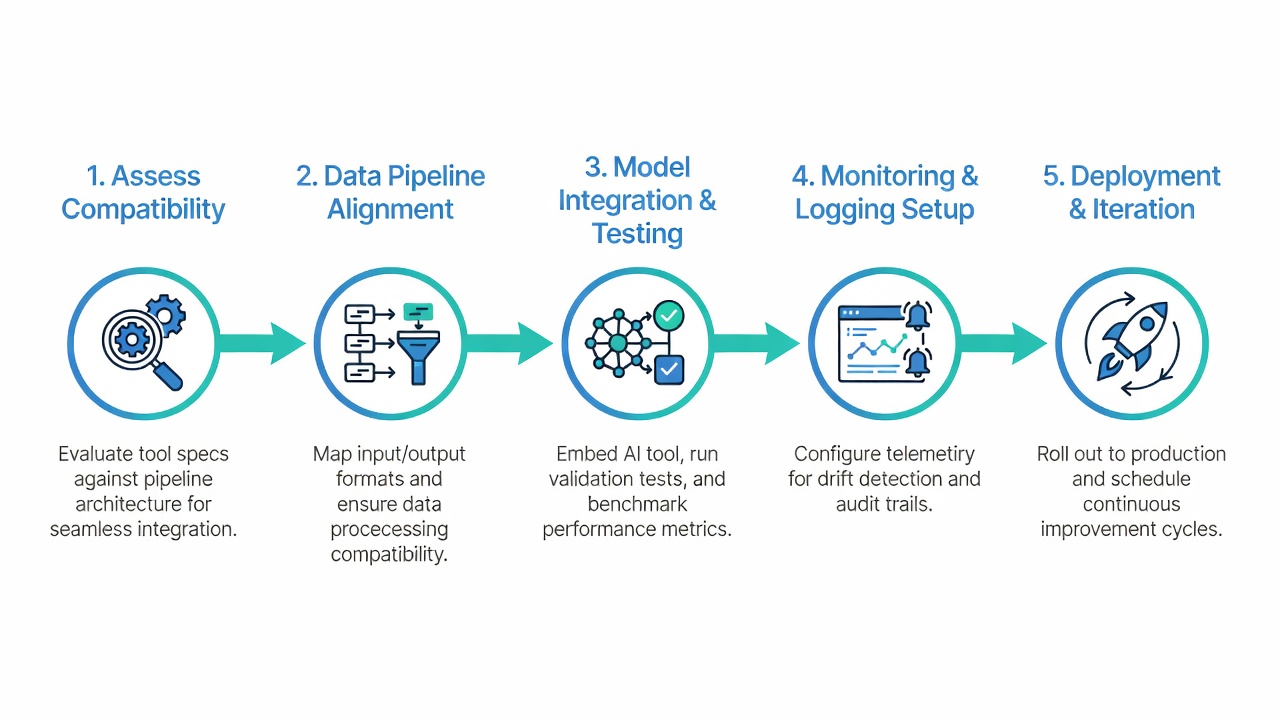
- Review recent publications from trusted sources within the past 48 hours and flag any tools that directly address current bottlenecks.
- Assess tool compatibility with your current ML stack by examining dependencies, supported hardware, and required data formats.
- Run controlled benchmarks on representative data subsets while measuring accuracy, latency, throughput, and resource utilization.
- Document expected gains in speed, accuracy, or cost and compare them against baseline performance established in the previous quarter.
- Pilot integration on a non-critical project to surface hidden integration challenges and gather team feedback.
- Measure ROI through defined KPIs such as deployment frequency, model performance drift rates, and engineering hours saved.
- Scale successful pilots across production workflows only after establishing monitoring dashboards and rollback procedures.
Common Pitfalls to Avoid
Teams frequently overcommit to unproven tools based on preliminary benchmarks that fail to generalize to production data distributions. Another common issue is neglecting data privacy implications when adopting new open-source releases that may inadvertently expose sensitive training examples. Establishing governance checkpoints before full rollout mitigates these risks. Additional pitfalls include ignoring version compatibility with existing pipelines, underestimating the learning curve for team members, and failing to maintain fallback mechanisms when new tools underperform in edge cases. Documenting lessons learned after each evaluation cycle helps prevent repeated mistakes across different projects.
FAQ: Tool Selection and ROI Measurement
How should teams prioritize which AI tools to test?
Prioritize tools that directly address current bottlenecks in your pipeline, such as training duration or inference latency, while aligning with existing infrastructure and team expertise.
What metrics best measure ROI from new AI tools?
Track improvements in model accuracy, reduction in compute hours, and time-to-deployment. Compare against baseline performance established prior to integration and monitor these metrics over at least three production cycles.
How frequently should ML teams review AI news?
Daily scanning combined with weekly deep dives ensures timely awareness without overwhelming operational focus. Monthly retrospectives help refine which sources deliver the highest signal-to-noise ratio.
What role does open-source community activity play in tool selection?
Active GitHub repositories with recent commits, responsive issue trackers, and growing contributor bases indicate healthier long-term support compared with stagnant projects.
How can teams quantify productivity gains after adopting new tools?
Measure changes in model iteration velocity, number of experiments completed per week, and reduction in manual debugging time using internal analytics dashboards.
Conclusion
By systematically monitoring AI news and applying structured evaluation processes, ML teams can integrate transformative tools with confidence in 2026. The combination of curated sources, rigorous testing, and measured implementation delivers sustained workflow enhancements and competitive positioning. Organizations that treat news consumption as a core competency rather than an afterthought consistently outperform peers who react slowly to emerging capabilities.

No comments yet. Be the first!