 NeoBit Daily

Introduction: Why AI News Matters for New Machine Learning Learners in 2026
Artificial intelligence continues to evolve rapidly, and staying informed through AI news helps beginners understand shifts in machine learning practices. In 2026, announcements from major labs influence everything from model training techniques to ethical guidelines and hardware optimizations. This guide breaks down the process without assuming prior expertise, focusing on how recent reports translate into actionable knowledge for those just starting out. Machine learning, at its core, involves teaching computers to learn patterns from data rather than following rigid instructions. News coverage often spotlights innovations that lower barriers, such as more efficient algorithms or user-friendly interfaces, allowing newcomers to experiment sooner.
Understanding the impact starts with recognizing that machine learning relies on algorithms that improve through data. News often highlights breakthroughs in areas like natural language processing or computer vision, which newcomers can apply to personal projects. By following developments thoughtfully, beginners build intuition about what works in practice versus theoretical promises, setting a foundation for long-term growth in the field.
Decoding Major AI Announcements for Beginners
Major AI announcements typically come from organizations like OpenAI or research institutions. These releases detail new model architectures, performance benchmarks, or regulatory updates. Beginners should focus on the core claims rather than technical jargon. For instance, a report on improved efficiency in training large models might emphasize reduced computational needs, making experimentation more accessible on standard hardware. Look for sections explaining the underlying data requirements, potential biases addressed, and scalability factors that affect real deployment.
Key elements to look for include the problem being solved, the data sources used, and any limitations mentioned. Cross-referencing with sources such as IBM's AI resources provides clearer context on industry applications. Take time to parse the abstract or executive summary first, then dive into examples of use cases. This layered reading approach prevents overwhelm and reveals how announcements connect to everyday machine learning tasks like classification or prediction problems.
Spotting Relevant Machine Learning Applications from Recent Reports
Recent AI reports often showcase real-world uses in healthcare diagnostics, autonomous systems, content generation, environmental monitoring, and personalized education platforms. Beginners can identify opportunities by noting recurring themes like multimodal models that handle text and images together. These trends suggest starting points for learning frameworks that support similar capabilities, such as integrating vision and language tasks in small-scale prototypes.
Practical spotting involves scanning summaries for metrics on accuracy or speed improvements. Reports might highlight how new techniques reduce bias in datasets, offering lessons for building fairer models at home. For example, an update on reinforcement learning could inspire projects simulating game environments or resource allocation scenarios. Tracking these applications helps map abstract news to concrete skills, like fine-tuning pre-trained models for specific domains without starting from scratch.
Simple Comparisons: Hype Versus Real AI Tools
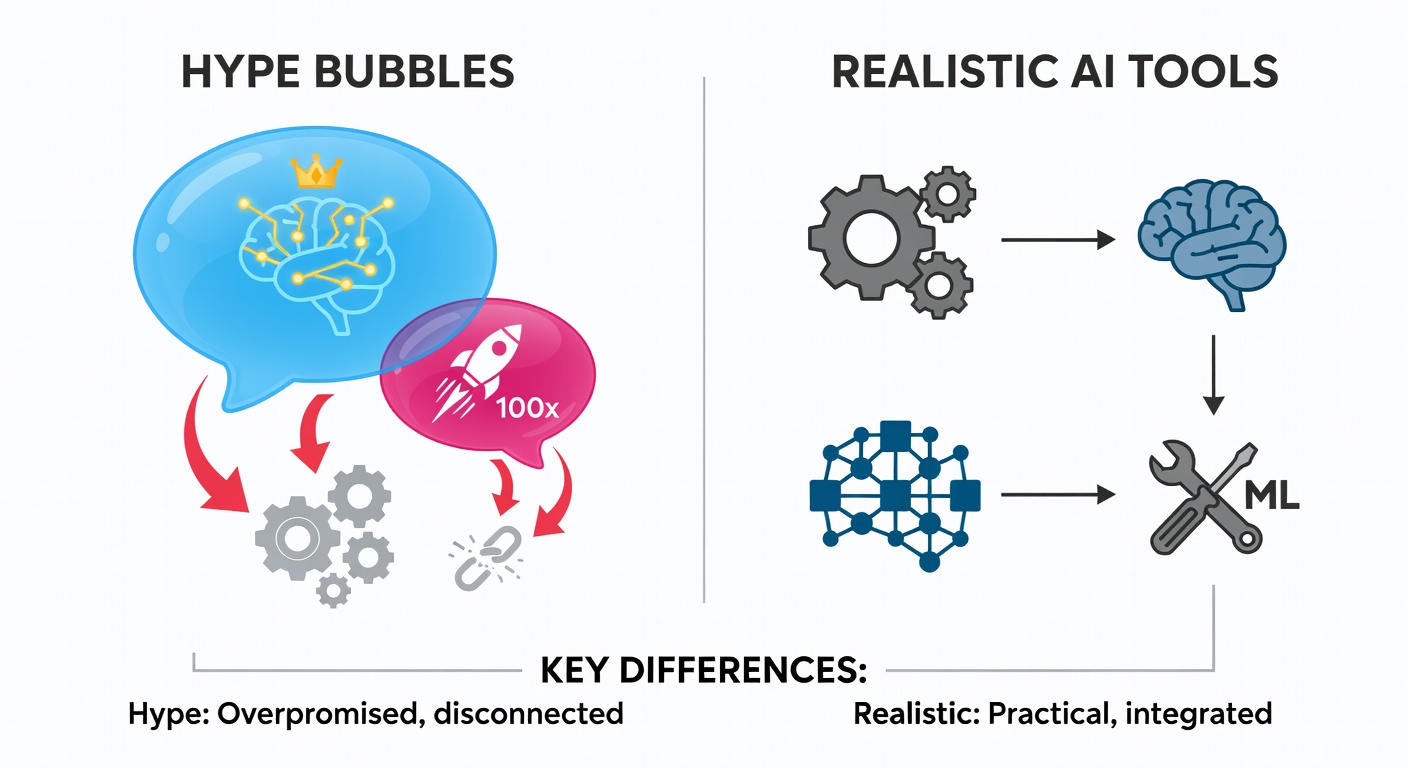
AI news frequently mixes promotional language with genuine advances. Hype often promises instant solutions, while real tools require setup and iteration. Consider these distinctions in more detail:
- Hype example: Claims of fully autonomous coding agents that eliminate all human input and handle complex enterprise software instantly.
- Real tool: Assistants that suggest code snippets but need verification and customization, as seen in current integrated development environments where users review outputs for errors.
- Hype example: Assertions that new models solve any creative task perfectly without training data concerns or ethical oversight.
- Real tool: Systems that generate drafts requiring human editing to ensure originality and compliance with guidelines.
Another comparison involves image generation. Overstated reports may ignore ethical concerns around copyrighted training data, whereas established libraries from PyTorch provide transparent, controllable options for experimentation. Evaluating claims against documented limitations helps beginners avoid frustration and focus on sustainable learning paths that build genuine expertise over time.
Practical Steps to Apply News Insights
Turning news into practice involves a structured approach that scales with your growing knowledge. Begin by selecting one announcement and summarizing its main contribution in your own words. Next, identify a related open-source resource or tutorial that demonstrates the concept simply. For instance, if news covers advances in efficient transformers, search for beginner walkthroughs on attention mechanisms using small datasets.
- Read the announcement summary and note one key feature, such as a new optimization technique.
- Search for open tutorials on related concepts using beginner-friendly platforms, testing basic implementations immediately.
- Experiment with small datasets in accessible environments like Google Colab, adjusting parameters to observe changes firsthand.
- Document results and compare against the reported benchmarks, noting any discrepancies due to hardware differences.
- Join community discussions to refine understanding and gather feedback on your experiments.
- Iterate by applying the insight to a second, slightly more complex scenario to reinforce learning.
This method ensures insights lead to skill development rather than passive consumption, creating a feedback loop that accelerates progress.
Actionable Examples of Tracking Reliable Sources
Effective tracking starts with curated feeds from reputable outlets and official blogs. Set up alerts for terms like "machine learning advancements" or "AI model releases." Follow organizations publishing transparent research, such as Microsoft AI initiatives and TensorFlow documentation. Use RSS readers to aggregate updates from multiple sites without constant browsing.
Weekly reviews of aggregated newsletters help filter noise. Maintain a simple notebook logging three takeaways per article and potential project ideas. Over time, patterns emerge that reveal which news truly influences everyday machine learning workflows. Consider following academic repositories for preprints and participating in moderated forums where experts discuss implications, ensuring a balanced intake of information.
Common Pitfalls Beginners Face When Following AI News
One frequent challenge is chasing every headline without prioritization, leading to scattered efforts. Combat this by focusing on themes aligned with your goals, such as computer vision if that interests you most. Another pitfall involves accepting benchmarks at face value without considering testing conditions like dataset size or hardware used. Always seek details on reproducibility to gauge practicality. Finally, overlooking ethical dimensions in announcements can result in projects that ignore bias or privacy issues, so integrate reviews of responsible AI guidelines into your routine.
Conclusion: Building a Sustainable Habit for 2026 and Beyond
Integrating AI news into machine learning learning creates informed beginners who adapt quickly. By focusing on decoding, application spotting, and balanced evaluation, newcomers develop skills aligned with current trends. Consistent tracking ensures ongoing relevance without overwhelm, empowering individuals to contribute meaningfully as the field advances. With deliberate practice, following news becomes a powerful tool rather than a distraction.
FAQ: Common Beginner Questions on Staying Informed About AI Developments
How often should I check AI news as a beginner?
Start with two to three focused sessions per week to avoid overload while building awareness of key developments. This cadence allows time for reflection and experimentation between readings.
Which sources are most trustworthy for machine learning updates?
Prioritize official research blogs, peer-reviewed summaries, and established tech organizations over unverified social media claims. Cross-check multiple outlets for consensus on major claims.
Can news help me choose my first machine learning project?
Yes, trending applications in reports often suggest timely project ideas, such as experimenting with lightweight models for mobile devices or bias detection in datasets.
What if I don't understand the technical details in announcements?
Focus on high-level outcomes and seek beginner explanations; many announcements include simplified overviews or accompanying videos that break down concepts accessibly.
How do I verify if an AI tool mentioned in news is suitable for beginners?
Check for community tutorials, ease of installation, and availability of sample code. Start with tools that offer guided notebooks or pre-built examples to minimize initial hurdles.


No comments yet. Be the first!