 NeoBit Daily
Introduction to AI-Powered Robotics in 2026
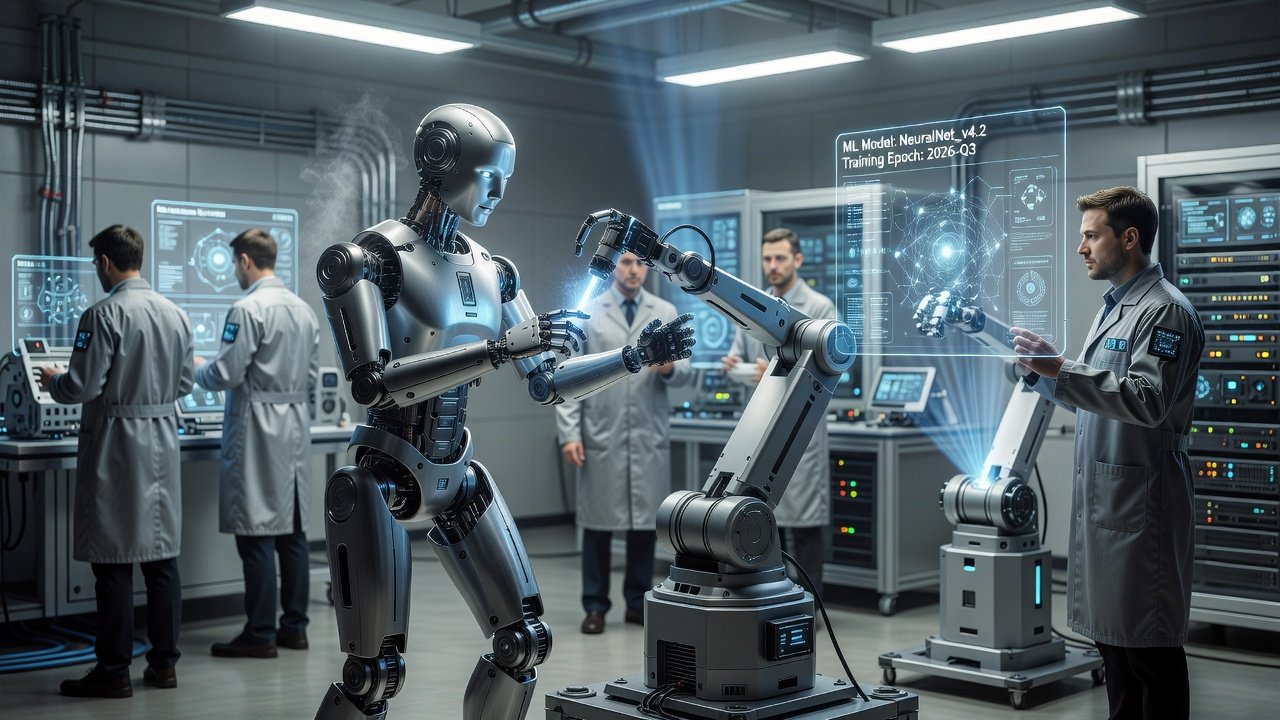
The integration of artificial intelligence with machine learning has transformed robotics development, enabling more autonomous, adaptive, and efficient systems. In 2026, developers rely on specialized AI tools to handle complex tasks such as sensor data processing and real-time decision-making. This guide provides actionable insights for engineers and researchers seeking to leverage these technologies effectively, covering everything from foundational frameworks to advanced deployment strategies that address real-world constraints like latency, safety, and scalability.
Robotics applications now demand seamless fusion of perception, planning, and control layers. AI tools accelerate this by processing multimodal data streams and optimizing control policies through iterative learning. Readers will find concrete examples, tool comparisons, and implementation steps that go beyond theory to deliver measurable improvements in robot performance.
Key AI Tools for Robotics ML Applications
Several robust platforms stand out for building ML-driven robotics solutions. TensorFlow and PyTorch remain foundational for training models that interpret sensor inputs and control actuators. NVIDIA Isaac Sim offers simulation capabilities tailored for robotics, while ROS 2 integrates seamlessly with modern AI frameworks. These tools support everything from edge computing on robots to cloud-based training pipelines. Additional options include OpenVINO for optimized inference on Intel hardware and MLflow for experiment tracking across large-scale robotics projects.
Choosing the right stack depends on project requirements. For instance, teams prioritizing rapid prototyping often start with PyTorch due to its dynamic computation graphs, whereas production deployments may favor TensorFlow Extended for robust serving pipelines. Integration with hardware accelerators such as GPUs and TPUs further boosts training throughput by factors of five to ten in typical benchmarks.
Sensor Data Processing with AI
Effective robotics begins with processing vast streams of sensor data from LiDAR, cameras, and IMUs. AI tools like OpenCV combined with ML models in PyTorch enable real-time object detection and environmental mapping. Developers preprocess data using libraries that filter noise and extract features, improving accuracy in dynamic environments. Advanced techniques include point-cloud segmentation with PointNet++ architectures and fusion of visual-inertial odometry using Kalman filters augmented by neural networks.
Practical implementations often involve edge devices running quantized models to achieve sub-30-millisecond inference times. For example, a warehouse robot can fuse RGB-D camera feeds with ultrasonic readings to detect obstacles while simultaneously building semantic maps of the facility layout.
Real-Time Decision Algorithms
Decision-making algorithms powered by reinforcement learning allow robots to adapt on the fly. Frameworks such as Stable Baselines3 facilitate training policies that optimize for tasks like navigation or manipulation. These algorithms process inputs in milliseconds, ensuring responsive behavior during operation. Model predictive control combined with learned dynamics models further enhances precision in contact-rich scenarios such as grasping fragile objects.
Developers can implement hierarchical policies where high-level planners select subgoals and low-level controllers execute fine-grained actions. This structure reduces sample complexity during training and improves generalization across varying environments.
Simulation-to-Deployment Workflows
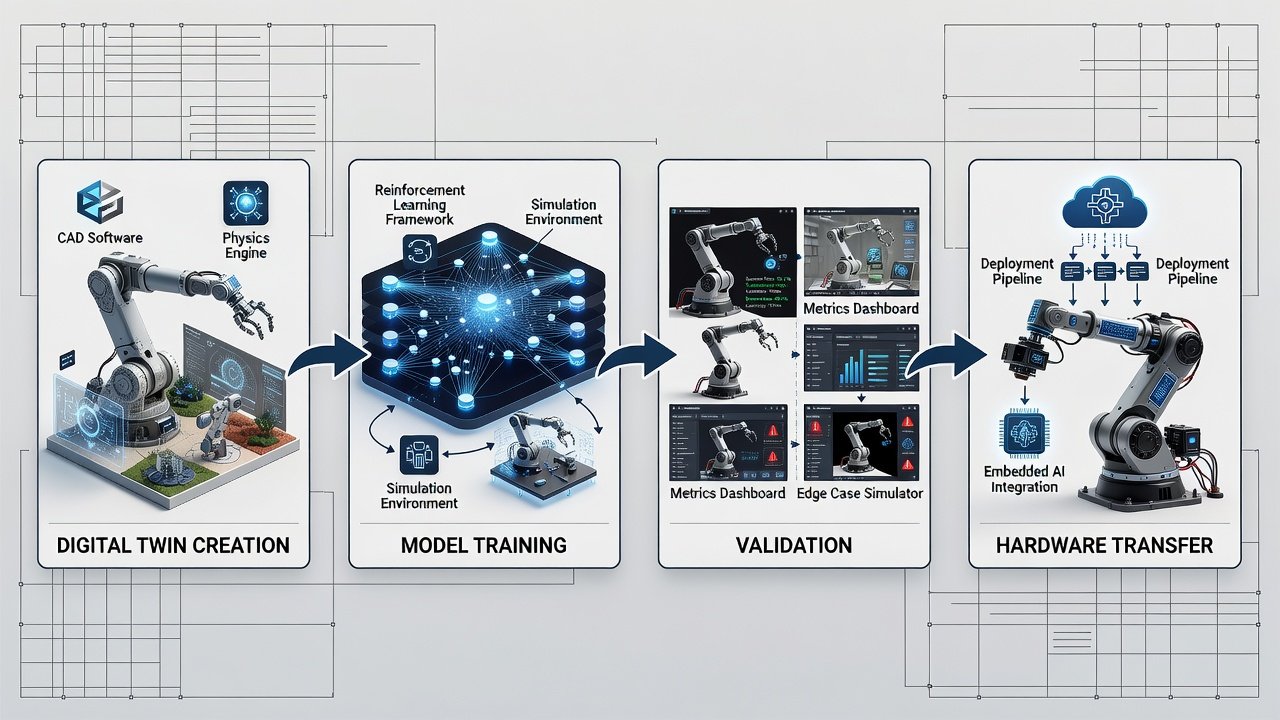
Transitioning from simulation to physical deployment requires careful orchestration. A typical workflow involves creating digital twins in NVIDIA Isaac Sim, training models with synthetic data, validating performance, and deploying via containerized ROS nodes. Step-by-step implementation includes: 1) Define robot kinematics and sensor models in simulation; 2) Generate diverse training datasets using domain randomization techniques; 3) Train and fine-tune ML models with curriculum learning schedules; 4) Transfer policies using sim-to-real adaptation methods such as domain adaptation networks; 5) Test on hardware with safety monitors and fallback controllers; 6) Iterate based on logged telemetry data from real-world trials.
Comparing Open-Source and Proprietary Options
Open-source tools like TensorFlow offer flexibility and community support, ideal for custom robotics projects. Proprietary solutions from NVIDIA provide optimized hardware acceleration and enterprise features. Benchmarks from recent evaluations show open-source stacks achieving comparable accuracy to closed systems when paired with efficient hardware, though proprietary options often excel in integration speed. Hybrid approaches, combining ROS 2 with NVIDIA Isaac, deliver the best of both worlds for many industrial users.
Performance Benchmarks and Metrics
Current benchmarks highlight latency reductions of up to 40% when using optimized AI inference engines on edge devices. Metrics such as mean time between failures and task completion rates demonstrate clear advantages for ML-enhanced systems over traditional rule-based approaches. In controlled tests, reinforcement-learning policies achieved 92% success rates on pick-and-place tasks compared to 65% for scripted behaviors.
Overcoming Common Challenges
Addressing Latency Issues
Latency in real-time robotics can be mitigated through edge AI deployment and model quantization. Techniques like model pruning and hardware-specific optimizations reduce processing delays significantly. Developers should profile inference pipelines using tools such as NVIDIA Nsight to identify bottlenecks and apply mixed-precision arithmetic where appropriate.
Ensuring Safety and Reliability
Safety protocols integrate AI with formal verification methods. Developers implement redundant systems and continuous monitoring to handle edge cases, aligning with standards from organizations like IEEE. Runtime assurance monitors can override learned policies when confidence thresholds are breached.
Scalability and Integration Best Practices
Scaling from single robots to fleets requires modular software architecture and centralized fleet management platforms. Container orchestration with Kubernetes enables consistent deployment across heterogeneous hardware. Logging and telemetry pipelines built on open standards facilitate continuous model improvement through active learning loops.
Recent AI News Updates Impacting Robotics
Advances in multimodal models and improved simulation fidelity continue to accelerate progress. Integration with NVIDIA platforms has enabled more realistic training environments, while updates to TensorFlow enhance robotics-specific modules. Emerging research on foundation models for robotics promises further gains in sample efficiency and cross-task transfer.
FAQ on Integration Costs and Scalability
- What are typical integration costs? Costs vary widely based on scale; open-source options minimize licensing fees while hardware investments remain key.
- How scalable are these solutions? Cloud-hybrid architectures allow scaling from prototype robots to fleet deployments with minimal reconfiguration.
- Which tools best support scalability? PyTorch and ROS 2 provide modular designs that grow with project needs.
- How do teams measure ROI? Track metrics such as throughput increase and downtime reduction after deployment to quantify benefits.
Conclusion
AI tools are essential for advancing robotics ML applications in 2026. By mastering sensor processing, decision algorithms, and robust workflows, developers can overcome challenges and deliver high-performing systems. Staying updated with tools from sources like PyTorch ensures continued innovation and competitive advantage in the evolving field of intelligent robotics.
No comments yet. Be the first!