 NeoBit Daily

Introduction to Neural Architecture Search in 2026
Neural Architecture Search (NAS) has become a cornerstone of modern machine learning, allowing automated discovery of optimal neural network designs. In 2026, AI tools are transforming NAS by minimizing manual intervention and boosting efficiency across industries. These platforms leverage advanced algorithms to deliver faster, more accurate, and scalable models for applications ranging from computer vision to natural language processing and reinforcement learning systems.
Researchers and engineers now rely on these tools to handle complex search spaces that were previously intractable due to computational demands. The focus has shifted toward real-time adaptability, hardware awareness, and seamless integration with dynamic data sources. As organizations scale their ML operations, the demand for tools that reduce human oversight while maintaining high performance continues to grow, making 2026 a pivotal year for NAS advancements.
Understanding Neural Architecture Search Fundamentals
NAS automates the design of neural networks by exploring architectures through reinforcement learning, evolutionary algorithms, gradient-based methods, or hybrid approaches. Traditional manual design required extensive human expertise and trial-and-error, but 2026 tools incorporate self-optimizing mechanisms that reduce search times dramatically while exploring billions of possible configurations efficiently.
Key components include the search space definition, performance estimation strategy, and overall search strategy itself. Modern implementations emphasize hardware-aware NAS to ensure models run efficiently on edge devices, mobile hardware, or large-scale cloud infrastructure. For example, in autonomous driving applications, NAS can discover architectures that balance accuracy with low latency requirements critical for safety.
Additional considerations involve multi-objective optimization that simultaneously targets accuracy, model size, energy consumption, and inference speed. Practitioners often start with proxy tasks on smaller datasets before scaling to full problems, which helps validate promising architectures early in the process.
Leading AI Tools for NAS Optimization
Several platforms stand out in 2026 for their ability to accelerate NAS processes. Tools built on frameworks like TensorFlow and PyTorch offer robust ecosystems with extensive community support and pre-built modules for differentiable NAS and one-shot training, enabling rapid prototyping and iteration.
Other notable solutions integrate with research repositories such as arXiv for staying updated on latest methodologies. These tools often feature automated hyperparameter tuning, progressive shrinking techniques, and multi-objective optimization balancing accuracy with latency constraints. Some platforms also provide visualization dashboards that allow users to inspect discovered architectures in detail and compare them against baseline models.
Integration capabilities extend to popular MLOps platforms, allowing seamless handoff from architecture discovery to training, deployment, and monitoring stages. This end-to-end support reduces the friction commonly experienced when moving research prototypes into production environments.
Benchmarks: Speed, Accuracy, and Scalability
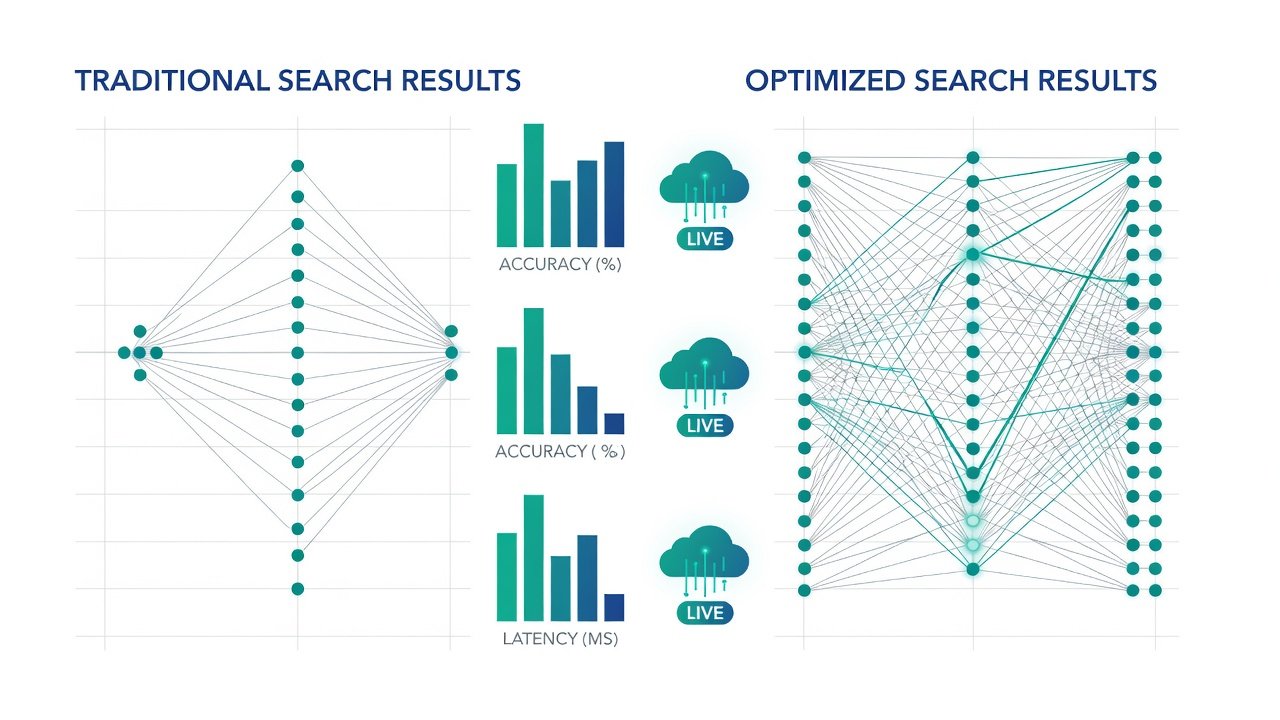
Comparative benchmarks reveal significant gains across leading tools. Many achieve search completion in hours rather than days, with accuracy improvements of 5-15% over manual designs on standard datasets such as ImageNet or GLUE. Scalability tests on large GPU clusters show near-linear performance gains when distributed across hardware from providers like NVIDIA.
Metrics such as FLOPs reduction, inference speed on target hardware, and parameter efficiency are prioritized in evaluations. Real-world tests highlight tools that maintain high accuracy while scaling to billion-parameter models without proportional increases in compute requirements. Teams should evaluate tools using both synthetic benchmarks and domain-specific datasets to ensure relevance to their use cases.
Additional benchmark dimensions include robustness to noisy data, transferability of discovered architectures across datasets, and support for continual learning scenarios where models must adapt over time without full retraining.
Integration with Real-Time AI News Feeds
Advanced platforms connect directly to live data streams, incorporating emerging techniques from research feeds and industry announcements. This allows dynamic adjustment of search strategies based on the latest publications and benchmarks shared across the ML community, ensuring discovered architectures reflect current best practices.
Integration reduces the lag between discovery and deployment, enabling models to incorporate state-of-the-art advancements in areas like efficient transformer variants, sparse attention mechanisms, and neuromorphic-inspired designs. Users can configure alerts for specific topics, automatically triggering refined searches when relevant breakthroughs appear.
Step-by-Step Workflow for Production Deployment
Deploying these tools involves a structured process that ensures reliability and reproducibility. Begin by clearly defining the search space and objectives aligned with business goals, including constraints on model size, latency targets, and supported hardware platforms. Next, select a tool with appropriate hardware support and integration options for your existing stack.
Run initial searches on validation datasets using progressive evaluation techniques to discard poor candidates early. Validate promising architectures through ablation studies and sensitivity analysis to understand which components drive performance. Integrate the final model into production pipelines using containerization technologies for reproducibility across environments.
Production pipelines benefit from continuous monitoring, where feedback loops can retrigger searches when performance drifts due to data distribution shifts. Document every step, including random seeds and configuration files, to support auditing and future improvements. Teams often establish staging environments to test architectures under realistic load before full rollout.
Case Studies from Research Labs
Advanced labs have reported substantial success using these tools for medical imaging models that outperform previous standards on tasks like tumor detection. One study achieved notable reductions in training time while improving diagnostic precision across multiple imaging modalities. Another lab scaled NAS for autonomous systems, resulting in architectures optimized for real-time decision-making under variable lighting and weather conditions.
In natural language processing, research groups have applied these platforms to discover efficient language models suitable for on-device deployment. Results included architectures with significantly lower memory footprints yet competitive performance on question-answering and summarization benchmarks. These case studies demonstrate how NAS tools accelerate innovation while addressing practical constraints such as regulatory compliance and deployment costs.
Cost Optimization Strategies
Efficient resource allocation remains critical for sustainable NAS projects. Teams use early-stopping criteria, low-fidelity proxy tasks, and weight-sharing techniques to lower compute expenses substantially. Cloud-based solutions allow flexible scaling, and hybrid approaches combining on-premise infrastructure with burst capacity in the cloud further optimize overall spend.
Monitoring resource utilization throughout the search process helps identify bottlenecks. Implementing caching for intermediate results and parallelizing independent search trials across available hardware maximizes throughput. Organizations that adopt these strategies report more predictable project timelines and reduced waste of computational resources.
Common Pitfalls and How to Avoid Them
- Overly broad search spaces leading to excessive computation—mitigate by constraining based on domain knowledge and prior experiments.
- Ignoring hardware constraints during search—always include latency, memory, and power targets from the outset.
- Lack of reproducibility—use version-controlled pipelines, seeded random states, and detailed logging of all configurations.
- Neglecting data quality—ensure training datasets are representative, balanced, and thoroughly cleaned prior to launching searches.
- Overfitting to validation sets—employ nested cross-validation and hold-out test sets for final evaluation.
- Underestimating integration effort—plan for MLOps compatibility and monitoring infrastructure early in the project.
Performance Metrics to Track
Monitor top-1 and top-5 accuracy, search wall-clock time, parameter count, FLOPs, energy consumption, and inference latency on target hardware. Advanced dashboards provide real-time visualizations, enabling quick iteration when metrics fall short of targets. Teams should also track secondary metrics such as robustness to adversarial examples and performance under distribution shift for comprehensive assessment.
FAQ on Selecting the Right AI Tool
Which tool suits computer vision tasks?
Platforms with strong support for convolutional, vision transformer, and hybrid search spaces excel here, offering hardware-aware optimizations and pre-trained backbone libraries.
How do emerging 2026 trends affect tool choice?
Trends toward neuromorphic computing, federated NAS, and automated sparsity favor tools with modular architectures that can incorporate new paradigms and hardware targets quickly.
What about NLP-specific domains?
Look for tools emphasizing attention mechanism search, efficient transformer variants, and sequence modeling capabilities to handle variable-length inputs effectively.
Can these tools handle multi-modal models?
Yes, leading platforms now support joint search across vision, language, and audio modalities with shared embedding spaces and cross-attention components.
What level of expertise is required?
Most tools offer both low-code interfaces for practitioners and advanced APIs for researchers, lowering the barrier while still supporting customization for complex scenarios.
Conclusion and Future Outlook
AI tools for NAS are reshaping machine learning development in 2026 by delivering unprecedented efficiency and reducing reliance on manual design. By following best practices around workflows, cost management, and pitfall avoidance, teams can achieve superior models with minimal manual effort. Staying informed on emerging trends and continuously evaluating new integrations ensures organizations maintain a competitive advantage in this rapidly evolving field. The continued maturation of these platforms promises even greater automation and performance gains in the years ahead.


No comments yet. Be the first!