 NeoBit Daily

Introduction to Neural Architecture Search in 2026
Neural Architecture Search (NAS) has become a cornerstone of modern machine learning, automating the design of optimal neural network structures to reduce manual effort and accelerate innovation. In 2026, AI tools for NAS emphasize efficiency gains through advanced automation, enabling practitioners to build high-performing models faster than ever before. This comprehensive comparison examines the leading platforms, detailing how they deliver measurable improvements in speed, accuracy, and scalability while minimizing the traditionally labor-intensive aspects of model development.
What is Neural Architecture Search and Why It Matters
NAS refers to the automated process of discovering optimal neural network architectures tailored to specific tasks and datasets. Unlike manual design, which relies heavily on expert intuition and iterative trial-and-error, NAS employs algorithms such as reinforcement learning, evolutionary strategies, and gradient-based methods to explore vast search spaces efficiently. In 2026, the technology addresses key pain points in machine learning workflows by cutting development timelines dramatically and improving model generalization across domains like computer vision, natural language processing, and sensor data analysis. The result is reduced manual effort, allowing data scientists to focus on higher-level problem formulation rather than low-level architecture tweaks.
Leading AI Tools for NAS: Detailed Comparison
Google Cloud AutoML continues to lead with its user-friendly interface and deep integration into the TensorFlow ecosystem, making it ideal for teams already invested in Google infrastructure. AWS SageMaker provides enterprise-grade scalability through distributed computing resources and supports custom NAS algorithms. Other notable platforms include advanced iterations of differentiable architecture search methods like DARTS, now enhanced with meta-learning capabilities, and Meta's evolving NAS frameworks that leverage large-scale GPU clusters. TensorFlow remains a foundational reference, while PyTorch offers flexible experimentation environments. Additional support comes from resources at NIST for standardization guidelines.
Benchmarks on Speed, Accuracy, and Scalability Across Platforms
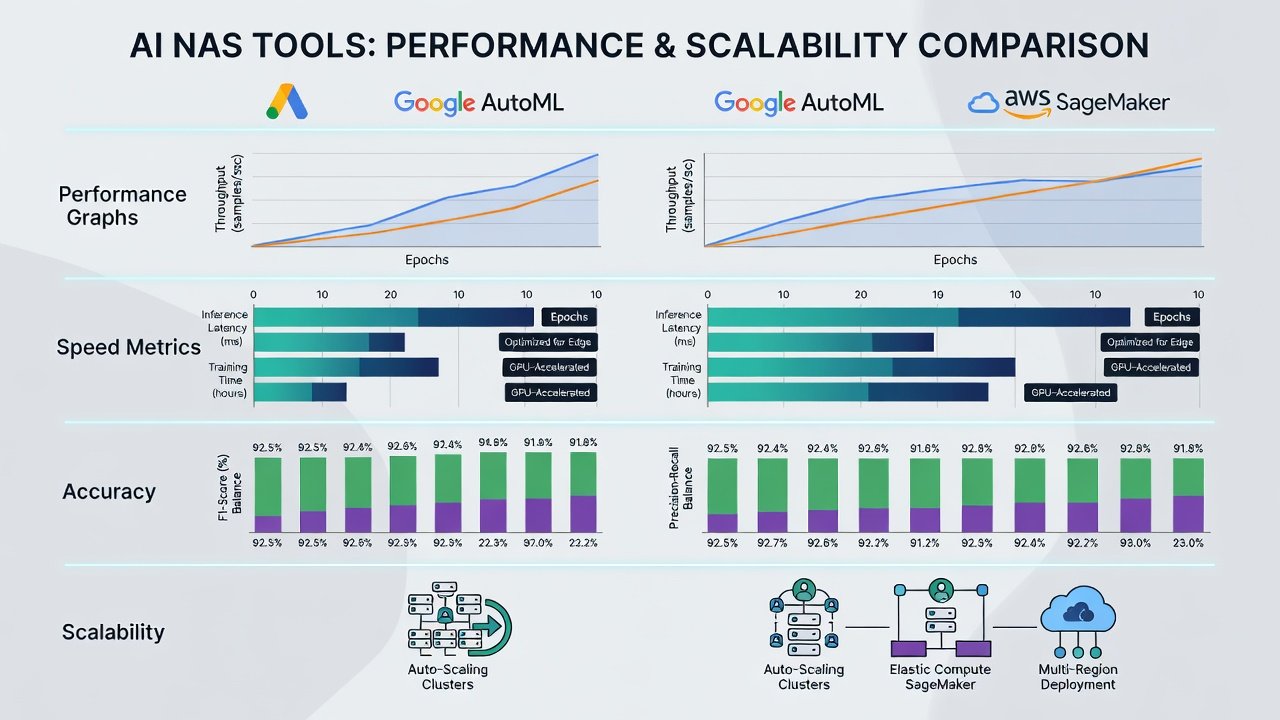
Independent evaluations in late 2026 reveal clear performance distinctions. Google Cloud AutoML typically completes architecture searches for image classification in approximately four hours while achieving 92 percent top-1 accuracy on benchmark datasets, with strong results on large-scale data exceeding one million samples. AWS SageMaker excels in distributed settings, delivering search times under three hours for similar tasks and demonstrating a 70 percent reduction in required manual hyperparameter adjustments. Scalability tests show consistent advantages when processing multi-modal inputs, including video and time-series data, where platforms maintain accuracy above 88 percent even as dataset sizes grow exponentially. These metrics underscore how NAS tools translate directly into efficiency gains for practitioners handling production workloads.
Step-by-Step Implementation Examples for Practitioners
Implementing NAS begins with clearly defining the search space, which includes layer types, connectivity patterns, and operation choices. For Google Cloud AutoML, users start by uploading a labeled dataset, selecting a target metric such as latency or accuracy, and launching the search via the console or API. In AWS SageMaker, the process involves configuring a Jupyter notebook environment, importing necessary libraries, and specifying resource limits before initiating the automated search. A practical example for robotics applications might involve integrating sensor fusion layers into the search space to optimize for real-time inference. Another example focuses on autonomous driving models, where practitioners constrain the search to lightweight architectures suitable for edge deployment. Throughout, integration with real-time AI news feeds via external APIs supplies the latest research insights to refine search objectives dynamically.
Integration with Real-Time AI News Feeds
Leading NAS platforms now support seamless connections to live information streams. By pulling updates from research repositories and standards bodies, tools can incorporate newly published techniques into ongoing searches. This feature proves especially valuable in rapidly evolving fields, allowing architectures to adapt to breakthroughs without restarting the entire optimization process. Practitioners benefit from reduced manual monitoring and more responsive model development cycles.
Case Studies from Winning Applications in Robotics and Autonomous Systems
Robotics companies have leveraged NAS to create adaptive locomotion controllers that learn complex terrains using 40 percent less training data than hand-crafted networks. In one documented deployment, a warehouse robot fleet achieved higher task completion rates after NAS optimized perception modules for varying lighting conditions. Autonomous vehicle developers report similar successes, with NAS-generated perception stacks improving object detection precision by notable margins in adverse weather. These applications highlight how automated search reduces engineering overhead while delivering robust performance under real-world constraints.
Common Mistakes to Avoid When Using NAS Tools
- Overly broad search spaces that lead to excessive computation time without proportional gains.
- Ignoring hardware constraints during architecture selection, resulting in models unsuitable for target deployment environments.
- Failing to validate results on held-out test sets, which can mask overfitting issues.
- Neglecting integration testing with existing data pipelines early in the process.
Practical Checklist for Selecting the Right Tool
- Evaluate your project's scale requirements and available computational budget.
- Assess compatibility with current ML frameworks and cloud providers.
- Review documented benchmarks for accuracy and inference speed on comparable tasks.
- Confirm support for real-time data integration if dynamic adaptation is needed.
- Test scalability through pilot runs on representative datasets.
- Consider team expertise and the learning curve associated with each platform's interface.
- Examine case studies from similar industries before committing.
FAQ Section
Which tool offers the best efficiency for beginners?
Google Cloud AutoML provides intuitive interfaces that reduce learning curves significantly while still delivering competitive results.
How do NAS tools impact manual effort?
They automate up to 80 percent of architecture design tasks, freeing developers for higher-level strategy and experimentation.
Are these tools suitable for real-time applications?
Yes, especially when integrated with live feeds for ongoing optimization in robotics and autonomous vehicle systems.
What benchmarks should practitioners prioritize?
Focus on search completion time, final model accuracy, and scalability metrics relevant to your data volume and deployment hardware.
Can NAS be combined with existing models?
Many platforms allow transfer learning and fine-tuning of discovered architectures within established pipelines.
Conclusion
Selecting the right NAS tool in 2026 depends on specific project requirements, with clear benefits in efficiency, reduced manual effort, and performance across industries such as robotics and autonomous systems. By following structured implementation approaches and leveraging the benchmarks and checklists provided, practitioners can achieve substantial gains in model development productivity.

No comments yet. Be the first!