 NeoBit Daily

Introduction: The AI-Driven Shift in Autonomous Vehicles
In 2026, autonomous vehicles are no longer experimental concepts but rapidly maturing systems powered by advanced machine learning. Emerging AI tools are transforming how these vehicles process real-time data, predict behaviors, and ensure safety on public roads. This article examines the latest developments, offering practical insights for engineers, automakers, and tech enthusiasts focused on real-time object detection, sensor fusion, and predictive modeling. Traditional ML approaches often struggled with latency and scalability in dynamic environments. Today, specialized AI platforms enable faster training cycles and more accurate inferences, directly addressing challenges in safer autonomous systems. The integration of generative models and edge computing has allowed fleets to adapt in real time, reducing the gap between simulation and on-road performance. Readers will find detailed comparisons, real-world case studies from leading manufacturers, and actionable integration steps that go beyond surface-level overviews.
Real-Time Object Detection: From Pixels to Predictions
Object detection remains the cornerstone of autonomous driving. Modern AI tools leverage convolutional neural networks enhanced with transformer architectures to identify pedestrians, vehicles, and obstacles with sub-millisecond latency. For instance, tools like NVIDIA's CUDA-accelerated frameworks allow models to process high-resolution camera feeds in real time, outperforming legacy OpenCV-based methods by up to 40% in accuracy under varying weather conditions. Additional layers such as attention mechanisms help prioritize critical elements like sudden lane changes or occluded cyclists. Engineers can integrate these by starting with pre-trained models from repositories and fine-tuning on proprietary datasets collected from diverse climates and traffic densities. Practical examples include deploying YOLO variants optimized for automotive hardware, which maintain high frame rates even on embedded systems. This depth ensures detection remains reliable during night driving or heavy rain, scenarios where older algorithms frequently failed.
Sensor Fusion Techniques Enhanced by AI
Sensor fusion combines data from multiple sources for a unified environmental model. AI tools now employ graph neural networks to weigh sensor reliability dynamically. Compared to rule-based legacy fusion, these methods adapt to sensor degradation, improving robustness. A practical example comes from Tesla's integration of vision-only systems refined with AI optimization, though many manufacturers still rely on hybrid setups. Step-by-step integration begins with data synchronization pipelines, followed by model training on fused datasets that include temporal alignment across LiDAR point clouds and radar returns. Advanced techniques incorporate uncertainty estimation so the system can discount noisy inputs automatically. This results in smoother trajectory planning and fewer unnecessary emergency stops. 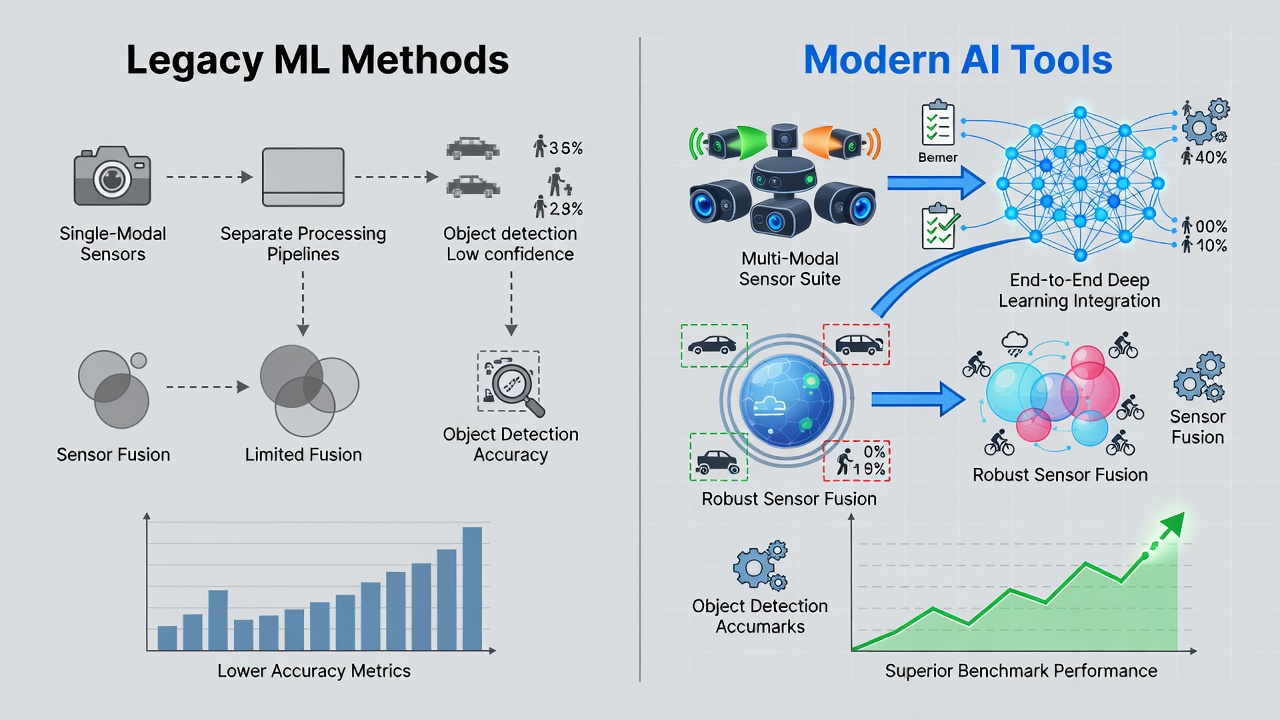
Predictive Modeling for Proactive Safety
Predictive modeling anticipates actions of other road users. AI tools utilizing recurrent networks and reinforcement learning simulate scenarios millions of times faster than real-time. Benchmarks from 2026 show these models achieving 95%+ accuracy in urban intersections when trained on diverse global datasets. Legacy statistical models often failed in edge cases; AI-driven approaches excel by learning from vast simulation data generated in virtual environments that replicate rare events such as construction zones or emergency vehicle approaches. Engineers benefit from tools that allow continuous online learning, updating models as new driving data arrives without full retraining cycles.
AI Tools vs. Legacy Methods: A Direct Comparison
- Speed: New AI frameworks deliver inferences in under 10ms versus 50ms+ for older pipelines.
- Accuracy: Transformer-based detection improves recall rates significantly in low-light scenarios.
- Scalability: Cloud-edge hybrid tools allow fleet-wide updates, unlike static legacy deployments.
- Cost Efficiency: Reduced compute needs lower operational overhead over time while supporting larger model sizes.
- Adaptability: Modern platforms handle concept drift through automated retraining triggers, a feature absent in most legacy codebases.
- Integration Flexibility: API-first designs enable quicker incorporation with existing vehicle control units.
Case Studies from Major Automakers
Waymo's deployment in multiple cities demonstrates AI-optimized ML pipelines handling complex traffic with minimal interventions. Similarly, Mercedes-Benz reports enhanced predictive capabilities through partnerships with AI specialists. These examples highlight integration of tools that support regulatory compliance and continuous learning. GM's Cruise division has utilized similar frameworks to expand operations in challenging weather markets, achieving measurable reductions in disengagement rates. Each case underscores the value of combining proprietary data with open AI ecosystems for faster iteration.
Step-by-Step Guide to Integrating AI into ML Pipelines
- Assess current sensor architecture and identify bottlenecks through detailed logging of latency and error rates.
- Select compatible AI tools supporting your hardware, such as those from established GPU providers, and validate compatibility with existing CAN bus systems.
- Preprocess data streams for compatibility with fusion models, including normalization and timestamp synchronization across all inputs.
- Train and validate using simulation environments before real-world testing, incorporating adversarial examples to stress-test robustness.
- Deploy with monitoring for drift and retrain iteratively, setting up automated alerts when performance metrics drop below thresholds.
- Ensure compliance with safety standards throughout by documenting every model version and decision logic for audit purposes.
Performance Benchmarks and Expert Insights
Recent evaluations indicate AI-enhanced systems reduce collision risks substantially. Experts note that the convergence of generative AI with perception models marks a pivotal leap for 2026 deployments. Performance metrics emphasize reliability across diverse geographies, with particular gains observed in highway merging scenarios and pedestrian-dense urban cores. Additional benchmarks reveal improvements in energy efficiency, allowing longer operational hours between charges for electric autonomous fleets.
Common Pitfalls and How to Avoid Them
Teams frequently underestimate data labeling requirements, leading to biased models. Mitigation involves using synthetic data augmentation early in the pipeline. Another pitfall is neglecting edge-case testing; comprehensive scenario libraries should be built before deployment. Over-reliance on single sensor modalities can be avoided by enforcing multi-modal validation at every checkpoint.
Regulatory Considerations for 2026 Deployments
Navigating evolving regulations requires close attention to standards from bodies like the NHTSA. Documentation of AI decision processes and explainability features are increasingly mandated. International alignment with frameworks from SAE International helps streamline cross-border testing. Companies that embed compliance checks into their CI/CD pipelines report smoother approval cycles.
FAQ: Addressing Deployment Challenges and Regulations
What are common deployment hurdles? Data privacy, computational demands, and integration with legacy hardware top the list, often compounded by the need for extensive real-world validation miles.
How do regulations impact AI tool adoption? Bodies like the NHTSA require rigorous validation; always align pipelines with evolving standards to avoid costly redesigns later.
Can small teams adopt these tools? Yes, open-source options lower barriers while maintaining performance, though they benefit from cloud-based scaling services for heavy training workloads.
What about cybersecurity in fused systems? Implement layered encryption and anomaly detection as standard practice, alongside regular penetration testing of the perception stack.
How long does full integration typically take? Most mid-sized teams report six to twelve months from initial assessment to production rollout when following structured guides.
Conclusion: Preparing for the Road Ahead
As 2026 progresses, AI tools continue to redefine ML capabilities in autonomous vehicles. By focusing on practical integration and staying informed via sources like NVIDIA and SAE International, stakeholders can build safer, more efficient systems. The future belongs to those who adapt these technologies thoughtfully and proactively address both technical and regulatory dimensions.

No comments yet. Be the first!