 NeoBit Daily

Introduction: Turning 2026 AI Headlines into Actionable ML Experiments
Artificial intelligence continues to evolve at a rapid pace in 2026, creating both opportunities and challenges for machine learning practitioners. The key to staying ahead lies in systematically analyzing AI news to uncover genuine advancements rather than fleeting hype. This guide provides a complete workflow for curating news, identifying testable hypotheses, and integrating insights into custom experiments using modern AI tools. Search intent around this topic centers on practical, step-by-step methods that deliver real results. Practitioners want to know how to separate signal from noise and translate announcements into working prototypes that can be tested and iterated upon quickly.
By the end of this article you will have a repeatable process that turns daily AI updates into a steady stream of experiment ideas. The approach works whether you are an independent researcher or part of a larger team managing multiple projects simultaneously.
Step-by-Step Workflow for Curating AI News
Effective news curation begins with reliable sources and structured filtering. Follow this repeatable process to build a daily or weekly pipeline that scales with your available time:
- Subscribe to authoritative feeds including arXiv preprints, major research blogs, and conference proceedings summaries.
- Use keyword alerts for terms like "transformer efficiency" or "multimodal reasoning" while excluding marketing-heavy phrases such as "revolutionary breakthrough" unless backed by data.
- Tag items by potential experiment value: high, medium, or low based on reproducibility signals such as code availability and benchmark tables.
- Schedule weekly review sessions to cluster related stories and eliminate duplicates.
- Archive promising items in a shared repository with notes on possible datasets and compute requirements.
This structured approach prevents information overload while surfacing the most promising leads for deeper analysis.
Filtering Hype Versus Real Advancements
Not every breakthrough announcement holds up under scrutiny. Real advancements typically include open-source code releases, detailed benchmarks against established baselines, and peer-reviewed validation. In contrast, hype often relies on vague performance claims without datasets, ablation studies, or independent verification.
Apply a simple verification checklist before investing time: Does the claim reference a specific paper with DOI? Are metrics compared against established baselines on public datasets? Has the work been reproduced by independent teams within the first 30 days of release? These questions quickly eliminate overstated marketing claims that lack substance.
Identifying Testable Hypotheses from Breakthroughs
Once you isolate credible news, convert findings into hypotheses that can be tested with modest resources. For example, a report on improved attention mechanisms might lead to the hypothesis that a modified self-attention layer will reduce training time by at least 15 percent on sequence tasks without accuracy loss. Another example could involve a new regularization technique shown to improve generalization on vision tasks; the hypothesis would specify the expected improvement margin on a standard benchmark like ImageNet.
Document each hypothesis with clear success criteria, required datasets, evaluation metrics, and an estimated timeline. This documentation becomes the foundation for your experiment design and helps prioritize which ideas to pursue first.
Practical Example: From News Item to Working Prototype
Consider a 2026 announcement about a new efficient vision-language model. Start by locating the associated arXiv paper. Extract the core architectural change and implement a minimal version using TensorFlow. Run controlled experiments on a standard benchmark such as COCO, comparing against the original baseline while logging training time, memory usage, and accuracy metrics. 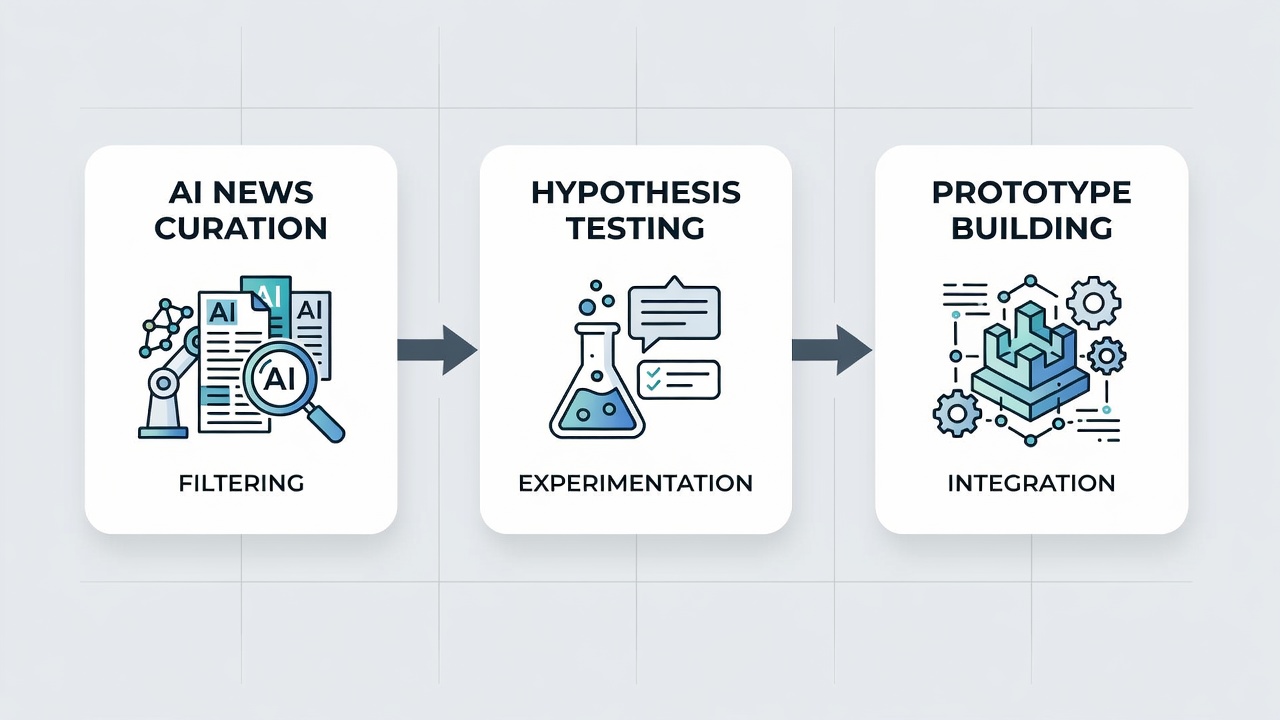
After the first successful run, extend the prototype by testing the model on a domain-specific dataset relevant to your work. Share the notebook internally so teammates can reproduce results and suggest further modifications. This process typically takes one to two days and yields a reusable artifact that can be extended or shared with the broader community.
Free Versus Paid Analysis Methods Compared
Free methods rely on open tools like RSS readers, public arXiv APIs, and community notebooks. They offer flexibility and zero monetary cost but require more manual effort for summarization, trend tracking, and duplicate removal. Practitioners using only free resources often spend additional hours each week organizing information.
Paid platforms provide automated summarization, trend dashboards, and priority alerts that surface relevant papers faster. They also include collaboration features useful for teams. Choose paid options when your experiment cadence is high or when you handle large volumes of daily publications. The decision ultimately depends on your experiment cadence, team size, and available resources rather than any single feature.
Integrating Findings into Custom ML Experiments
After validation, fold successful hypotheses into your ongoing projects. Maintain an experiment registry that links each prototype back to its source news item with timestamps and outcome notes. This traceability supports reproducibility and helps justify compute allocation to stakeholders when results look promising.
Iterate by combining multiple news-derived ideas into larger composite experiments when patterns emerge across several sources. Regular review of the registry reveals which types of news items consistently lead to valuable prototypes.
Recommended Tools and Platforms for News Analysis
Several established platforms simplify the curation and analysis process. Public repositories such as Hugging Face provide model cards and reproducible notebooks that accelerate prototyping. Papers with Code offers leaderboards that make it easy to verify claimed improvements. Combining these resources with simple scripts for automated alerts creates a robust, mostly automated pipeline suitable for both individuals and teams.
Avoiding Common Pitfalls in AI News Analysis
Many practitioners fall into predictable traps. Over-reliance on social media summaries can lead to missing important technical details. Another common issue is failing to check for reproducibility signals before investing significant time. Setting strict time limits per news item and maintaining a verification checklist helps avoid these problems while keeping the workflow sustainable over months and years.
Conclusion
Systematic analysis of 2026 AI news transforms passive reading into a strategic advantage. By following the workflows above, ML practitioners can consistently surface high-value opportunities and convert them into meaningful experiments that advance both personal projects and organizational goals.
FAQ
How do I avoid information overload when following AI news?
Set strict time limits and use tiered tagging to focus only on items that pass initial relevance filters. Review your subscription list quarterly and remove sources that rarely yield actionable leads.
What verification techniques work best for new model claims?
Always check for open code, independent reproductions, and detailed experimental setups published alongside the announcement. Cross-reference results on public leaderboards before proceeding to your own tests.
Can free tools compete with paid analysis platforms?
Yes, when combined with disciplined workflows and community resources such as Hugging Face model hubs and arXiv RSS feeds. Many independent researchers achieve strong results without paid subscriptions.
How long should I spend on each news item during curation?
Limit initial screening to five minutes per item. Only items that pass the verification checklist deserve deeper reading and hypothesis development.
What should I do when a promising paper lacks code?
Reach out to the authors politely or search for community re-implementations. If no code appears within two weeks, consider whether the paper still warrants manual re-implementation based on the claimed gains.

No comments yet. Be the first!