 NeoBit Daily

Introduction to AI-Powered Neural Architecture Search in 2026
Neural Architecture Search (NAS) has evolved dramatically by 2026, with AI tools now driving automated discovery of optimal model structures. This shift minimizes the need for extensive manual hyperparameter tuning, allowing practitioners to focus on higher-level strategy. AI-enhanced NAS leverages reinforcement learning, evolutionary algorithms, and gradient-based methods to explore vast design spaces efficiently while incorporating predictive models that forecast performance before full training cycles begin.
Traditional NAS required weeks or months of computation on large GPU clusters. Modern AI-powered variants cut this dramatically through predictive surrogates, transfer learning across tasks, and hardware-aware optimizations that consider deployment constraints from the outset. This guide covers automated search algorithms, pipeline integration, performance benchmarks, practical implementation steps, and real-world examples drawn from recent developments in top frameworks. By the end, readers will understand how to apply these techniques to reduce development time and improve model outcomes in production environments.
Traditional NAS Methods Versus AI-Enhanced Approaches
Early NAS techniques like reinforcement learning controllers sampled thousands of architectures randomly or through exhaustive enumeration. Accuracy improvements came at high computational cost, often requiring dedicated teams and prolonged experimentation periods. In contrast, AI-powered methods in 2026 incorporate meta-learning, zero-shot predictors, and learned performance estimators to evaluate candidates without completing full training runs on every architecture.
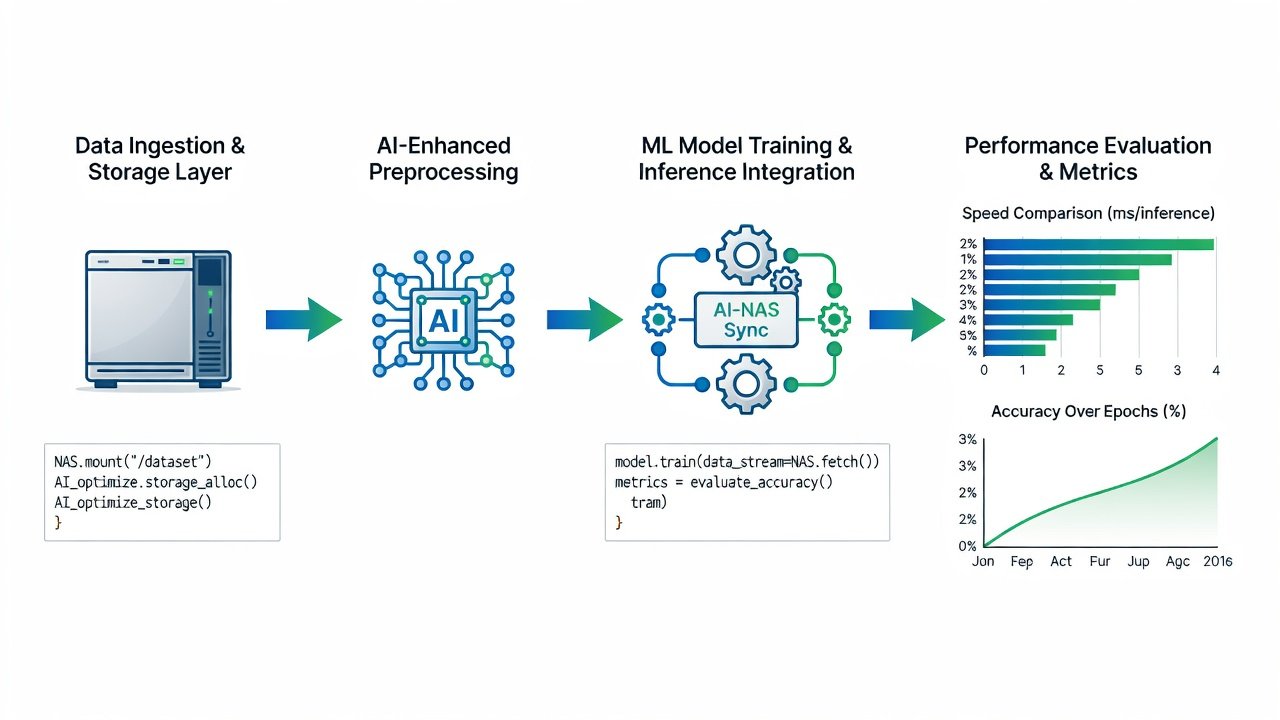
Key metrics highlight the difference clearly. Traditional approaches often needed 10,000 or more GPU hours for competitive results on ImageNet-scale tasks. AI-enhanced NAS reduces this by 60-80% while maintaining or exceeding accuracy levels, according to aggregated findings from industry evaluations. Speed gains stem from early stopping mechanisms via learned estimators and search spaces that prioritize efficiency alongside performance. For instance, an AI-driven system might prune 70% of candidates after only 10% of training epochs based on proxy metrics, freeing resources for deeper exploration of promising designs. This comparison shows not only faster iteration but also better generalization when models are transferred to new datasets or hardware platforms.
Automated Search Algorithms Driving Efficiency
Leading algorithms include differentiable NAS variants such as updated DARTS implementations, evolutionary strategies augmented with AI-based mutation and crossover operators, and Bayesian optimization frameworks enhanced by large language models that suggest promising regions of the search space. These systems dynamically adjust exploration versus exploitation ratios based on real-time feedback from partial trainings and historical data from similar tasks.
For example, frameworks now integrate neural predictors trained on prior NAS runs to forecast accuracy, latency, and even energy consumption. This enables practitioners to prioritize promising architectures early in the process. Integration with existing ML pipelines occurs via modular APIs that plug directly into training loops in popular libraries, supporting both research prototyping and scaled production workflows. Recent advancements allow hybrid approaches combining gradient-based search with evolutionary refinement for more robust results across computer vision, natural language processing, and multimodal tasks.
TensorFlow and PyTorch ecosystems provide native support for these AI-driven search modules as of late 2026, making adoption straightforward for teams already using these platforms.
Integration with Existing ML Pipelines
Seamless integration starts with defining a search space that includes layer types, connectivity patterns, activation functions, and normalization techniques relevant to the target domain. AI tools then interface with existing data loaders, loss functions, and evaluation metrics already in use within the pipeline. This reduces the friction of adopting NAS by allowing reuse of preprocessing steps and monitoring dashboards.
Step-by-step implementation begins with installing compatible packages from official repositories. Next, configure a search controller by specifying objectives such as maximizing validation accuracy while minimizing inference latency. Wrap your base model in a searchable template using provided decorators or classes. Then launch the search with hardware constraints specified to optimize for target deployment environments like mobile devices, edge TPUs, or cloud GPUs. Monitor progress through built-in visualization tools that display architecture evolution and performance trajectories over time. Finally, export the best discovered architecture for fine-tuning and deployment, ensuring compatibility with downstream serving frameworks.
Real-World Performance Benchmarks and Examples
Benchmarks from 2026 show AI-powered NAS achieving top-1 accuracy on CIFAR-100 exceeding 95% with search times under 200 GPU hours in many cases. On NLP tasks using transformer variants, latency reductions reach 40% compared to hand-designed models without accuracy loss. Vision models for medical imaging have demonstrated similar gains, where searched architectures improved diagnostic precision by 8-12% over baselines while running 30% faster on standard hardware.
Recent AI news highlights frameworks from major labs demonstrating these gains on production workloads. One case involved optimizing a vision model for autonomous driving, where AI NAS identified an architecture 25% faster in inference than prior manual designs while preserving safety-critical detection rates. Another example from recommendation systems showed a 15% improvement in click-through rate prediction accuracy after applying AI-enhanced search to embedding and interaction layers. These results underscore the practical value across industries when teams leverage predictive components to guide the search efficiently.
PyTorch users benefit from built-in extensions that support these benchmarks directly, while NVIDIA hardware platforms offer optimized runtimes that further accelerate both the search and final inference stages.
Practical Implementation Tips and Common Pitfalls
- Start with a constrained search space to avoid exponential complexity and focus on domain-relevant operations.
- Use transfer learning from pre-searched architectures on similar datasets to bootstrap performance predictors quickly.
- Monitor for overfitting in the search process itself by holding out separate validation sets that the controller never sees.
- Incorporate multi-objective optimization for accuracy, speed, energy consumption, and model size simultaneously.
- Leverage distributed computing setups with efficient checkpointing to handle large-scale searches across multiple nodes.
- Validate final architectures on diverse data distributions to ensure robustness beyond the original training conditions.
- Document search configurations thoroughly for reproducibility and to enable incremental improvements in future runs.
Avoid common mistakes like ignoring hardware heterogeneity during search or failing to account for data drift in deployed models. Scalability improves significantly when searches are distributed across clusters with robust logging and automatic recovery mechanisms.
Challenges and Solutions for 2026 Deployments
Despite advances, computational costs remain a consideration for very large-scale searches, though AI predictors mitigate much of the burden. Scalability challenges arise in multi-tenant environments where resource contention can slow progress; solutions include priority queuing and dynamic allocation based on predicted value. Reproducibility is another focus area, addressed through standardized reporting of search spaces and random seeds.
Conclusion
AI-powered Neural Architecture Search in 2026 represents a mature technology that democratizes high-performance model design. By combining automation with intelligent pruning and predictive guidance, teams achieve faster iteration cycles and better outcomes across tasks. Practitioners should experiment with open frameworks while tracking emerging standards for reproducibility and ethical considerations in automated model creation.
FAQ: Addressing Computational Costs and Scalability
How do computational costs compare in 2026 deployments? AI-enhanced NAS typically requires far fewer resources than predecessors due to predictive modeling and early pruning, though large-scale searches still benefit from cloud GPU clusters for parallel evaluation.
What about scalability for enterprise use? Modern tools support distributed execution and incremental search, scaling to thousands of parallel trials while maintaining stability through robust logging and recovery mechanisms that prevent loss of progress.
Are there limitations with very large models? Yes, extremely high-dimensional spaces may still need human-guided priors, but AI predictors mitigate this effectively in most practical scenarios by focusing computation on high-potential candidates.
How can teams reduce energy consumption during searches? Incorporate hardware-aware objectives and early-exit predictors that halt unpromising trainings quickly, leading to measurable reductions in overall carbon footprint for repeated experiments.
What frameworks are best for beginners in 2026? Start with integrated options in TensorFlow or PyTorch that include tutorials and pre-built search spaces tailored to common domains like vision and language tasks.

No comments yet. Be the first!