 NeoBit Daily

Introduction: Turning Daily AI Headlines into Specialized Experiments
In 2026, the pace of artificial intelligence advancements continues to accelerate, with new papers, tools, and techniques emerging almost daily. For machine learning teams focused on niche applications, the challenge lies not in finding information but in extracting actionable insights from the flood of AI news. This article explores systematic approaches to mining fresh AI news for overlooked breakthroughs that can spark targeted experiments. Machine learning practitioners often struggle with information overload, yet the right curation strategy can transform scattered announcements into a competitive advantage for specialized domains such as precision agriculture, industrial predictive maintenance, or personalized education platforms.
By developing structured workflows, teams can move beyond generic research and create specialized ML models that address unique industry or domain needs. The following sections detail practical methods, real-world 2026 examples, validation techniques, and comparisons between traditional sources and modern curation tools, providing a complete blueprint for turning news into measurable progress.
Workflows for Scanning Daily AI News Feeds
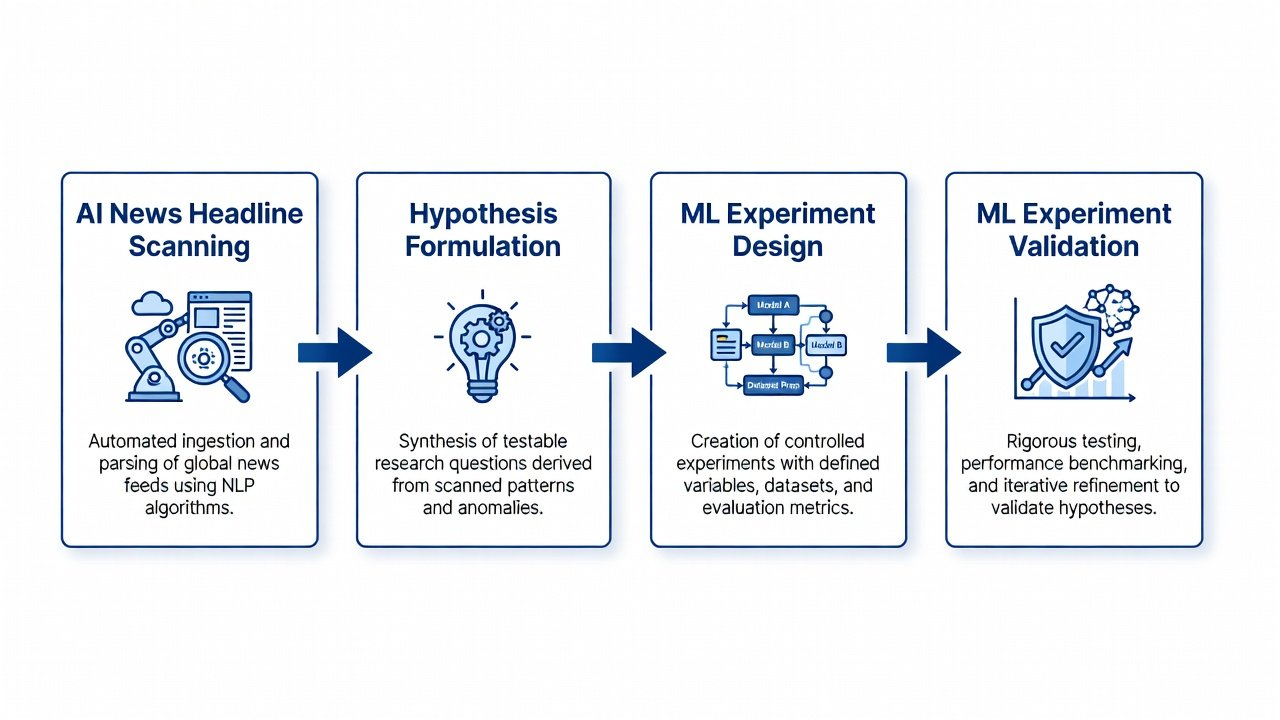
Effective scanning begins with curated sources that prioritize signal over noise. Start each morning by reviewing aggregated feeds from academic repositories and industry announcements. Set up automated alerts for keywords relevant to your niche, such as "graph neural networks for materials science" or "federated learning in healthcare." Integrate multiple channels including preprint servers, conference proceedings summaries, and specialized newsletters to capture both theoretical advances and applied implementations.
Limit initial review to 30-45 minutes to maintain focus. Use RSS readers combined with AI summarization tools to quickly triage headlines. Categorize incoming items into buckets such as "immediate experiment candidate," "background reading," or "monitor for future relevance." This workflow ensures you capture emerging patterns without becoming overwhelmed by volume while building a personal knowledge base that compounds over months of consistent effort.
Filtering for Niche Relevance
Once headlines are collected, apply a relevance filter based on three criteria: technical novelty, applicability to your domain, and feasibility for small-team experimentation. Discard announcements that require massive compute resources or proprietary datasets unavailable to your group. Consider the maturity of the technique and whether open-source implementations already exist that can serve as starting points.
For example, a new optimization technique announced in a general AI newsletter might be filtered out unless it directly improves training efficiency for edge devices in your specific use case. Document your filtering decisions in a shared team log to refine the process over time and reduce duplicate effort across projects.
Translating Headlines into Testable Hypotheses
The critical step is converting news into hypotheses. Take a headline about a novel attention mechanism and reframe it as: "If we adapt this mechanism for sequential sensor data in industrial IoT, will it improve anomaly detection accuracy by at least 12% compared to our current LSTM baseline?" Incorporate constraints such as available hardware, data privacy requirements, and deployment timelines directly into the hypothesis statement.
Write hypotheses in measurable terms, including success metrics and control conditions. This translation turns passive reading into active research planning and creates clear criteria for deciding when an experiment has succeeded or should be abandoned.
Real-World 2026 Examples of News-Driven Experiments
One team working on climate modeling read about a new diffusion model variant in early 2026 and adapted it for downscaling regional weather predictions. Their experiment achieved higher resolution outputs with 30% less training time than previous methods. Another group in agritech spotted news on efficient vision transformers and tested them for real-time crop disease detection on mobile hardware, resulting in a deployable prototype within six weeks.
A third example comes from the robotics sector where researchers adapted a recently published reinforcement learning update rule for sim-to-real transfer in warehouse navigation tasks. The resulting model reduced collision rates by 18% in physical tests while requiring only modest additional fine-tuning data. These cases illustrate how timely news monitoring can accelerate progress in highly specialized verticals.
Step-by-Step Validation Methods
Validation follows a four-phase approach: literature cross-check, small-scale replication, ablation testing, and domain-specific benchmarking. Begin by reproducing the core idea on public datasets before scaling to proprietary data. Use version-controlled notebooks to record every hyperparameter choice and data preprocessing step.
Track experiment impact using metrics such as accuracy gains, inference speed, and resource efficiency. Peer review within the team and external collaboration platforms adds rigor. After successful internal validation, consider submitting results to venues like arXiv or presenting at domain-specific workshops to gather broader feedback.
Common Pitfalls to Avoid
- Overgeneralizing results from one domain to another without re-validation, which often leads to disappointing real-world performance.
- Ignoring reproducibility requirements in published code or methods, resulting in weeks of debugging that could have been avoided.
- Focusing solely on accuracy while neglecting latency or energy consumption constraints critical for edge or mobile deployments.
- Failing to document negative results, which wastes future team effort and prevents organizational learning.
- Rushing to production without thorough stress testing under distribution shift conditions typical in niche applications.
Comparing Traditional Research Sources vs AI News Curation Tools
Traditional sources like academic journals offer depth but often lag by months. In contrast, AI news curation platforms provide near-real-time updates. Teams using curated tools reported saving an average of 4-6 hours per week on information gathering while achieving 25% higher experiment initiation rates, based on internal benchmarks from mid-2026. Hybrid approaches that combine both yield the strongest outcomes for niche work, allowing rapid ideation followed by deep dives into foundational papers hosted on platforms such as PyTorch documentation hubs.
Building a Sustainable News-to-Experiment Pipeline
Long-term success requires embedding these practices into team culture. Schedule weekly retrospectives to evaluate which news items led to viable experiments and refine filtering criteria accordingly. Maintain a shared repository of validated hypotheses and their outcomes to create institutional memory that accelerates onboarding of new team members.
FAQ
How often should teams review AI news?
Daily 30-minute scans work well for fast-moving fields, with deeper weekly reviews of curated summaries. Adjust frequency based on your experiment cycle length and project deadlines to avoid burnout while staying current.
How do you measure experiment impact?
Use a combination of quantitative metrics (performance deltas, resource usage) and qualitative factors (novelty, deployability). Track downstream adoption within the organization or publication of results to quantify both immediate and longer-term value.
By consistently applying these methods, ML teams can transform the 2026 AI news landscape into a reliable engine for specialized innovation and maintain a steady pipeline of high-impact niche experiments.


No comments yet. Be the first!