 NeoBit Daily

Introduction to AI Tools for Personalized Medicine in 2026
Personalized medicine is revolutionizing healthcare by using machine learning to create tailored treatment plans based on an individual’s unique genetic, environmental, and lifestyle factors. In 2026, AI tools are accelerating the development and deployment of these ML models, enabling real-time analysis of vast datasets. This comprehensive guide explores practical ways to integrate AI tools with machine learning workflows, covering patient data integration, predictive analytics, regulatory compliance, and more. ML teams can apply these insights immediately to improve patient outcomes while staying ahead of current artificial intelligence trends such as federated learning and explainable AI.
The demand for personalized approaches has grown as chronic diseases like cancer and diabetes require highly specific interventions. AI-driven tools help process multimodal data sources efficiently, reducing the time from data collection to actionable recommendations. Throughout this article, we provide step-by-step examples, tool comparisons, and real-world case studies from 2026 deployments to ensure teams have concrete guidance.
Patient Data Integration Strategies
Successful personalized medicine relies on robust integration of heterogeneous patient data. This includes electronic health records (EHRs), genomic sequences, imaging results, wearable sensor outputs, and social determinants of health. In 2026, leading AI platforms support secure, privacy-preserving methods like federated learning to combine insights across institutions without moving raw data.
To implement data integration, follow these practical steps: First, audit existing data sources and map them to a common ontology using standards such as FHIR. Second, apply cleaning and normalization pipelines with libraries like Apache Spark or TensorFlow Data. Third, perform feature engineering to create unified representations, such as embedding genomic variants alongside clinical notes via natural language processing models. Fourth, validate the integrated dataset for completeness and bias using statistical checks. An example workflow might involve ingesting real-time streams from patient wearables into a cloud-based ML pipeline, where edge computing nodes preprocess signals before central aggregation. Teams should also incorporate real-time AI news feeds to stay updated on emerging data standards and integration best practices.
Predictive Analytics for Treatment Plans
Predictive analytics forms the core of ML applications in personalized medicine. Models forecast treatment responses, disease progression, and potential adverse events by analyzing biomarkers, historical outcomes, and population-level trends. Advanced techniques in 2026 include transformer-based architectures for multimodal fusion and reinforcement learning for dynamic treatment optimization.
Consider a step-by-step implementation: Begin by selecting relevant features from integrated datasets. Train an initial model using supervised learning on labeled outcome data, then fine-tune with reinforcement learning loops that simulate patient trajectories. Deploy the model in a shadow mode for validation before live use. For oncology, a predictive model might recommend immunotherapy combinations based on tumor genomics and prior response rates. Comparisons of leading tools reveal distinct strengths: Google Cloud Healthcare API excels at scalable real-time analytics and seamless EHR connectivity, while IBM Watson Health offers robust genomic integration modules. NVIDIA Clara provides GPU-accelerated imaging analysis, and open-source options like scikit-learn combined with Hugging Face transformers allow cost-effective customization for smaller teams. Each tool should be evaluated against criteria such as ease of regulatory documentation, scalability, and support for explainability features.
Regulatory Compliance Tips
Navigating regulations is essential for deploying AI in healthcare. Key frameworks include FDA guidelines on software as a medical device (SaMD), HIPAA for data protection in the US, and GDPR in Europe. In 2026, emphasis has increased on algorithmic transparency and bias mitigation to prevent discriminatory outcomes.
Practical tips include embedding audit logging in every ML pipeline stage, conducting regular fairness assessments with tools like Fairlearn, and maintaining detailed model cards that document training data, performance metrics, and limitations. Teams must also ensure patient consent mechanisms are dynamic and revocable. Consult the FDA for the latest SaMD premarket submission requirements. Additional global health perspectives are available from the World Health Organization, which provides ethical AI frameworks applicable to personalized medicine.
Comparisons of Leading AI Tools
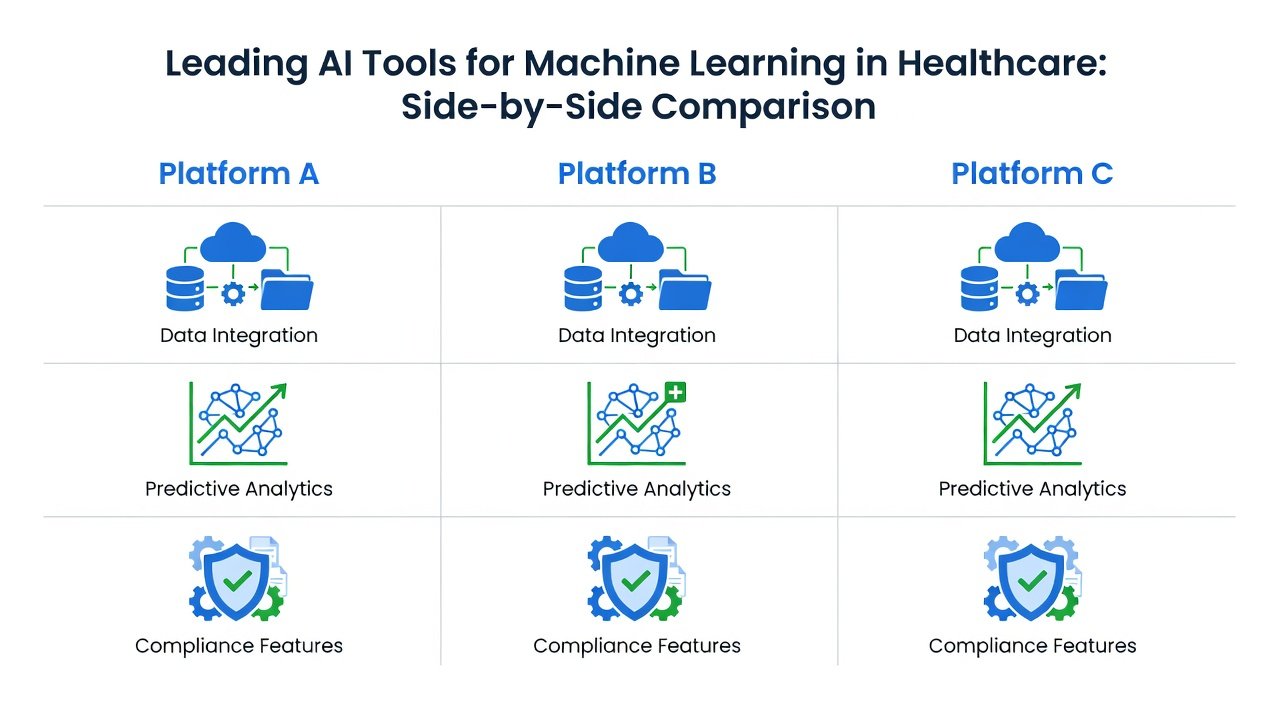
Choosing the right AI tool depends on team size, data volume, and specific use cases. Here is a detailed comparison:
- Google Cloud Healthcare API: Best for real-time predictive analytics and large-scale EHR integration; strong compliance tooling but may require significant configuration.
- IBM Watson Health: Superior for genomic and multi-omics data fusion with built-in clinical decision support; excels in regulated environments.
- NVIDIA Clara: Ideal for imaging-heavy applications and GPU-accelerated training; offers high performance for deep learning models.
- Open-source stacks (TensorFlow + Hugging Face): Flexible and budget-friendly for custom predictive models; requires more in-house expertise for compliance features.
Evaluate tools through proof-of-concept pilots that measure accuracy, latency, and documentation effort.
Case Studies from 2026 Deployments
Real deployments illustrate the impact of these technologies. A major US hospital network implemented an AI-enhanced ML system for diabetes management by integrating continuous glucose monitor data with genomic profiles. The result was a 25% reduction in hypoglycemic events through personalized insulin dosing recommendations generated daily. In Europe, an oncology consortium used predictive analytics across five centers to optimize immunotherapy selection, achieving higher response rates by combining tumor sequencing with real-world evidence. A third example from Asia involved a national health system deploying federated learning for cardiovascular risk prediction, allowing rural clinics to benefit from urban-trained models without sharing sensitive records.
Common Pitfalls and How to Avoid Them
Many teams encounter issues such as model overfitting on homogeneous datasets, inadequate handling of missing data, or insufficient attention to privacy during integration. To avoid these, always use diverse validation cohorts, implement robust imputation techniques, and adopt privacy-by-design principles from the outset. Another frequent mistake is neglecting ongoing monitoring after deployment; establish automated drift detection to retrain models when performance degrades.
FAQs on Data Privacy and Model Accuracy
How do AI tools protect patient data in 2026 deployments? Modern platforms employ differential privacy, homomorphic encryption, and federated architectures to minimize exposure while enabling collaborative learning.
What practices ensure high model accuracy? Continuous retraining on fresh, representative data combined with external validation sets and ensemble methods significantly boosts reliability.
Are there specific standards for explainability? Yes, regulatory bodies increasingly require SHAP or LIME explanations alongside predictions; refer to technical documentation practices at MDN Web Docs for structuring related data outputs.
How should teams handle bias in training data? Conduct stratified sampling and apply bias detection algorithms during preprocessing to maintain equitable performance across demographics.
Conclusion
AI tools for personalized medicine ML in 2026 offer powerful capabilities when implemented thoughtfully. By focusing on integrated data strategies, robust predictive models, and strict compliance, ML teams can deliver immediate value while preparing for future advancements in artificial intelligence.


No comments yet. Be the first!