 NeoBit Daily

Introduction to 6G: The Next Wireless Revolution
The telecommunications world is buzzing with anticipation for 6G, the successor to 5G set for initial global launches in 2026. Promising terabit-per-second speeds and microsecond latency, 6G isn't just an upgrade—it's a transformation. This article compares 6G to 5G, explores real-world applications in augmented reality (AR), autonomous vehicles, and smart cities, spotlights major players like Ericsson and Huawei, discusses regulatory challenges, and offers preparation tips for businesses.
6G Timeline: Global Launches in 2026
While 5G rolled out commercially around 2019, 6G development accelerated post-2020. Standardization efforts by the International Telecommunication Union (ITU) aim for completion by 2026, with early deployments in tech-forward nations like China, South Korea, Japan, and parts of Europe and the US. Huawei and Ericsson lead trials, with China targeting nationwide coverage by 2030. Expect pilot networks in 2026, full commercial viability by 2028-2030.
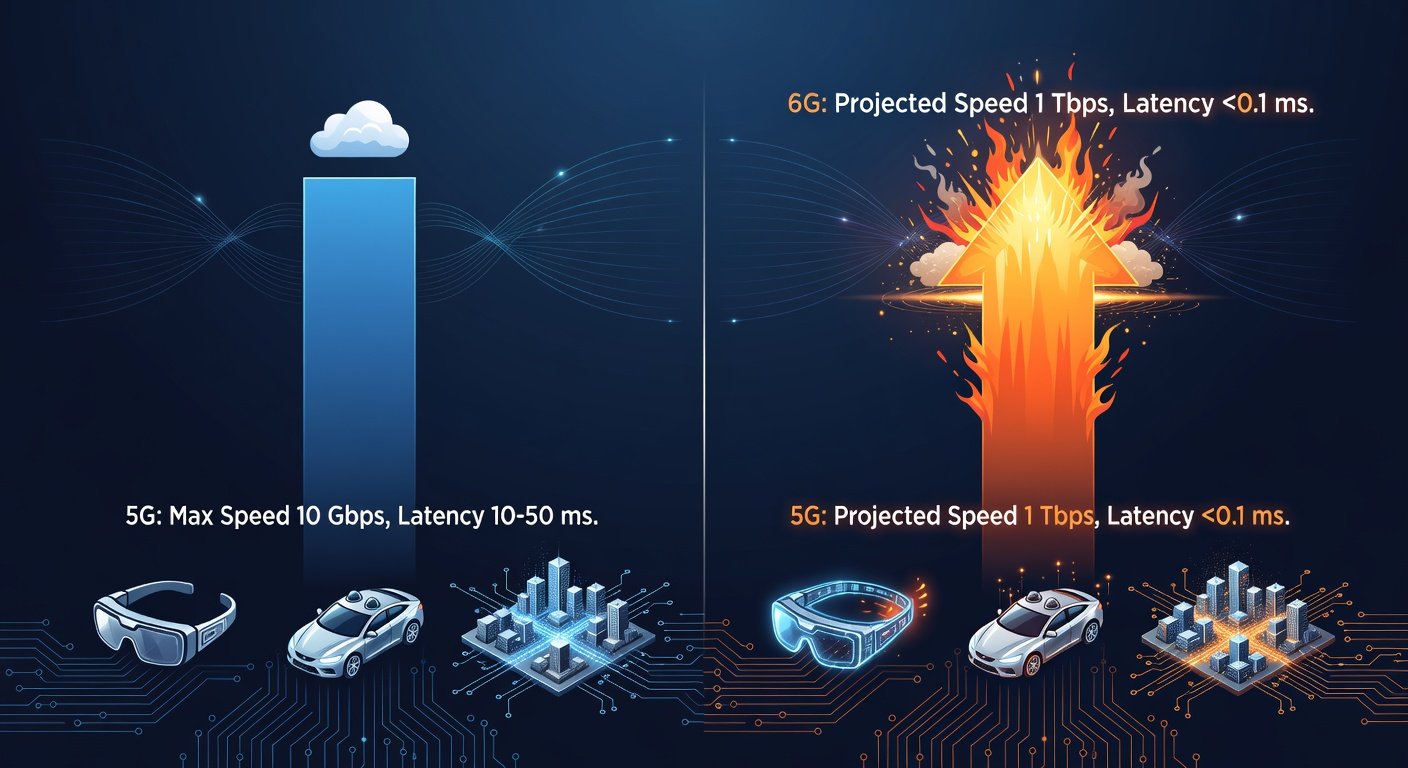
Speed and Latency: How 6G Crushes 5G
5G revolutionized connectivity with peak speeds up to 20 Gbps and latency around 1-10 ms. But 6G takes it further:
- Speed: 5G averages 100-500 Mbps real-world; 6G targets 1 Tbps (1000 Gbps)—up to 100x faster, enabling instant 8K video streaming for millions.
- Latency: 5G's 1 ms is impressive; 6G aims for sub-1 ms (0.1 ms), crucial for real-time interactions.
- Capacity & Efficiency: 6G supports 10 million devices per km² vs 5G's 1 million, using AI-driven spectrum management.
Here's a quick comparison table:
| Metric | 5G | 6G |
|---|---|---|
| Peak Speed | 20 Gbps | 1 Tbps |
| Latency | 1 ms | 0.1 ms |
| Device Density | 1M/km² | 10M/km² |
These specs stem from 6G's use of terahertz frequencies, advanced MIMO, and AI optimization. For more on standards, check the ITU website.
Real-World Applications: AR, Autonomous Vehicles, and Smart Cities
Augmented Reality (AR)
6G's ultra-low latency powers immersive AR experiences. Imagine holographic meetings where participants interact in real-time 3D spaces, or remote surgery with zero lag. Unlike 5G's occasional buffering, 6G enables seamless AR overlays in gaming, education, and retail—think virtual try-ons processing petabytes instantly.
Autonomous Vehicles
Self-driving cars demand split-second decisions. 5G supports Level 3 autonomy; 6G unlocks Level 5 with vehicle-to-everything (V2X) communication at Tbps speeds. Fleets could share sensor data city-wide, predicting hazards before they occur. Ericsson's trials demonstrate this potential.
Smart Cities
6G integrates IoT at scale for traffic optimization, energy grids, and public safety. Drones monitor infrastructure in real-time, predictive maintenance cuts downtime by 90%, and AI oracles manage resources dynamically. Huawei's smart city pilots in Shenzhen showcase energy savings via 6G edge computing.
Major Players: Ericsson and Huawei Lead the Charge
Ericsson, a Swedish giant, invests billions in 6G R&D, partnering with universities for terahertz tech. Their vision includes sustainable networks with AI for spectrum sharing. Visit Ericsson's site for updates.
Huawei, despite geopolitical tensions, dominates with massive 6G patents. China's backing accelerates their progress, focusing on AI-native networks. See Huawei's page for innovations.
Other contenders include Nokia, Samsung, and Qualcomm, but Ericsson and Huawei set the pace.
Regulatory Hurdles Slowing 6G Rollout
Spectrum allocation poses the biggest challenge. Terahertz bands require global harmonization, complicated by US-China trade wars. The FCC in the US and EU bodies demand security audits, delaying auctions. Privacy concerns with AI-driven networks add scrutiny—expect standards from ITU to address these by 2026.
Preparation Tips for Businesses
To thrive in the 6G era:
- Upgrade Infrastructure: Invest in 5G now for hybrid transitions; test edge computing.
- Skill Up: Train teams in AI, terahertz tech via certifications.
- Partner Strategically: Collaborate with Ericsson/Huawei for pilots.
- Security First: Implement quantum-resistant encryption.
- Pilot Applications: Start AR/V2X proofs-of-concept.
Businesses ignoring 6G risk obsolescence—early adopters gain first-mover advantage.
Conclusion: 6G's Dawn in 2026
2026 marks 6G's commercial dawn, dwarfing 5G with unprecedented performance. From AR holograms to fully autonomous ecosystems, its applications reshape society. While regulations loom, players like Ericsson and Huawei pave the way. Businesses: prepare now to harness this wireless frontier.


No comments yet. Be the first!