 NeoBit Daily

Introduction: The 2026 Privacy Shift in Enterprise Data
As regulations tighten globally, 2026 tech news highlights privacy-enhancing technologies (PETs) that are fundamentally reshaping how enterprises manage sensitive data. Organizations now prioritize tools that enable analysis without exposing raw information, reducing breach risks while maintaining compliance. This shift is driven by stricter enforcement of frameworks such as GDPR expansions and emerging U.S. state laws, pushing companies to adopt technologies that protect data at every stage of processing.
Leading firms are deploying differential privacy and homomorphic encryption in production environments, yielding measurable gains in regulatory adherence and operational security. These tools allow businesses to derive value from data collaborations and cloud analytics without compromising individual privacy. This article examines real-world deployments, solution comparisons, and integration pathways drawn from recent industry updates, providing actionable insights for technology leaders and compliance teams seeking to future-proof their data strategies.
Differential Privacy in Action: Case Studies and Technical Details
Differential privacy adds controlled noise to datasets, allowing aggregate insights without identifying individuals. In 2026, companies in healthcare and finance are adopting it to meet standards from bodies like the National Institute of Standards and Technology. The core mechanism involves injecting mathematical noise calibrated by a privacy budget parameter known as epsilon, which quantifies the trade-off between accuracy and protection.
One major hospital network implemented differential privacy for patient outcome analytics. By applying epsilon values calibrated to their risk tolerance, they shared research data with external partners while preventing re-identification. The result was faster collaborative studies and reduced legal exposure. Analysts could run queries on treatment efficacy across thousands of records, with noise ensuring no single patient's data could be reverse-engineered even if combined with public datasets.
Another example comes from a global bank that integrated differential privacy into fraud detection models. Analysts could query transaction patterns across regions without accessing individual records, improving detection rates by 18% while satisfying audit requirements. This approach also extended to marketing teams that analyzed customer segmentation trends without risking exposure of personal identifiers, demonstrating how the technology scales across departments.
Homomorphic Encryption Deployments and Real-World Applications
Homomorphic encryption permits computations on encrypted data, returning encrypted results that only the data owner can decrypt. This technology is gaining traction in cloud-heavy enterprises seeking to outsource processing without surrendering control. Fully homomorphic encryption schemes, though computationally intensive, have seen performance improvements through optimized libraries that leverage modern hardware accelerators.
A logistics firm recently piloted homomorphic encryption for route optimization using third-party algorithms. Encrypted shipment data was processed externally, and the decrypted recommendations improved efficiency without exposing proprietary details. Similar approaches appear in pharmaceutical research collaborations where multiple companies jointly analyze trial results while keeping compound structures confidential throughout the computation phase.
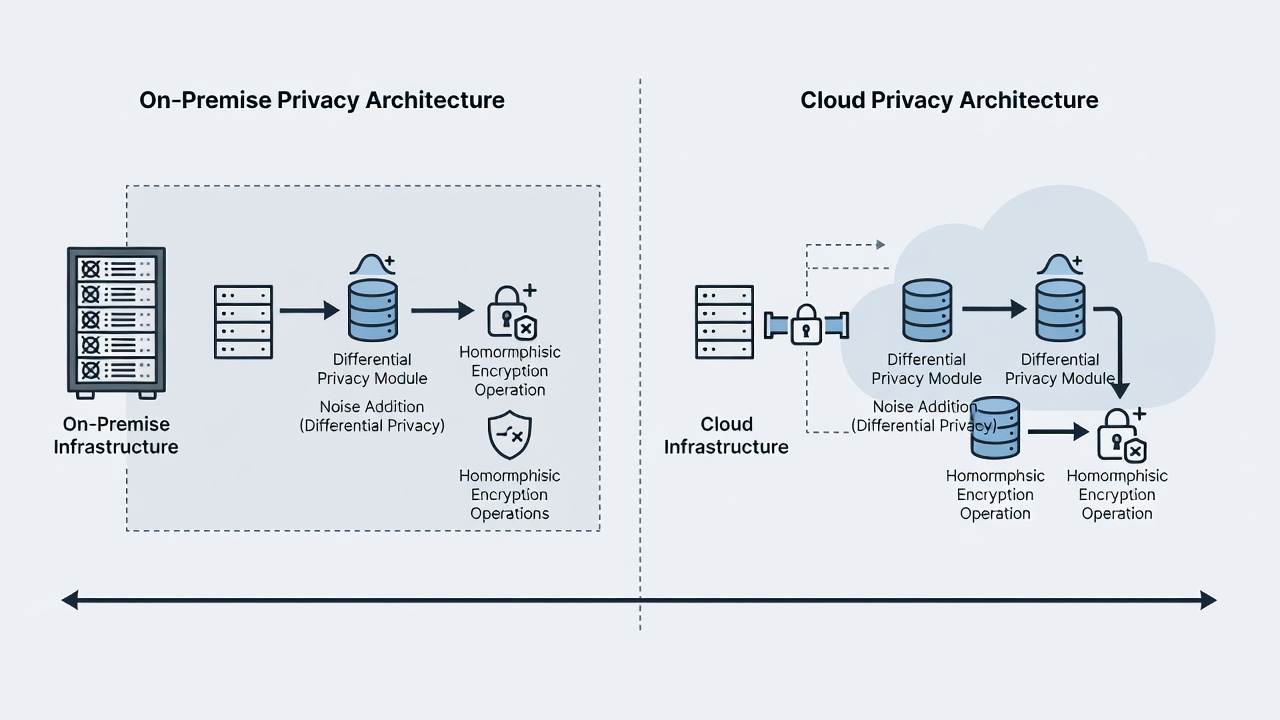
Additional deployments include insurance providers using homomorphic encryption to evaluate risk models across shared industry datasets. By encrypting policyholder information before sending it for external analysis, these firms maintain compliance with data minimization principles while gaining broader statistical insights that refine their underwriting processes.
On-Premise Versus Cloud Privacy Solutions: Detailed Comparison
Choosing between on-premise and cloud deployments depends on control needs, scalability, and regulatory jurisdiction. On-premise setups offer direct hardware oversight but require significant internal expertise. Cloud options provide elasticity and managed services, often with built-in PET support from providers.
- On-Premise Advantages: Full data sovereignty, customizable encryption layers, and avoidance of multi-tenant risks. Organizations retain complete control over key management and can implement air-gapped systems for the most sensitive workloads.
- Cloud Advantages: Rapid scaling, access to specialized PET toolkits, and reduced maintenance overhead. Providers increasingly offer native integration with privacy libraries, enabling faster experimentation and deployment cycles.
- Hybrid Models: Many 2026 adopters combine both, keeping core keys on-premise while leveraging cloud compute for encrypted workloads. This balanced approach supports global operations where data residency rules vary by country.
Decision frameworks from sources such as NIST help organizations evaluate these trade-offs based on data sensitivity and threat models. Additional guidance is available from Electronic Frontier Foundation on best practices for selecting architectures that align with long-term privacy goals.
Step-by-Step Integration Examples from Leading Firms
Leading firms follow structured rollouts that minimize disruption. A technology company began with a data inventory audit, then selected differential privacy libraries compatible with existing analytics stacks. They conducted pilot tests on non-critical datasets, iteratively refined noise parameters, and expanded to production after third-party audits. Key steps included mapping data flows, training staff on parameter selection, and establishing monitoring dashboards to track utility loss versus privacy gains.
For homomorphic encryption, another enterprise started by identifying workloads suitable for encrypted computation, such as statistical modeling. They integrated open-source libraries, trained data scientists on key management, and phased in encrypted queries over six months. Documentation from IEEE provided foundational guidance on implementation pitfalls, including performance benchmarking and fallback strategies for high-latency operations.
Regulatory Landscape and Compliance Gains in 2026
The 2026 regulatory environment emphasizes proactive privacy measures, with audits increasingly focusing on technical safeguards rather than policy documents alone. Enterprises adopting PETs report stronger audit outcomes and lower incident response costs. Differential privacy supports GDPR and CCPA reporting by design, while homomorphic encryption limits exposure during third-party processing. These tools also enhance customer trust by demonstrating proactive data stewardship and reducing the likelihood of high-profile breaches.
Common Mistakes to Avoid During Implementation
Organizations often underestimate the importance of pilot testing, leading to overly aggressive privacy budgets that degrade data utility. Another frequent error is neglecting staff training, which results in misconfigured tools that either leak information or render analytics unusable. Finally, failing to establish clear metrics for success can stall projects; teams should define success criteria such as acceptable accuracy thresholds and audit pass rates before full rollout.
FAQ: Implementation Hurdles
What are the main technical challenges?
Performance overhead remains significant with homomorphic encryption, though hardware acceleration is improving. Differential privacy requires careful parameter tuning to balance utility and privacy, often demanding iterative testing across multiple dataset types.
How do organizations measure success?
Key metrics include reduced breach impact, faster regulatory approvals, and maintained or improved analytical accuracy post-deployment. Regular third-party assessments help validate that privacy guarantees hold under real-world attack scenarios.
Are there skill gaps?
Yes. Teams often need training in cryptography and privacy engineering. External consultants or specialized platforms help bridge these gaps during initial phases, ensuring sustainable in-house capabilities over time.
Conclusion
Privacy tools are no longer experimental in 2026; they are strategic assets for enterprises navigating complex data landscapes. By studying proven case studies and following methodical integration paths, organizations can achieve compliance gains and meaningful risk reduction. Staying informed through authoritative channels ensures continued adaptation as technologies evolve and new regulatory expectations emerge.


No comments yet. Be the first!