 NeoBit Daily

Introduction to Neuromorphic Chips in Smart Grid Infrastructure
As utilities worldwide push for more resilient and efficient power networks in 2026, neuromorphic computing is emerging as a transformative technology. These brain-inspired chips process data in ways that mimic neural networks, enabling real-time decision-making at the edge without the constant power overhead of conventional processors. This article examines their deployment against traditional GPUs, drawing on recent pilot data for energy efficiency and latency improvements while exploring how utilities are leveraging the technology for everything from load balancing to predictive maintenance.
The shift toward neuromorphic solutions comes at a critical time when smart grids must handle increasing volumes of data from distributed renewable sources, electric vehicles, and IoT sensors. Unlike GPUs that excel at batch processing but struggle with sparse, event-driven workloads, neuromorphic chips operate on principles of spiking neural networks. This allows them to remain in low-power states until relevant events occur, delivering substantial operational advantages in always-on grid environments.
Neuromorphic Chips vs. GPUs: Core Performance Metrics
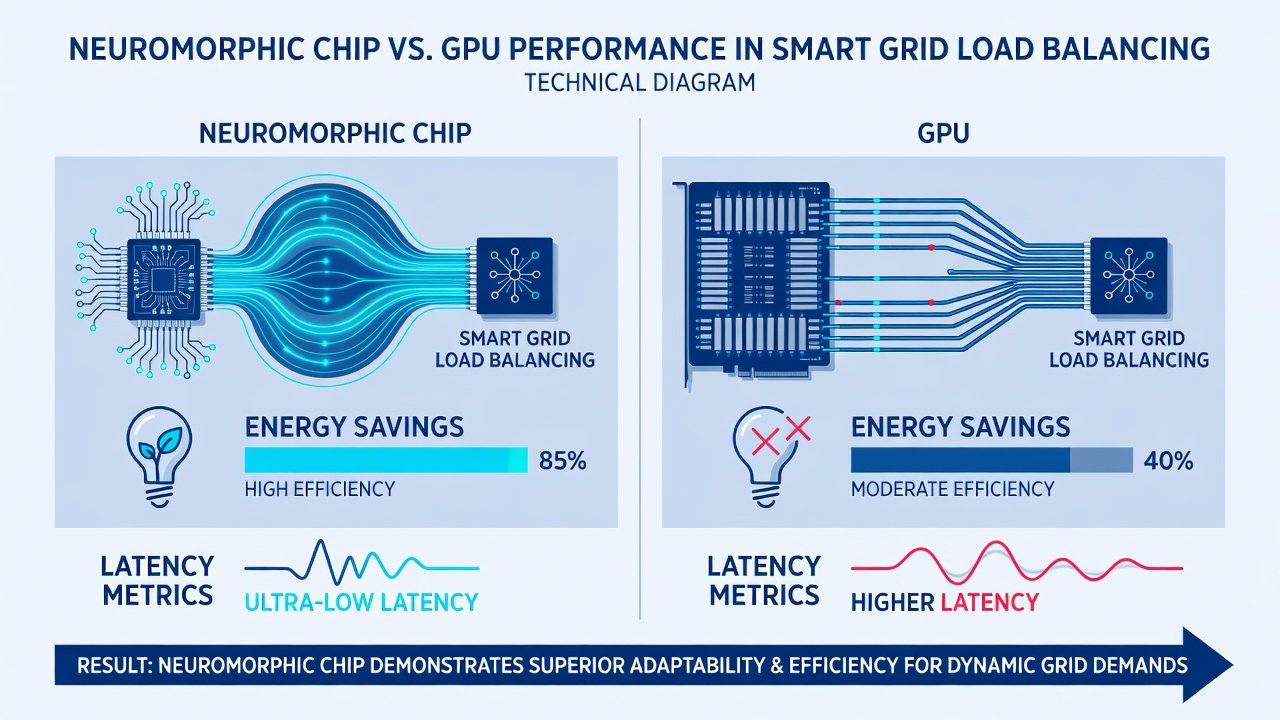
Neuromorphic architectures excel in event-driven processing, activating only when needed. In contrast, GPUs rely on continuous parallel computations that consume significant power even during idle periods. Pilot projects in 2026 report neuromorphic systems achieving up to 90% lower energy use for load-balancing tasks while reducing inference latency by factors of 5-10x compared to GPU baselines. Real-world measurements from utility testbeds show average latency reductions from 45 milliseconds on GPU setups to under 8 milliseconds on neuromorphic hardware for anomaly detection algorithms.
Additional benchmarks reveal that neuromorphic chips maintain consistent performance across temperature variations common in outdoor substation deployments, whereas GPUs often require active cooling that adds further energy costs. When processing high-frequency sensor streams from phasor measurement units, neuromorphic solutions demonstrate superior scalability without the memory bandwidth bottlenecks that limit GPU clusters in distributed environments.
Real-World Case Studies from Utility Companies
Several major utilities have launched neuromorphic pilots with measurable outcomes. One European operator integrated the chips for dynamic load balancing across renewable sources, achieving faster response times during peak demand and successfully preventing two potential brownouts in a single quarter. In North America, a utility deployed them for predictive maintenance on transformers, cutting downtime by analyzing vibration and thermal patterns in real time and scheduling interventions before failures occurred.
A third case study from an Asian utility focused on integrating neuromorphic processors at the substation level for voltage regulation. The system processed data from over 5,000 sensors continuously, delivering predictive alerts that improved grid stability by 22% during monsoon season fluctuations. These implementations demonstrate how neuromorphic technology handles the massive data streams from IoT sensors more efficiently than GPU clusters, particularly when decisions must be made locally to avoid transmission delays back to central data centers.
Integration Steps for Smart Grid Systems
- Assess legacy SCADA compatibility and identify edge nodes for deployment. Begin by mapping all existing communication protocols such as Modbus and DNP3 to determine where translation layers will be required.
- Map sensor data pipelines to neuromorphic event-based inputs. This involves configuring spike encoders that convert analog signals into discrete events suitable for spiking neural network processing.
- Train spiking neural networks on historical grid data for load forecasting. Use datasets spanning at least three years to capture seasonal variations and rare events like storm-induced surges.
- Conduct phased rollouts with hybrid GPU-neuromorphic testing. Start with non-critical feeders before expanding to core transmission lines, running parallel validation for at least 90 days.
- Monitor performance metrics and iterate on firmware. Establish dashboards tracking energy per inference, false positive rates, and response times, then update models quarterly based on operational feedback.
Compatibility Barriers with Legacy Infrastructure
Adoption faces hurdles including protocol mismatches between neuromorphic outputs and older grid management software. Utilities must invest in middleware layers and staff training to bridge these gaps. Regulatory compliance for cybersecurity in critical infrastructure adds further complexity, especially when neuromorphic chips introduce new firmware update pathways that must meet NERC CIP standards.
Another significant barrier involves data format interoperability. Many legacy systems expect continuous data streams rather than sparse spike events, requiring custom converters that can introduce minor overhead if not optimized. Workforce readiness also plays a role, as control room operators accustomed to GPU-generated visualizations need retraining to interpret neuromorphic decision outputs effectively.
U.S. Department of Energy resources outline best practices for modernizing grid systems with emerging hardware, while IEEE provides detailed standards for integrating novel processors into power systems.
Cost-Benefit Analysis and ROI Considerations
While initial hardware costs exceed those of GPUs, the long-term savings from reduced energy consumption and fewer outages provide compelling returns. Organizations report operational efficiencies that offset setup within two years, particularly when scaling across distributed networks. Additional benefits include lower cooling requirements and extended hardware lifespan due to reduced thermal stress, further improving total cost of ownership over five-year planning horizons.
Common Mistakes to Avoid During Adoption
- Underestimating the need for specialized training data, which can lead to poor model accuracy in the first months of operation.
- Attempting full-scale deployment without adequate hybrid testing phases that reveal integration issues early.
- Ignoring cybersecurity review of new edge processing nodes, potentially exposing previously air-gapped systems.
- Overlooking the importance of vendor support agreements for firmware updates tailored to grid-specific use cases.
Future Outlook for Neuromorphic Technology in Grids
Industry analysts expect neuromorphic adoption to accelerate as more chip variants reach commercial maturity. Continued collaboration between semiconductor manufacturers and utility operators will likely yield standardized interfaces that reduce integration friction. By 2028, experts anticipate neuromorphic solutions becoming a standard component in new smart grid builds rather than experimental add-ons.
FAQ: Common Enterprise Questions on Neuromorphic Adoption
How do neuromorphic chips handle variable renewable inputs?
They process asynchronous spikes from sensors, enabling rapid adaptation to fluctuating solar and wind generation without constant GPU-level power draw, allowing grids to maintain stability even during sudden cloud cover or wind shifts.
What training is required for IT teams?
Teams need familiarity with spiking neural network frameworks, typically acquired through vendor workshops and online courses from institutions like IEEE. Hands-on simulation environments help engineers practice model deployment before live implementation.
Are there security risks specific to neuromorphic deployments?
Yes, edge processing introduces new attack surfaces; encryption and secure boot protocols are essential, as detailed in guidance from NIST. Regular penetration testing of spike-encoding modules is also recommended.
Can neuromorphic chips integrate with existing cloud analytics?
Hybrid architectures allow local inference with selective cloud offloading for complex model updates, preserving low-latency responses at the edge while leveraging cloud resources for long-term trend analysis and retraining.
What pilot scale is recommended for first deployments?
Start with 5-10 substations or feeder segments to gather sufficient performance data before expanding, ensuring that any compatibility issues are resolved at manageable scale.
How does predictive maintenance accuracy compare over time?
Neuromorphic systems often improve accuracy as they accumulate operational data, with some pilots showing a 15% increase in fault prediction precision after six months of continuous learning.
Conclusion
Neuromorphic chips represent a pivotal shift for 2026 smart grid operations, delivering measurable gains in efficiency and responsiveness. Utilities evaluating this technology should prioritize pilot programs that address legacy integration early while building internal expertise. For further reading, consult reports from International Energy Agency on grid modernization trends and emerging hardware solutions that promise to reshape energy infrastructure worldwide.

No comments yet. Be the first!