 NeoBit Daily

Introduction to Blockchain in Software Updates
As organizations prepare for 2026 software updates and operating system patches, traditional verification methods are increasingly vulnerable to tampering. Blockchain technology offers a robust solution by creating immutable audit trails for patch notes and delivery processes. This approach is particularly valuable for IT security professionals in regulated industries seeking advanced security beyond conventional release notes. In an era where supply chain attacks like those seen in recent years have exposed weaknesses in centralized update systems, blockchain provides a decentralized alternative that distributes trust and eliminates single points of failure.
Blockchain's decentralized ledger ensures that every software update transaction is recorded permanently and transparently. This prevents unauthorized modifications and builds trust in the patch delivery pipeline. For sectors handling sensitive data, such as finance and healthcare, the ability to prove that no alterations occurred during distribution is critical for compliance and incident response.
Blockchain Basics Applied to Software Updates
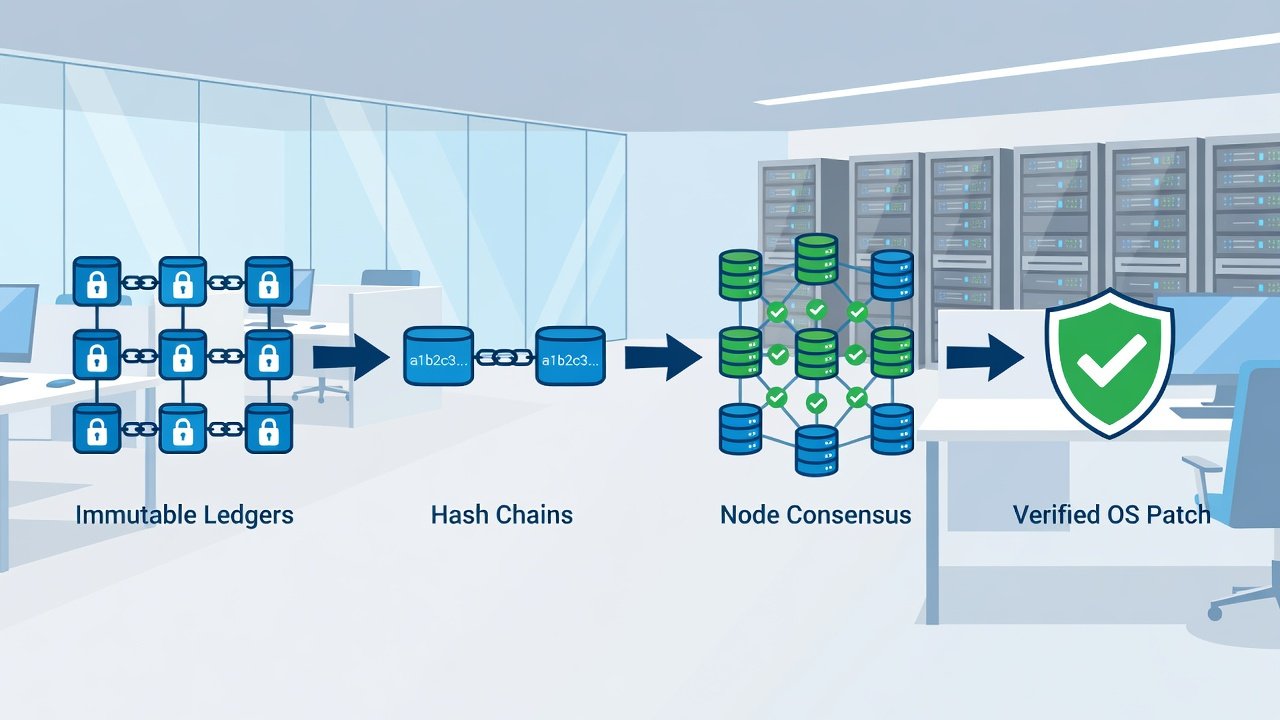
At its core, blockchain is a distributed database that maintains a continuously growing list of records secured by cryptography. When applied to software updates, each patch can be represented as a block containing metadata such as version number, hash of the update file, timestamp, and digital signatures. These blocks are linked chronologically, forming an unalterable chain. The use of cryptographic hashing means that even minor changes to a patch note would produce a completely different hash, immediately flagging tampering attempts to all network participants.
Additional concepts like Merkle trees allow efficient verification of large batches of updates without downloading the entire ledger. Smart contracts can enforce rules automatically, such as requiring multi-party approval before a patch is marked as verified. This setup provides end-to-end visibility. Any attempt to alter a patch note would require changing all subsequent blocks, which is computationally infeasible in a properly configured network. Enterprises often combine public and private blockchains to balance transparency with confidentiality needs.
Step-by-Step Implementation Examples
Implementing blockchain for secure patch delivery involves several phases. First, select a permissioned blockchain framework suitable for enterprise use. Next, integrate it with existing update servers by hashing each patch and storing the hash on the ledger. Detailed steps include mapping existing release processes to blockchain transactions and training teams on new verification dashboards.
- Define update metadata standards including file hashes and signatures, ensuring compatibility with tools like SHA-256.
- Deploy smart contracts to automate verification upon patch release, including conditions for rollback if anomalies are detected.
- Configure nodes across IT infrastructure for consensus on ledger updates, starting with a minimum of five validator nodes for resilience.
- Test the system with simulated tampering attempts to validate immutability, using both internal red-team exercises and third-party audits.
- Monitor and scale by integrating analytics that alert on unusual consensus delays or node failures.
Enterprises can start with pilot programs on non-critical systems before full rollout. For example, a manufacturing firm might first apply this to firmware updates for IoT devices before expanding to core ERP systems.
Comparisons with Conventional Verification Processes
Traditional methods rely on centralized repositories and digital signatures that can be compromised if the signing key is breached. In contrast, blockchain distributes trust across multiple nodes, eliminating single points of failure. Conventional processes often lack comprehensive audit trails, making post-incident forensics challenging. Blockchain provides a complete, tamper-proof history accessible to authorized parties at any time.
Another key difference lies in transparency: standard release notes can be edited on a vendor website without detection, whereas blockchain entries are immutable once confirmed. This makes blockchain superior for regulated industries where audit requirements demand provable integrity over months or years.
Real-World Case Studies from Enterprise Environments
Several large organizations have piloted blockchain for patch management. Financial institutions have used it to secure updates for core banking systems, ensuring compliance with strict regulations. Healthcare providers report improved transparency in medical device firmware updates, reducing the risk of compromised equipment affecting patient safety.
One notable example involves a multinational corporation that integrated blockchain to track OS patches across global data centers, reducing verification time by 40%. Another case from the energy sector showed how blockchain prevented a potential supply-chain attack by flagging an altered patch during consensus. NIST guidelines on cybersecurity frameworks support the use of distributed ledger technologies for such applications, offering frameworks that enterprises can adapt directly.
Checklist for Adoption
- Assess current update infrastructure for blockchain compatibility, including API access and hash generation capabilities.
- Identify key stakeholders including security, compliance, and IT operations teams to ensure cross-departmental buy-in from the start.
- Choose a scalable blockchain platform with enterprise support, evaluating factors like node management and integration libraries.
- Develop training programs for staff on new verification workflows, covering both technical operation and regulatory implications.
- Establish monitoring for ledger performance and anomaly detection, setting thresholds for consensus times and transaction volumes.
- Conduct regular audits aligned with industry standards such as ISO 27001 to maintain certification readiness.
Potential Challenges with Scalability
While promising, blockchain integration faces scalability hurdles. High transaction volumes during mass patch deployments can strain network resources. Solutions include hybrid architectures combining on-chain metadata with off-chain storage for large binary files. Performance impacts must be evaluated, particularly latency in consensus mechanisms. Organizations should benchmark systems under peak loads typical of major OS update cycles.
Common mitigations involve sharding the ledger or using layer-two protocols that batch transactions. In practice, teams report that after initial tuning, update delivery speeds match or exceed legacy systems while adding security layers. IBM provides resources on enterprise blockchain scalability best practices that include detailed architecture diagrams and performance testing methodologies.
Mistakes to Avoid
One frequent error is overlooking node distribution, which can reintroduce centralization risks. Another is failing to plan for key management in smart contracts, leading to locked or lost access during emergencies. Teams should also avoid rushing pilots without thorough threat modeling specific to their regulatory environment.
FAQ
Does blockchain slow down software update delivery?
Initial integration may add minimal overhead, but optimized implementations maintain or improve overall speed through automated verification and reduced manual checks.
What industries benefit most?
Regulated sectors like finance, healthcare, and government gain the greatest advantages due to audit and compliance requirements that demand immutable records.
How does it handle performance impacts?
Layer-2 solutions and permissioned networks mitigate latency, ensuring updates remain efficient even at enterprise scale with thousands of daily transactions.
Is blockchain suitable for air-gapped environments?
Yes, with offline node synchronization and periodic ledger exports, though full real-time consensus requires careful network design.
What about regulatory acceptance?
Many frameworks now explicitly recognize distributed ledgers as valid audit mechanisms, provided proper controls and documentation are in place.
Conclusion
Blockchain integration represents a significant advancement for 2026 software updates, delivering unmatched security and transparency. IT professionals should evaluate adoption strategies to stay ahead of evolving threats and meet the demands of increasingly regulated operating environments.


No comments yet. Be the first!