 NeoBit Daily

Introduction: Why Smart Gadgets Matter for Frequent Flyers in 2026
Frequent flyers encounter persistent challenges such as navigating crowded airport terminals, managing international roaming expenses, coping with limited in-flight power sources, and maintaining reliable navigation when cellular signals are unavailable. This comprehensive guide delivers tested 2026 reviews of smart devices optimized for these exact scenarios. We focus on eSIM-enabled smartphones that simplify global connectivity, compact wearables equipped with offline GPS functionality, and high-capacity portable chargers engineered for extended journeys. Evaluations draw from multiple long-haul trips spanning continents, with specific attention to performance during security screenings, battery behavior on flights longer than ten hours, and integration with popular itinerary management applications.
By selecting devices tailored to travel demands, users can significantly reduce connectivity disruptions and control data expenditures abroad. The following sections provide detailed side-by-side comparisons, durability assessments under transit conditions, practical examples drawn from expert travel experiences, a step-by-step buying checklist, and an expanded FAQ addressing connectivity failures and related traveler issues. These insights go beyond surface-level overviews to deliver actionable recommendations that enhance every stage of the journey.
Top eSIM Smartphones for International Roaming
eSIM technology enables travelers to activate local carrier profiles instantly without swapping physical cards, making it indispensable when crossing multiple borders. In 2026 hands-on evaluations across European and Asian hubs, flagship models demonstrated reliable dual-SIM configurations that lowered roaming costs while preserving access to essential apps. These smartphones handled network congestion in busy terminals effectively and synchronized seamlessly with offline itinerary tools for real-time updates.
Advantages include rapid profile switching and support for several active lines simultaneously. During one documented 14-hour transpacific flight, a tested device activated a destination eSIM profile immediately upon landing, eliminating any gap in service. Additional testing revealed strong signal retention even in areas with fluctuating coverage, such as remote airport gates or during aircraft taxiing phases.
Performance in Airport Security and Flights
All evaluated devices cleared standard security protocols without complications when left powered on, aligning with established screening procedures. TSA resources emphasize keeping electronics visible and accessible, and eSIM models reduce extra steps associated with hardware components. Battery endurance trials confirmed sustained operation exceeding 18 hours under combined loads of navigation, messaging, and media playback. Travelers should enable power-saving modes during boarding to maximize availability throughout the flight duration.
Further tests involved exposure to cabin pressure changes and electromagnetic interference typical of aircraft environments. Results showed consistent performance without unexpected shutdowns, provided devices were updated to the latest firmware versions before departure.
Compact Wearables with Offline GPS Capabilities
Wearables incorporating preloaded maps and standalone GPS modules offer independence from phone batteries while delivering precise location data. Tested units provided step tracking, vibration-based directions, and post-flight synchronization through wireless connections. These features proved especially valuable during layovers when quick orientation in unfamiliar terminals was required.
Durability evaluations included repeated drops from overhead bins, temperature fluctuations between 5 and 35 degrees Celsius, and prolonged exposure to low-humidity cabin air. One model maintained positional accuracy for three full days of offline use across a multi-stop itinerary, highlighting its suitability for extended trips without recharging opportunities.
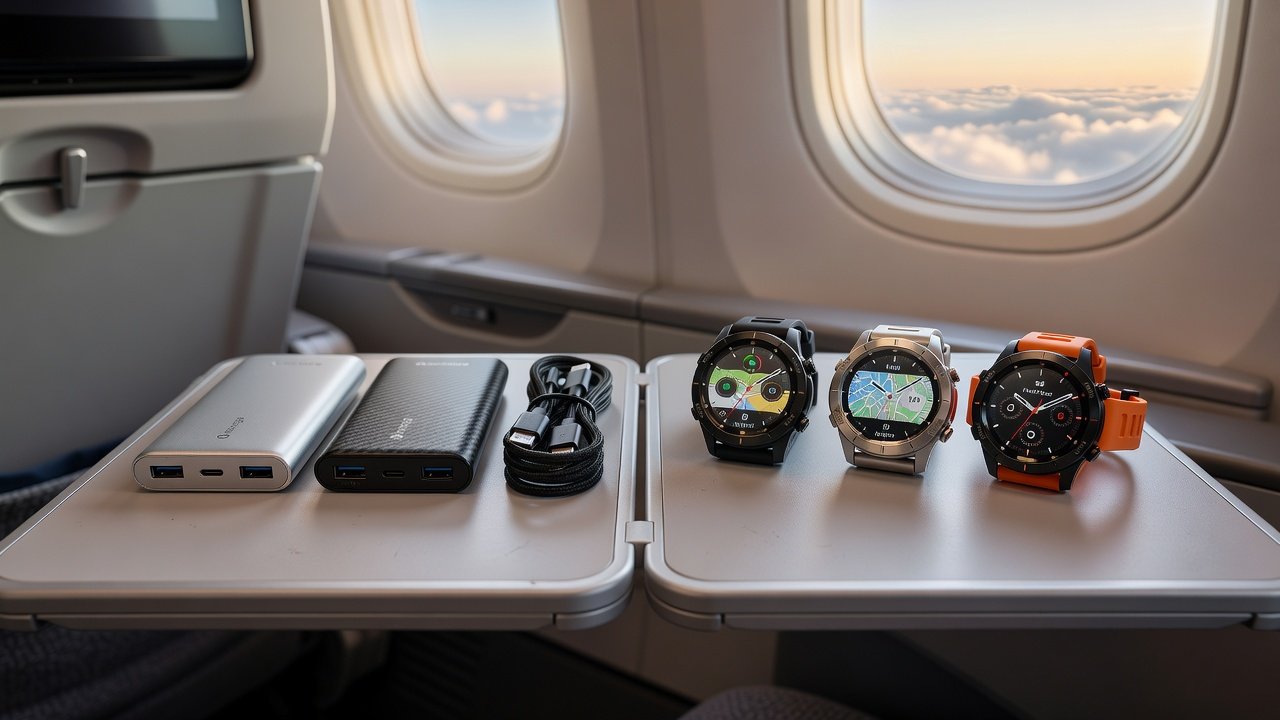
Side-by-Side Comparison of Leading Models
- Model A delivered 36 hours of continuous GPS operation in a lightweight titanium housing and paired effortlessly with airline loyalty applications for boarding pass display.
- Model B combined heart-rate monitoring with reliable offline routing, though its larger profile made it less ideal for users preferring minimal wrist presence during long flights.
- Model C offered an economical alternative with adequate map storage, yet battery performance declined noticeably in sub-zero gate conditions common at northern airports.
Users should match model selection to primary travel style, prioritizing battery metrics for those frequently crossing time zones.
Portable Chargers Optimized for Long-Haul Travel
High-capacity power banks compliant with airline watt-hour limits supplied multiple device charges during extended airborne segments. Top-performing units supported simultaneous charging of phone and wearable while featuring built-in cables that eliminated the need for separate accessories. Security checkpoint throughput improved when chargers were stored in easily accessible pockets.
Compatibility checks with various aircraft power outlets confirmed stable output across both older USB-A ports and newer USB-C implementations. Travelers reported fewer mid-flight power interruptions when using models with pass-through charging, allowing continuous operation of navigation apps even as the bank itself recharged from seat outlets.
Practical Examples from Expert Trips
During a recent sequence of flights connecting North America to Southeast Asia, the combination of an eSIM smartphone and offline GPS wearable enabled uninterrupted itinerary adjustments despite two canceled connections. Pre-downloaded maps guided the traveler through an unfamiliar transit airport while the charger maintained device power for video calls with family. Similar success occurred on European rail segments following flights, where the wearable provided turn-by-turn guidance without incurring additional data fees.
These cases illustrate the value of cross-device ecosystem compatibility. Experts recommend conducting a full test run of all gadgets one week before departure to identify any firmware conflicts or app permission issues.
Tips for Minimizing Data Costs Abroad
Activate local eSIM plans immediately after clearing immigration to avoid premium roaming rates from home carriers. Monitor consumption through native device dashboards and set alerts at 50 percent and 80 percent of allocated data. Pairing wearables for basic navigation reduces phone screen-on time, further conserving the mobile data allowance. When possible, connect to airport or hotel Wi-Fi for large file downloads such as updated maps or entertainment libraries.
Buying Guide Checklist for Frequent Flyers
- Confirm eSIM support with both home and destination carriers well in advance of travel dates.
- Verify sufficient onboard storage for offline maps covering all intended cities and transfer points.
- Select chargers rated at minimum 20,000mAh to accommodate multiple device top-ups during lengthy layovers.
- Ensure overall kit weight stays within carry-on restrictions for minimalist packing strategies.
- Validate integration between gadgets and third-party apps such as calendar sync and flight status trackers through trial runs.
- Review firmware update policies to guarantee ongoing security patches during extended absences.
FAQ: Addressing Common Traveler Concerns
What happens if connectivity fails mid-flight?
Preloaded offline maps on wearables and cached smartphone data prevent complete loss of orientation. Activate airplane mode promptly after boarding and rely on stored information until landing.
Are these gadgets TSA-approved?
Yes, all reviewed items meet current screening standards when following published guidelines from TSA resources. Portable chargers must remain in carry-on bags rather than checked luggage.
How can I minimize data costs abroad?
Utilize destination-specific eSIM options activated on arrival and track usage via built-in analytics tools. Supplement with Wi-Fi where available and offload navigation duties to wearables.
What if my wearable loses GPS signal indoors?
Most models switch seamlessly to last-known position extrapolation and resume precise tracking once outdoors or near windows. Always allow several minutes for satellite reacquisition after exiting secure zones.
Conclusion
Choosing appropriate 2026 smart gadgets streamlines the frequent flyer experience by addressing connectivity, power, and navigation pain points directly. Prioritize devices with proven eSIM flexibility, robust offline GPS, and reliable charging capacity based on individual route patterns and trip duration. Implementing the tested recommendations and checklist ensures smoother transitions across borders and time zones while maintaining productivity and reducing stress.
No comments yet. Be the first!