 NeoBit Daily
Introduction to Quantum Threats in Immersive Blockchain Environments
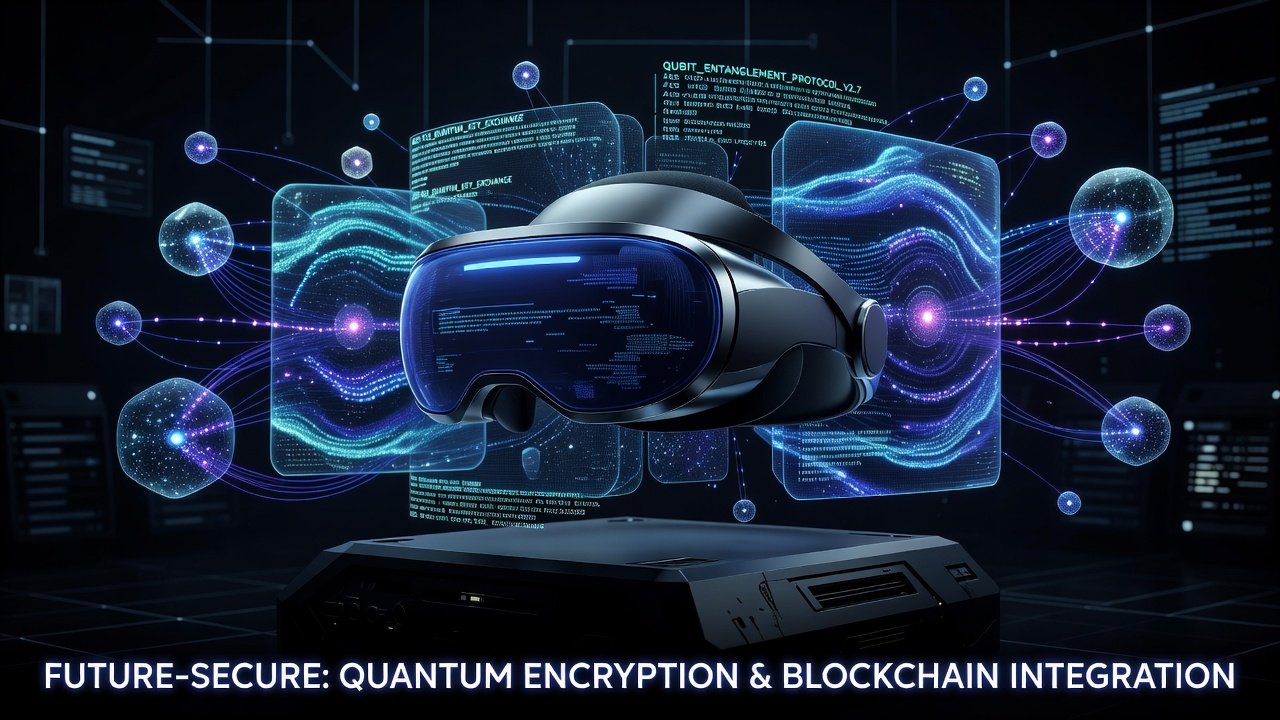
Virtual and augmented reality platforms built on blockchain face escalating risks from quantum computing advances. As quantum computers mature, traditional encryption like RSA and ECC could be broken, exposing user data, digital assets, and immersive experiences. This playbook provides a practical guide to post-quantum cryptography (PQC) integration while preserving low-latency performance essential for VR/AR. Enterprises deploying these technologies in 2026 must prioritize migration to maintain trust and regulatory compliance. The focus is on real-world workflows that balance security with seamless user experiences across decentralized networks powering virtual economies and collaborative AR spaces.
Immersive technologies are projected to integrate deeply with blockchain for asset ownership and identity verification. Without quantum resistance, these systems risk widespread compromise. The playbook emphasizes phased adoption strategies that minimize disruption to end-user interactions in high-fidelity environments.
Current Threat Landscape for VR/AR Blockchain Systems
Immersive environments generate vast amounts of sensitive data, including biometric information and spatial tracking. Blockchain secures transactions and ownership of virtual assets, yet quantum attacks could compromise private keys and smart contracts. Recent analyses highlight risks in decentralized identity systems and NFT marketplaces tied to AR overlays. Attackers may target the convergence points where VR rendering engines communicate with blockchain nodes, intercepting encrypted session keys or forging digital signatures on asset transfers.
Key threats include harvest-now-decrypt-later attacks where adversaries collect encrypted data today for future quantum decryption. Developers must assess exposure in real-time rendering pipelines and cross-chain communications. For example, a quantum-enabled adversary could retroactively decrypt historical transaction logs in a virtual land registry, undermining ownership proofs. Additional vectors involve side-channel attacks on hardware accelerators used in AR glasses or quantum-vulnerable random number generators in consensus protocols. Understanding these landscapes enables targeted defenses that protect both data at rest and in transit without introducing perceptible delays during live interactions.
Comparing Post-Quantum Cryptography Algorithms
Several NIST-standardized algorithms offer strong candidates for VR/AR blockchain integration. Kyber provides efficient key encapsulation suitable for session management, delivering strong security levels with relatively small ciphertext sizes that suit bandwidth-limited wireless VR headsets. Dilithium excels in digital signatures for asset verification, offering fast verification times critical for real-time blockchain confirmations during multiplayer AR sessions. Falcon offers compact signatures beneficial for bandwidth-constrained mobile AR devices, though it requires careful implementation to avoid floating-point vulnerabilities on certain embedded hardware.
Comparisons show Kyber-1024 achieving strong security with moderate overhead, while Dilithium2 balances signature size and verification speed. Enterprise teams should benchmark these against specific hardware like Oculus or HoloLens equivalents to identify optimal pairings. Additional considerations include SPHINCS+ for hash-based signatures in ultra-conservative deployments where long-term security outweighs performance. Each algorithm carries trade-offs: lattice-based options like Kyber and Dilithium provide speed but demand protection against timing side-channels, whereas hash-based alternatives offer simplicity at the cost of larger signatures. Practical selection often involves hybrid constructions that combine PQC with classical algorithms during transition periods to ensure interoperability.
Step-by-Step Integration Workflow
Begin with a cryptographic inventory of existing libraries in your blockchain node and VR rendering engine. Replace vulnerable primitives with hybrid schemes combining classical and PQC methods for backward compatibility. Map every encryption call in the authentication layer, transaction signing module, and data storage components. Next, update key generation modules to support lattice-based algorithms by integrating reference implementations from established cryptographic libraries. Test these replacements in isolated sandboxes before rolling out to production networks.
Integrate PQC into consensus mechanisms via smart contract libraries, ensuring signature verification logic accommodates variable-length outputs from new algorithms. Validate interoperability across Ethereum and Hyperledger frameworks through simulated multi-chain scenarios. Address performance bottlenecks by offloading cryptographic operations to specialized hardware where available. Finally, deploy monitoring tools to track latency impacts during live sessions and establish rollback procedures for any integration issues. NIST resources provide detailed implementation guidance for these transitions, while Hyperledger documentation supports blockchain-specific adaptations.
Performance Benchmarks and Latency Optimization
Benchmarks from 2026 enterprise pilots indicate that hybrid Kyber-Dilithium implementations add under 15% overhead to rendering pipelines when optimized with GPU acceleration. Low-latency targets below 20ms remain achievable through selective encryption of critical data streams only. Teams have achieved frame rates above 90 FPS in complex VR environments by prioritizing encryption for metadata and asset proofs rather than every rendered frame.
Techniques like algorithm agility and hardware offloading help maintain frame rates above 90 FPS in VR environments. Additional optimizations include caching precomputed keys for frequent interactions and using parallel processing for signature batches in blockchain validation queues. Continuous profiling ensures compliance with user experience standards, revealing that network jitter often outweighs cryptographic overhead in real deployments. Organizations should conduct A/B testing across different device classes to fine-tune parameters for consistent performance.
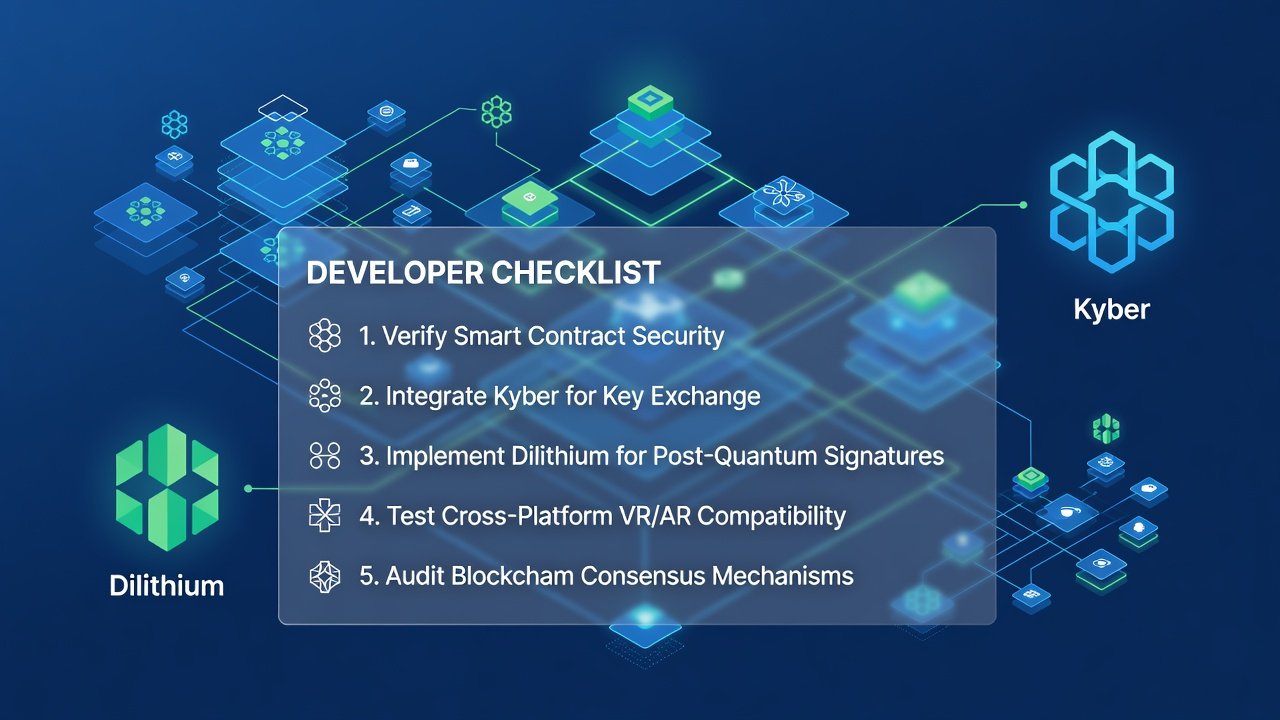
Developer Checklist for Quantum-Resistant Migration
- Audit all cryptographic dependencies and replace ECC/RSA usages with documented alternatives.
- Implement hybrid key exchange in authentication flows to support gradual rollout.
- Validate PQC signatures in blockchain transaction validation using test vectors from standards bodies.
- Conduct end-to-end latency testing in simulated immersive scenarios with representative user loads.
- Document compliance with emerging standards for audit readiness and third-party reviews.
- Train teams on lattice-based algorithm troubleshooting and common implementation pitfalls.
- Establish version control for cryptographic libraries to enable rapid updates as standards mature.
- Perform threat modeling specific to VR sensor data and AR overlay integrity.
Enterprise Case Studies and ROI Considerations
Leading deployments in virtual real estate platforms have successfully migrated core asset ledgers using Dilithium signatures, reducing vulnerability windows significantly. AR collaboration tools integrated Kyber for secure multi-user sessions with minimal performance trade-offs, enabling encrypted spatial audio sharing across global teams. One manufacturing firm reported streamlined compliance audits after adopting hybrid schemes in their internal training AR system built on permissioned blockchain.
Adopters report faster regulatory approval and enhanced user retention through demonstrated security leadership. Practical ROI emerges from avoided breach costs and premium positioning in the market, with qualitative gains in stakeholder confidence that support long-term platform growth. Case evidence shows that early movers gain advantages in attracting enterprise clients concerned about future-proofing their immersive investments.
Ensuring Compliance and Future-Proofing
Align implementations with global post-quantum standards to support cross-border VR/AR applications. Regular algorithm updates and crypto-agility features prevent obsolescence as standards evolve. Incorporate automated testing suites that verify PQC compliance after each code change. Future-proofing also involves monitoring quantum hardware progress through industry reports and adjusting security levels accordingly.
Frequently Asked Questions
What are typical migration timelines for 2026 adopters?
Most organizations complete phased rollouts within 9-12 months, starting with non-critical modules before full production deployment. Early planning phases can shorten this by identifying dependencies upfront.
How do teams calculate ROI for quantum-resistant upgrades?
ROI models factor reduced risk exposure, compliance savings, and competitive differentiation, often showing positive returns within two years of implementation through both quantitative risk reduction and qualitative brand benefits.
Which hardware platforms best support PQC acceleration in VR headsets?
Modern GPUs and dedicated security chips provide effective acceleration for lattice-based operations, with benchmarks confirming compatibility across major headset ecosystems when using optimized libraries.
Conclusion
Quantum-resistant encryption is essential for securing the next generation of VR/AR blockchain experiences. By following structured integration steps, leveraging benchmarks, and applying developer checklists, teams can achieve robust protection without sacrificing performance. Proactive adoption positions organizations at the forefront of secure immersive technology in 2026 and beyond, safeguarding user trust and enabling scalable innovation in decentralized virtual worlds.
No comments yet. Be the first!