 NeoBit Daily
Introduction: The Convergence of Immersive Worlds and Next-Gen Tech
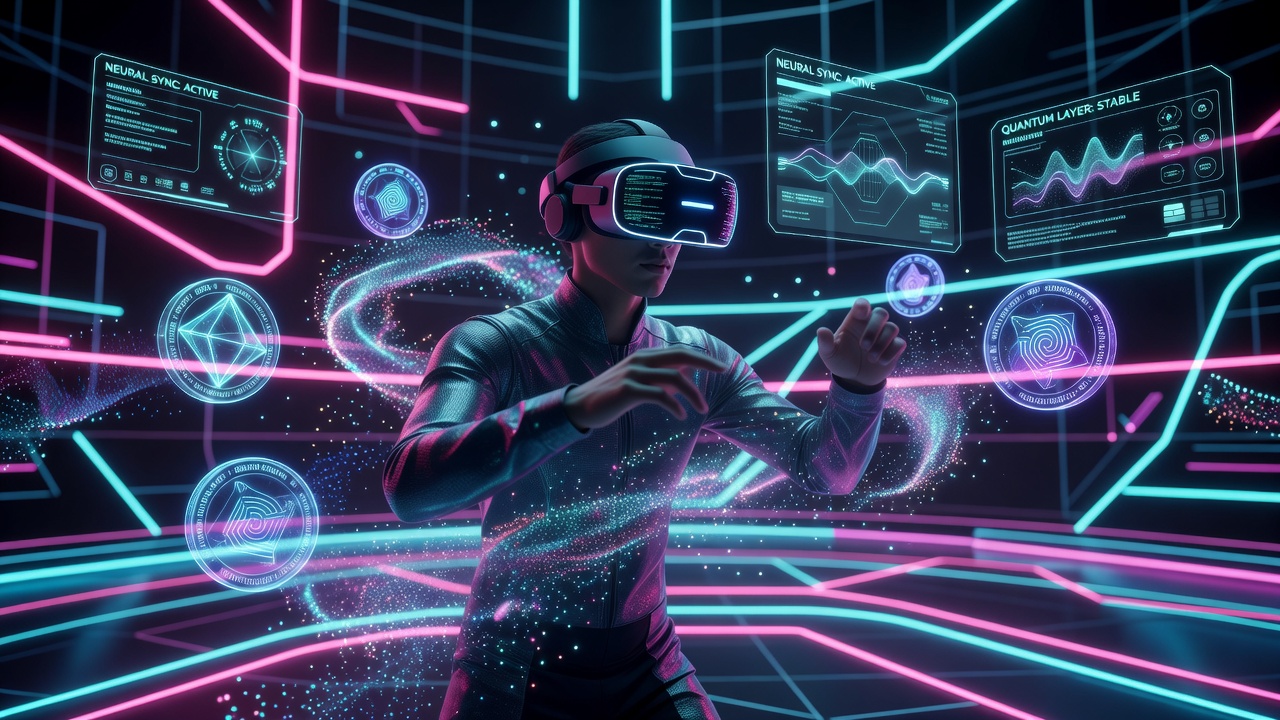
By 2027, VR and AR gaming is evolving beyond simple headsets into fully realized digital ecosystems. Blockchain technology is enabling true digital ownership and play-to-earn mechanics, while quantum computing powers unprecedented real-time physics simulations and AI-driven environments. This article examines these advancements in depth for gamers seeking new experiences, developers building future platforms, and investors evaluating emerging opportunities. The shift promises more than incremental improvements. Players can truly own in-game assets across platforms, and environments respond with quantum-level accuracy. Below we break down the key technologies, concrete applications, and actionable guidance that go far beyond basic overviews.
Traditional gaming has long suffered from centralized control where assets disappear when servers shut down or companies pivot. Blockchain solves this by creating immutable records of ownership. Quantum computing, meanwhile, tackles the computational bottlenecks that limit current VR and AR fidelity. Together they form a powerful foundation for the next era of interactive entertainment.
Blockchain: Enabling True Ownership and Play-to-Earn in VR AR
Blockchain provides decentralized ledgers that verify asset ownership without central authorities. In VR AR worlds, this means NFTs represent unique items, characters, or land that players can trade or use across games. Play-to-earn models reward participation with tokens that hold real value. Unlike traditional games where items vanish with server shutdowns, blockchain-backed assets persist. Developers integrate smart contracts to handle transactions seamlessly inside immersive sessions, allowing instant peer-to-peer exchanges without leaving the virtual environment.
Security features such as cryptographic signatures ensure that no duplicate assets can be created, addressing long-standing issues of fraud in digital economies. Interoperability standards like those built on ERC-721 and ERC-1155 extensions make it possible for a single avatar skin or weapon to function across multiple titles developed by different studios.
Five Concrete Use Cases with Emerging Examples
- Cross-Platform Asset Trading: A VR sword purchased in one metaverse can be equipped in an AR mobile title via blockchain verification. Emerging titles built on Ethereum extensions demonstrate early prototypes where players transfer legendary gear between fully immersive VR sessions and lightweight AR experiences on smartphones.
- Play-to-Earn Economies: Players earn tokens by completing quests in AR overlays of real cities, redeemable for VR upgrades. Projects inspired by earlier successes are expanding into spatial computing, letting users monetize exploration of physical spaces mapped into persistent digital layers.
- Decentralized Virtual Land Ownership: Users buy and develop plots in persistent VR worlds, with ownership recorded on-chain for AR exploration. This creates opportunities for community-driven events where landowners host concerts or tournaments visible to both VR and AR participants.
- Secure In-Game Marketplaces: Quantum-resistant ledgers protect high-value trades during live multiplayer events, reducing risks of theft or manipulation that have plagued earlier centralized systems.
- AI-Generated Content Monetization: Quantum AI creates unique environments that players can claim and sell as blockchain-verified assets, turning procedural generation into a creator economy where original worlds become tradable commodities.
These cases move beyond basic integration by embedding economic layers directly into gameplay loops, fostering deeper engagement and long-term retention.
Quantum Computing: Accelerating Rendering and AI Environments
Quantum systems process complex calculations exponentially faster than classical computers. In gaming this translates to real-time physics where every particle interaction feels authentic and AI opponents adapt with near-infinite strategy trees. Hybrid quantum-classical architectures are already being tested in research labs to simulate fluid dynamics, lighting, and collision detection at scales impossible on current hardware.
IBM Quantum Computing resources highlight how superposition enables simultaneous evaluation of multiple game states, dramatically reducing the time needed for path tracing and global illumination calculations.
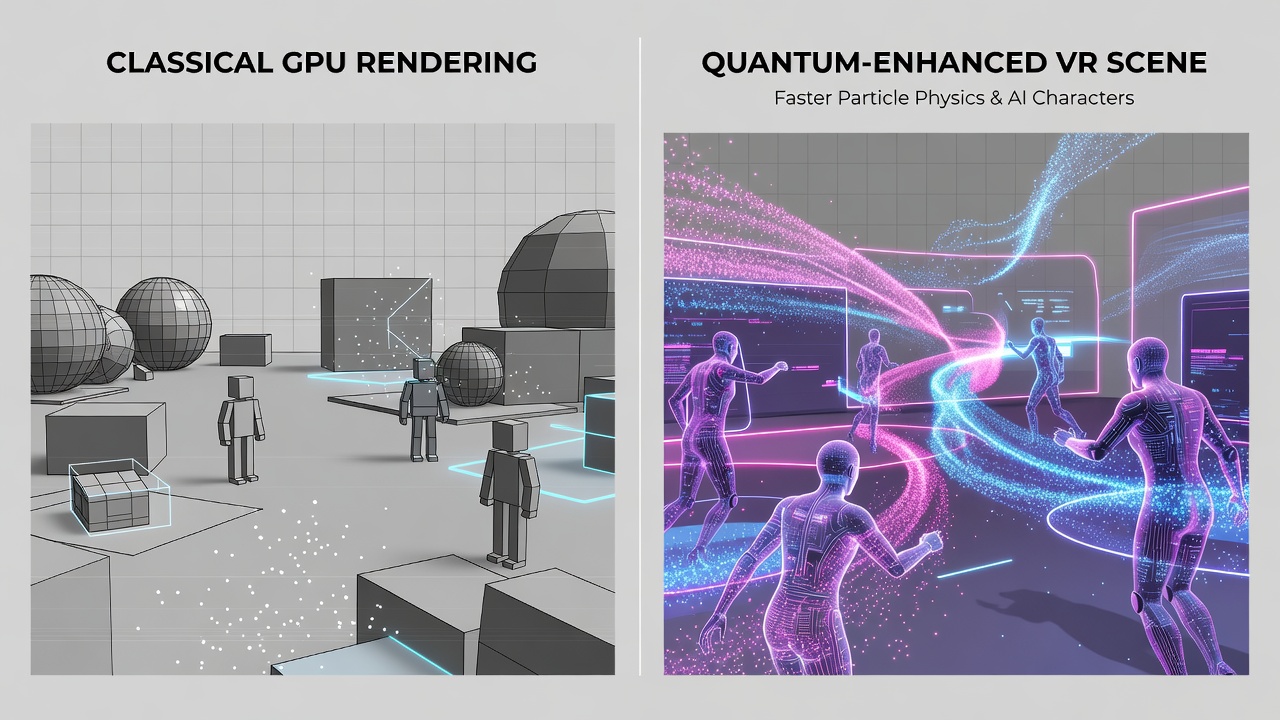
Current vs Quantum-Enhanced Rendering Speeds
Today’s top GPUs render complex VR scenes at roughly 90 frames per second with noticeable latency in dense environments. Quantum-enhanced pipelines, leveraging hybrid classical-quantum algorithms, are projected to push sustained rates beyond 240 fps while handling photorealistic global illumination and fluid dynamics simultaneously. The difference appears most dramatically in large-scale AR battles where thousands of interactive elements must update without lag. Developers report that quantum-assisted simulations allow for accurate modeling of cloth, smoke, and destructible environments that previously required pre-baked approximations.
Practical Steps for Prototyping a Blockchain-Secured VR Asset Marketplace
Developers can follow these steps to build a minimum viable marketplace that integrates both blockchain and quantum-resistant features:
- Choose a blockchain framework with strong VR SDK support, such as Ethereum or emerging layer-2 solutions that offer low-latency transaction finality suitable for real-time gameplay.
- Integrate wallet connections directly into the VR UI using spatial anchors so users can sign transactions without removing their headset.
- Implement smart contracts for asset minting, trading, and royalty distribution, ensuring automatic enforcement of creator fees on every secondary sale.
- Test interoperability between VR and AR clients using standardized token standards to guarantee assets remain functional across different hardware form factors.
- Run closed beta sessions to validate latency under quantum-accelerated physics loads, measuring frame times and transaction confirmation speeds under realistic user loads.
- Conduct security audits focused on smart contract vulnerabilities and post-quantum cryptographic implementations before public launch.
Start with open-source VR engines and gradually layer on-chain functionality while maintaining fallback mechanisms for offline play.
Developer Tips: Choosing Quantum-Resistant Encryption Methods
Protecting blockchain transactions against future quantum attacks requires post-quantum cryptography. Developers should evaluate NIST-approved algorithms such as CRYSTALS-Kyber for key encapsulation and CRYSTALS-Dilithium for digital signatures. NIST maintains up-to-date guidance on standardization. Hybrid schemes combining classical and post-quantum methods offer a practical migration path while maintaining performance in real-time VR sessions. Additional considerations include evaluating lattice-based and hash-based signature schemes for different use cases, benchmarking their impact on transaction size and verification speed within immersive environments.
Potential Challenges and Mitigation Strategies
Scalability remains a concern as user bases grow. Solutions include sharding and rollups that distribute computational load across multiple chains. User adoption hurdles such as onboarding friction can be addressed through simplified wallet integrations and educational in-game tutorials. Hardware costs for quantum-accelerated rendering are expected to decrease as specialized chips enter the consumer market, but early prototypes should prioritize graceful degradation on classical hardware.
FAQ: Scalability and User Adoption Hurdles in 2027
How will blockchain scale for millions of concurrent VR users?
Layer-2 solutions and sharding are expected to handle high throughput, though network congestion during peak events remains a focus area for ongoing protocol upgrades. Real-world tests in 2026 showed several networks achieving over 10,000 transactions per second under controlled conditions.
What barriers might slow mainstream adoption of quantum-enhanced gaming?
Hardware accessibility and the learning curve for new interaction paradigms are primary hurdles. Developers must prioritize intuitive onboarding to convert early enthusiasts into broad audiences, including support for legacy devices during the transition period.
Will play-to-earn models face regulatory challenges?
Jurisdictions are still defining frameworks around digital assets, so compliance planning should begin during the prototyping phase. Engaging legal experts familiar with both gaming and blockchain regulations is strongly recommended.
Conclusion
Blockchain and quantum technologies are set to redefine VR AR gaming by 2027. True ownership, lightning-fast simulations, and intelligent worlds will create richer experiences for players while opening new avenues for creators and investors. Those who prototype thoughtfully today will lead the next generation of immersive entertainment.
No comments yet. Be the first!