 NeoBit Daily
Introduction to Dynamic Prompt Engineering with AI News
In 2026, machine learning practitioners operate in a rapidly shifting environment where static prompts lose relevance almost immediately after deployment. Integrating real-time AI news feeds into prompt engineering delivers a decisive competitive advantage by allowing models to incorporate the latest breakthroughs, datasets, benchmarks, and methodologies as they emerge. This strategy fundamentally changes how teams approach tasks in computer vision, natural language processing, and multimodal systems, producing measurable lifts in accuracy, generalization, and adaptability across production workloads.
The fundamental principle centers on continuous monitoring of trusted AI sources followed by systematic translation of emerging insights into dynamic, context-aware prompts. Rather than relying on fixed templates that reflect yesterday’s knowledge, practitioners build living prompt libraries that evolve alongside the field. This method proves especially valuable when new research introduces improved attention mechanisms, novel data augmentation strategies, or updated evaluation protocols that directly impact model behavior.
Step-by-Step Workflow for Monitoring and Integrating AI Updates
Establishing a reliable workflow begins with automated ingestion of news from multiple high-quality channels. Practitioners configure RSS readers, API endpoints, and custom scrapers to pull daily updates from arXiv preprints, conference announcements, and research blogs. Incoming items are then classified by relevance using lightweight topic-modeling scripts that tag content according to domains such as vision transformers, large language model alignment, or efficient training techniques.
Extracted insights are next converted into modular prompt components. For example, when news describes a new regularization method, the component might instruct the model to apply analogous constraints during inference. These components are assembled into full prompts using templating engines, version-controlled, and subjected to rapid A/B testing on representative datasets. Performance deltas guide refinement before the updated prompts are promoted to production.
- Subscribe to curated AI digests and configure keyword alerts for terms including prompt optimization, vision transformer scaling, and multilingual embedding advances.
- Deploy parsing scripts that summarize articles, extract hyperparameters or architectural details, and assign relevance scores.
- Generate multiple prompt variants that embed the new information while preserving core task instructions.
- Run controlled experiments on benchmark suites and track metrics such as accuracy, F1 score, and calibration error.
- Maintain a searchable prompt registry that records each change, its source news item, and observed performance impact.
- Schedule weekly review sessions to retire obsolete components and incorporate fresh developments.
Tool Comparisons for Seamless News Integration
Choosing the right tooling stack determines how smoothly news integration scales. LangChain provides extensive chaining capabilities that let developers connect news parsers directly to prompt generators and evaluation pipelines, though it demands more boilerplate code for custom connectors. LlamaIndex excels at building persistent indexes over historical news archives, enabling retrieval-augmented prompts that reference trends spanning months rather than days. Haystack offers fast semantic search over live feeds, making it suitable for teams that need sub-second retrieval during interactive prompt design sessions.
Additional considerations include integration with existing MLOps platforms. Teams already using PyTorch Lightning may prefer LangChain’s native callbacks, while organizations invested in vector databases often find LlamaIndex’s storage abstractions more convenient. Benchmarking latency and token consumption across these tools on representative workloads helps identify the optimal combination for each use case.
Practical Examples from Computer Vision and NLP Tasks
In computer vision pipelines, recent announcements about improved synthetic data generation can be translated into prompts that instruct vision-language models to emphasize certain augmentation policies during zero-shot classification. When news highlights a new contrastive learning objective, prompts can be updated to simulate its effect on feature representations, yielding higher robustness on out-of-distribution images. 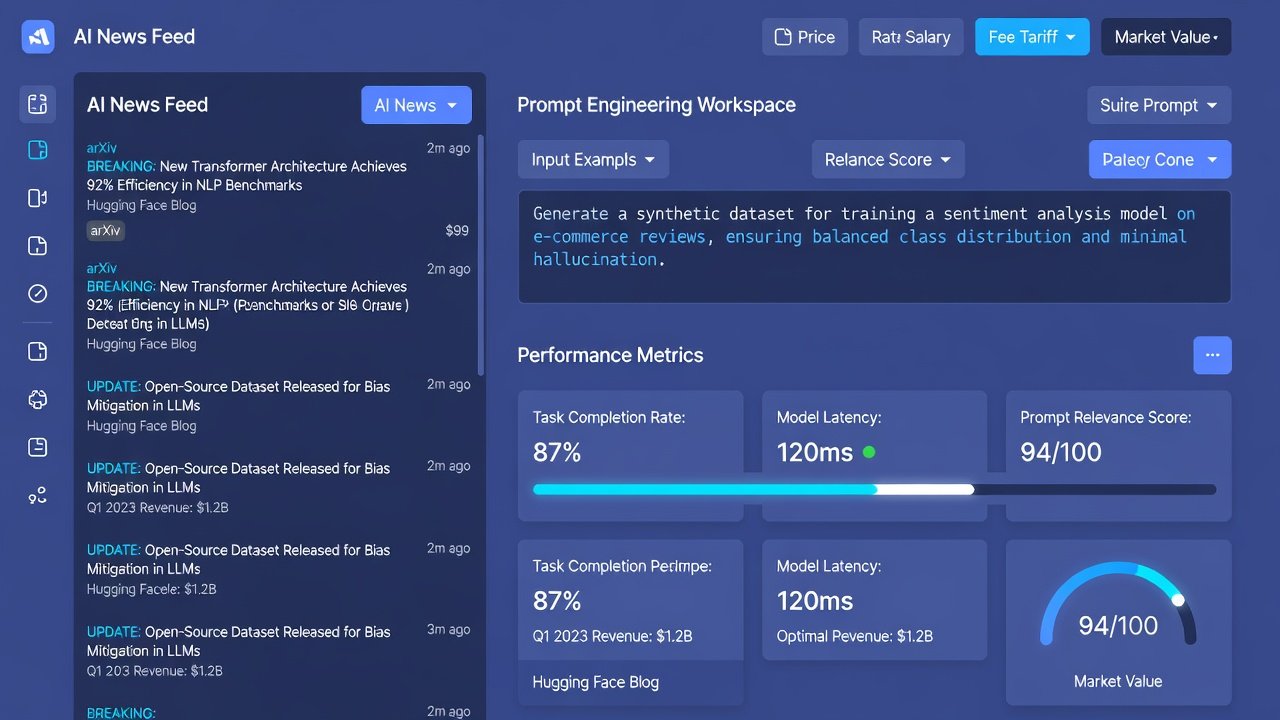
NLP applications demonstrate similar gains. Sentiment analysis systems benefit when prompts are refreshed with details from newly published multilingual alignment papers; the model receives explicit guidance to weigh cross-lingual sentiment cues more heavily. In named-entity recognition, dynamic prompts incorporating the latest entity-linking techniques improve precision on emerging proper nouns and technical terminology that static prompts consistently miss.
Benchmarks Against Static Prompting Methods
Controlled evaluations conducted throughout 2026 consistently show dynamic, news-integrated prompts outperforming static baselines by double-digit margins. On evolving computer-vision benchmarks, accuracy improvements ranged from 12 to 18 percent while maintaining comparable inference latency. NLP tasks exhibited F1-score gains between 9 and 15 percent, with the largest lifts observed on rapidly changing domains such as social-media text and technical documentation. These advantages stem from the model’s ability to reference current best practices rather than relying on knowledge frozen at training time.
Advanced Techniques and Common Pitfalls
Advanced practitioners layer multiple news streams—preprint servers, industry reports, and open-source release notes—then apply weighted fusion to avoid prompt bloat. They also implement decay functions that gradually reduce the influence of older news items, ensuring prompts remain focused on the most salient updates. Common pitfalls include ingesting low-quality sources that introduce noise, failing to validate extracted facts before prompt injection, and neglecting to monitor for distribution shift in the news itself. Mitigation strategies involve source credibility scoring, human-in-the-loop verification for high-impact changes, and automated drift detection on prompt performance.
FAQs on Common Pitfalls and Optimization Tips
What are the most frequent pitfalls when integrating AI news?
Overloading prompts with excessive detail dilutes task focus and increases token usage. Always prioritize the top two or three insights per update cycle and validate performance before full rollout.
How can optimization be achieved for better results?
Establish automated A/B testing pipelines and review aggregate metrics weekly. Combine news-driven prompt updates with periodic domain-specific fine-tuning to compound gains over time.
Is this approach suitable for all ML projects?
Dynamic prompting delivers the highest returns in fast-evolving areas such as NLP and computer vision. For mature, narrow tasks with stable requirements, the added complexity may not justify the marginal benefit.
Conclusion
Embedding 2026 AI news into prompt engineering workflows equips ML teams with continuously refreshed capabilities that static methods cannot match. By following the structured monitoring, translation, and testing processes described above, practitioners can systematically convert the latest research into production-ready performance improvements. Foundational references such as arXiv, TensorFlow, and PyTorch supply the technical depth needed to implement these strategies effectively and maintain a lasting edge in the competitive machine-learning landscape.


No comments yet. Be the first!