 NeoBit Daily

Introduction to Graph Neural Networks in 2026
Graph neural networks (GNNs) have become essential for handling complex relational data in machine learning. In 2026, emerging AI tools are transforming how data scientists train and deploy these models, offering competitive advantages in industries from e-commerce to pharmaceuticals. This guide explores the latest advancements, focusing on practical selection criteria, real-world applications, and integration strategies that help practitioners stay ahead. GNNs excel at learning from graph-structured data where entities are nodes and relationships are edges, making them superior for tasks involving networks, molecules, or social connections. The rapid evolution of supporting AI infrastructure in 2026 means faster training times, better scalability, and more intuitive interfaces for both beginners and experts.
Understanding the Evolution of GNNs and AI Tooling
Traditional machine learning models often struggle with non-Euclidean data like graphs. GNNs address this through message-passing mechanisms that aggregate information from neighboring nodes. By 2026, AI tools have integrated advanced features such as automated hyperparameter tuning and hardware-aware optimizations. These developments allow engineers to process graphs with millions of nodes efficiently. For example, a data scientist working on fraud detection can now leverage tools that automatically detect anomalous subgraphs without manual feature engineering.
Selecting the Right AI Tools for GNN Training
Choosing appropriate tools requires evaluating scalability, framework compatibility, and hardware acceleration. Leading options in 2026 include PyTorch Geometric extensions and TensorFlow's graph-specific libraries. Consider factors like automatic differentiation support and distributed training capabilities when assessing tools for large-scale graphs. Additional considerations include ease of debugging, support for heterogeneous graphs, and integration with cloud platforms. Data scientists should test tools on representative datasets to measure convergence speed and memory usage before committing to a full project.
- Evaluate integration with existing ML pipelines for seamless workflow adoption
- Prioritize tools with strong community support and up-to-date documentation
- Assess GPU/TPU optimization features for faster convergence on complex graphs
- Check for built-in support for dynamic graphs that change over time
- Review licensing terms and open-source contributions for long-term sustainability
Case Study: Recommendation Systems
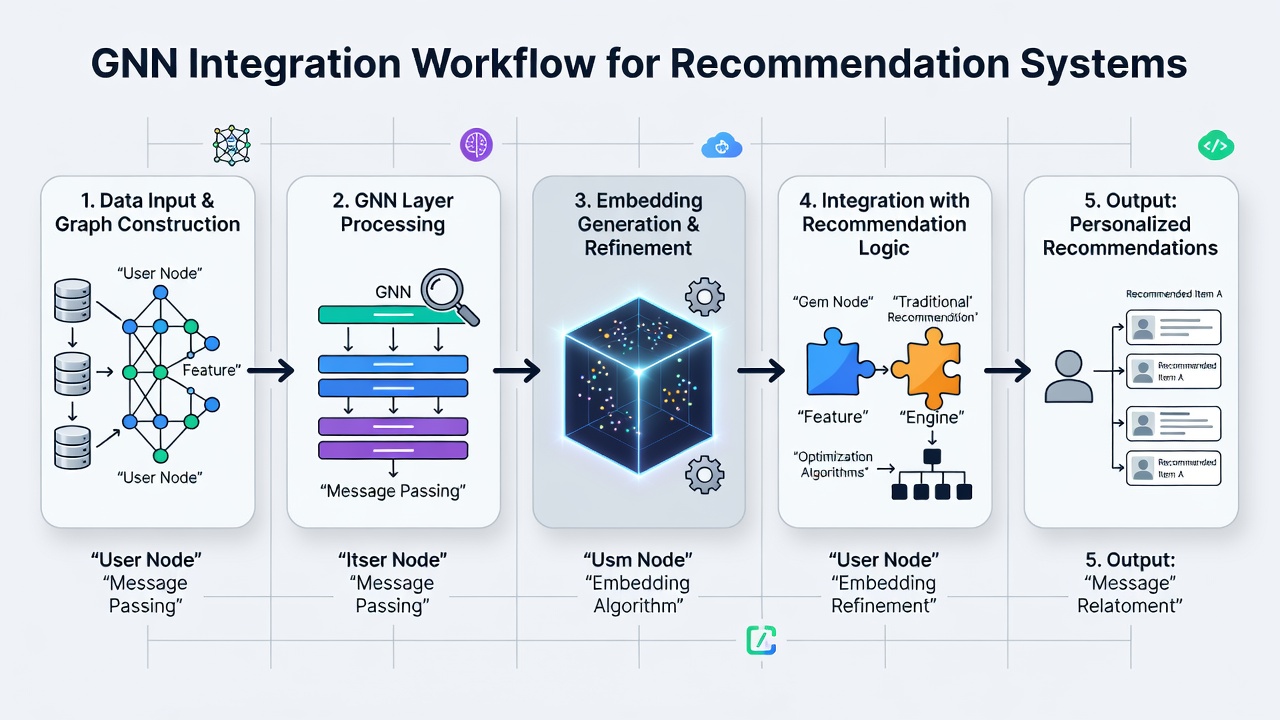
In recommendation engines, GNNs model user-item interactions as graphs. A major streaming platform recently leveraged updated AI tooling to improve personalization accuracy by capturing higher-order connections, resulting in more relevant suggestions and increased user engagement. The implementation involved constructing a bipartite graph of users and content, then applying graph attention networks to weigh influential neighbors. This approach outperformed matrix factorization methods by better handling cold-start problems for new users. Engineers reported reduced training time through parallel processing features in the 2026 toolkits.
Case Study: Drug Discovery
Pharmaceutical researchers use GNNs to predict molecular properties. By integrating 2026 AI accelerators, teams at leading labs have accelerated screening processes, identifying promising compounds faster than traditional methods. National Institutes of Health resources highlight ongoing advancements in this domain. In one project, researchers modeled proteins as graphs where atoms are nodes and bonds are edges. The GNN predicted binding affinities with high precision, shortening the typical discovery timeline from months to weeks. This case demonstrates how specialized AI tools can incorporate 3D structural data directly into training loops.
Step-by-Step Integration Tutorial
Follow these steps to integrate a modern AI tool with GNN workflows. Begin by setting up a dedicated virtual environment to avoid dependency conflicts. Next, install the latest compatible versions of core libraries alongside any accelerator plugins. Prepare your graph data by converting raw CSV files or database exports into standardized formats such as NetworkX or PyTorch Geometric Data objects. Define your model architecture using modular layer classes that support custom message-passing functions. Train the model while monitoring key metrics like loss curves and validation accuracy through built-in visualization dashboards. Finally, export the trained model for deployment on edge devices or cloud inference servers.
- Install the latest PyTorch Geometric package and compatible AI accelerator libraries using pip or conda commands.
- Prepare graph data using built-in loaders for datasets like Cora or custom molecular graphs, ensuring proper node and edge feature normalization.
- Define the GNN architecture with message-passing layers optimized for the chosen tool, including attention mechanisms where beneficial.
- Train the model on distributed hardware, monitoring performance metrics in real time with logging and early stopping callbacks.
- Deploy via containerized services for production inference, testing latency and throughput under realistic load conditions.
Performance Comparisons Against Conventional ML Models
GNNs often outperform standard models on relational tasks. Benchmarks from 2026 show improved accuracy on graph-structured datasets compared to traditional neural networks, though they require more computational resources. PyTorch and TensorFlow provide updated comparison tools for evaluation. In side-by-side tests on citation network datasets, GNN variants achieved 8-15% higher F1 scores while maintaining reasonable training durations when using optimized 2026 toolchains. Conventional models like random forests still hold advantages in tabular-only scenarios but falter when relationship structure is critical.
Common Mistakes to Avoid When Implementing GNNs
Many teams encounter pitfalls during adoption. Overfitting on small graphs can be mitigated by aggressive regularization and data augmentation techniques. Ignoring graph heterogeneity leads to suboptimal results; always use typed edge features when available. Neglecting scalability testing early in development often causes production failures. Another frequent error is choosing overly complex architectures without baseline comparisons, which wastes resources. Practitioners should document every hyperparameter decision and validate assumptions with ablation studies.
FAQ: Addressing Common Scalability Challenges
How do I handle large graphs without memory issues?
Use sampling techniques and mini-batch training offered by current AI tools to manage memory efficiently while preserving neighborhood information.
What hardware is recommended for 2026 GNN workloads?
High-end GPUs with expanded VRAM deliver optimal performance for complex graphs, especially when combined with multi-GPU setups for distributed training.
Are there open-source alternatives for enterprise needs?
Yes, community-driven projects on major frameworks provide scalable solutions with active maintenance and enterprise-grade extensions.
How can I ensure model interpretability in GNN applications?
Leverage attention visualization modules and node importance scoring available in modern AI toolkits to explain predictions to stakeholders.
What strategies help with dynamic graphs that evolve over time?
Incorporate temporal GNN layers and incremental learning pipelines that update embeddings without full retraining cycles.
Conclusion
AI tools in 2026 are propelling GNN applications forward, enabling data scientists and engineers to tackle sophisticated problems with greater efficiency. By applying the strategies outlined here, practitioners can achieve meaningful improvements in their ML workflows and maintain a competitive edge in rapidly evolving fields.

No comments yet. Be the first!