 NeoBit Daily

Introduction to Multimodal Machine Learning in 2026
Multimodal machine learning has become a cornerstone of advanced AI systems by 2026, allowing models to process and integrate text, images, audio, and other data types simultaneously. Developers and ML engineers are increasingly turning to specialized AI tools to build efficient pipelines that deliver higher accuracy and real-world applicability. This guide explores the rise of multimodal ML, key benefits, tool selection for data fusion, a step-by-step tutorial, comparisons, and a healthcare case study.
The Rise of Multimodal ML in 2026 AI News
Recent advancements have accelerated multimodal ML adoption across industries. Models now fuse inputs from diverse modalities to achieve better contextual understanding than single-modality approaches. OpenAI and similar organizations continue to push boundaries with successors to early models like CLIP, enabling seamless integration of vision and language. Autonomous systems in vehicles and robotics rely heavily on these capabilities for safer decision-making.
Key Benefits and Real-World Applications
Multimodal models offer improved accuracy by cross-referencing data sources, reducing errors in ambiguous scenarios. In autonomous systems, they combine camera feeds with audio cues for obstacle detection. Healthcare applications include analyzing medical images alongside patient notes and voice recordings for faster diagnostics.
Improved Accuracy Through Data Fusion
Data fusion techniques align embeddings from different modalities, leading to richer representations. Benchmarks from 2026 show multimodal systems outperforming unimodal ones by 15-25% on complex tasks like sentiment analysis with visual context.
Selecting AI Tools for Data Fusion
Choosing the right tools is critical. Popular options include successors to CLIP such as advanced vision-language models and new fusion frameworks built on PyTorch and TensorFlow. Consider factors like scalability, pre-trained model availability, and community support.
- CLIP successors: Focus on zero-shot capabilities for text-image alignment.
- Fusion frameworks: Libraries that handle cross-modal attention mechanisms.
- Evaluation metrics: Prioritize tools with strong benchmarks on multimodal datasets.
Step-by-Step Tutorial for Building a Multimodal Pipeline
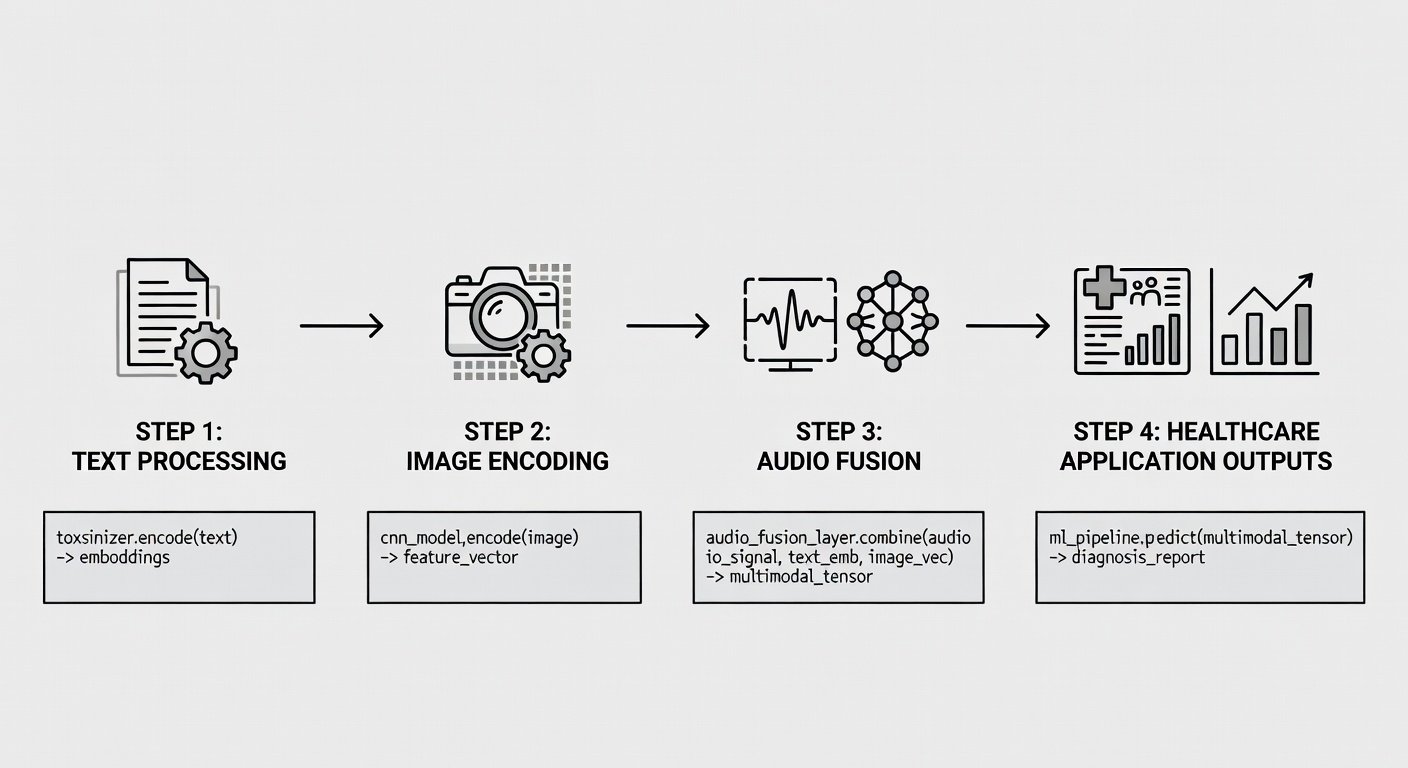
Follow these steps to construct a basic multimodal pipeline handling text, images, and audio.
Step 1: Data Preparation
Collect aligned datasets. Use libraries to preprocess each modality separately before fusion.
import torch
from transformers import CLIPProcessor
# Example preprocessing for text and image
Step 2: Model Selection and Fusion
Load pre-trained encoders and implement a fusion layer.
# Fusion example using cross-attention
class MultimodalFusion(torch.nn.Module):
    def __init__(self):
        super().__init__()
        # Define encoders and fusion logic
Step 3: Training and Evaluation
Train with combined loss functions and evaluate on held-out multimodal test sets.
Tool Comparisons on Performance and Ease-of-Use
Comparing leading frameworks reveals trade-offs. PyTorch-based tools excel in flexibility for custom fusion, while higher-level platforms offer faster prototyping. Ease-of-use is highest in managed environments with built-in multimodal support, though performance may vary by hardware.
Case Study: 2026 Healthcare Deployment
A leading hospital system deployed a multimodal model integrating radiology images, clinical notes, and audio consultations. The system improved diagnostic accuracy by fusing modalities, reducing false positives in early cancer detection. Integration used open-source frameworks for cost-effective scaling.
FAQ on Common Challenges Like Data Alignment
How do I handle misaligned multimodal data?
Use contrastive learning techniques to align embeddings during training.
What benchmarks are standard in 2026?
Refer to updated leaderboards on platforms like Hugging Face for current multimodal performance metrics.
Are there pitfalls in tool selection?
Avoid over-relying on single-vendor ecosystems; test interoperability with PyTorch and TensorFlow ecosystems.
In conclusion, AI tools are transforming multimodal ML into a practical reality for developers in 2026. By mastering data fusion and pipeline construction, engineers can unlock powerful applications across sectors.

No comments yet. Be the first!